The Day Germany Disappeared: How a Single Cryptographic Error Paralyzed the .de Namespace
 Do Son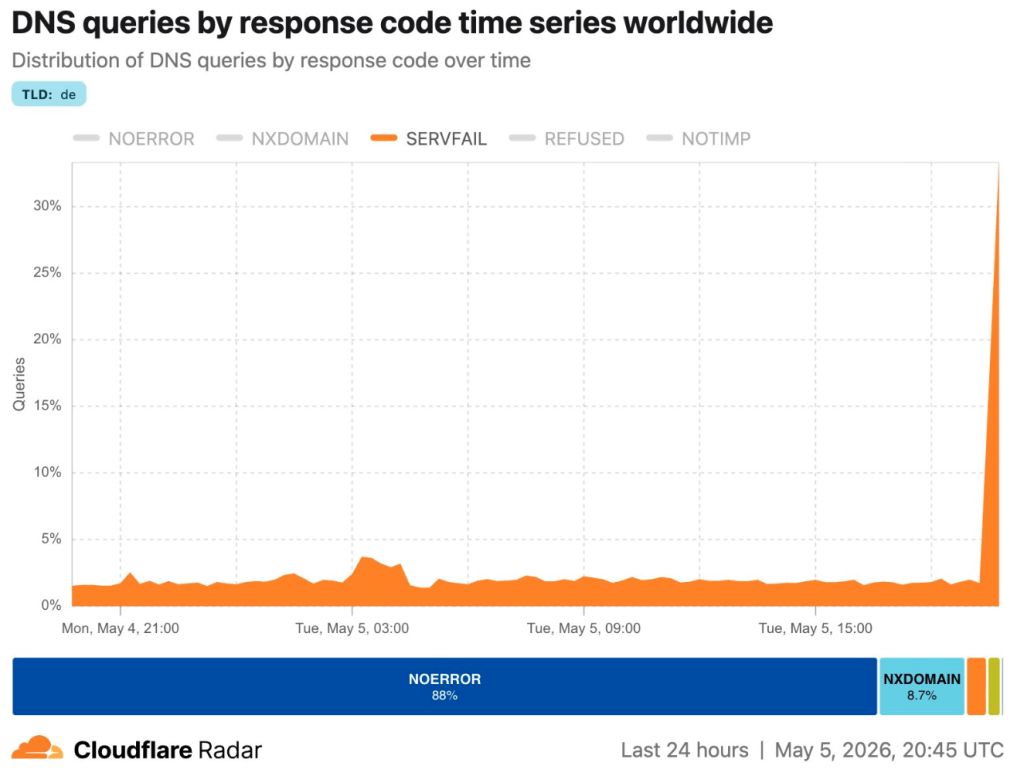
The German country-code top-level domain (ccTLD) experienced an extensive and protracted service disruption last night. This outage did not originate from a failure within the .de root nameservers themselves, but rather from a profound cryptographic error in the DNSSEC (Domain Name System Security Extensions) signing process. The publication of an invalid signature effectively paralyzed the entire .de namespace.
Technical forensics suggest this catastrophe was the result of a fundamental configuration oversight by DENIC, the regulatory body overseeing the domain. Specifically, during a routine rotation of the Zone Signing Key (ZSK)—a critical component utilized for DNSSEC encryption—DENIC released a malformed signature.
As a consequence of this invalid signature, all recursive resolvers configured with DNSSEC validation began returning SERVFAIL errors. This triggered a cascade of resolution failures across millions of .de domains; notably, prominent platforms such as Amazon.de were rendered inaccessible to the public.
Upon identifying the anomaly, Cloudflare, the operator of the 1.1.1.1 public DNS service, immediately deactivated DNSSEC validation for the .de zone. Consequently, users utilizing 1.1.1.1 or 1.0.0.1 were largely insulated from the disruption, whereas those relying on other public DNS providers endured prolonged connectivity failures.
However, Cloudflare’s unilateral intervention has elicited scrutiny. Critics question whether the emergency deactivation of security protocols could be exploited during a genuine assault—specifically, whether adversaries might orchestrate a distraction to coerce major DNS providers into disabling DNSSEC, thereby facilitating subsequent hijacking attempts.
While DNSSEC was architected as a digital signature layer to preclude DNS spoofing, this rudimentary administrative error resulted in the total isolation of the German web. This has led industry experts to reflect on the fragility of the internet’s failover mechanisms, noting that while DNSSEC fortifies security, it simultaneously introduces a new dimension of systemic brittleness.
DENIC has since issued a formal communique acknowledging that all .de domains utilizing DNSSEC signatures were impacted. While the agency stated that the root cause has yet to be definitively established, its technical teams are laboring to restore stability.
As of this publication, accessibility to affected .de domains is being progressively restored. However, due to varying TTL (Time to Live) configurations, certain domains may remain unreachable until global DNS caches have fully refreshed.
Support Our Threat Intelligence
Find our tech and OS security coverage helpful? Support our work today and unlock a 100% ad-free reading experience!
 Buy Me a Coffee
