 Do Son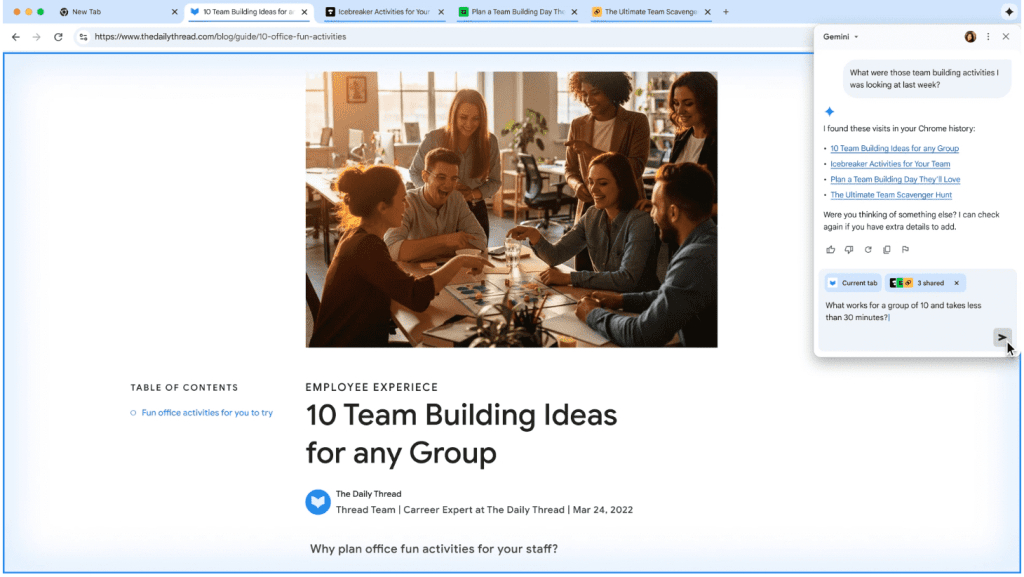
Google has announced that Gemini, its intelligent assistant previously reserved for AI Pro and AI Ultra subscribers, is now freely available to all Chrome desktop users in the United States, supporting both Windows and macOS — provided the browser language is set to English.
If these conditions are met, users will see a new “spark” icon in the upper-right corner of Chrome, signaling the AI’s presence. A single click summons Gemini, enabling direct interaction and command input.
This update brings Gemini into deeper integration with Chrome, extending its utility beyond simple queries. It can now organize and compare information across multiple tabs and introduces a new Recall feature for browsing history. With it, users can issue natural prompts like “Where was the back-to-school shopping list blog I read earlier?” and Gemini will automatically retrieve the relevant page, sparing them the need for manual searches.
Beyond cross-tab analysis and historical recall, Gemini is now more tightly woven into Google’s broader ecosystem, including Google Calendar, YouTube, and Maps. Users can, for instance, ask Gemini to schedule meetings directly or generate automatic time-stamped chapters for lengthy YouTube videos, enabling swift navigation.
At the same time, Google revealed that Chrome’s built-in security protections are being enhanced with Gemini Nano, designed to detect phishing sites and fake virus alert pages. It can also learn a user’s permission preferences, suppressing unlikely requests — such as camera or location access — in a less disruptive way. Gemini will additionally help with automatic password updates, initially supporting platforms such as Coursera, Duolingo, and Spotify, allowing users to reset credentials with a single click.
Looking ahead, Google plans to add more advanced “agentic” capabilities to Gemini over the coming months, enabling it to perform online tasks on the user’s behalf — for example, automatically fulfilling weekly Instacart shopping lists.
Originally previewed under the codename Project Mariner in late 2024, the feature has now matured into a full release, steadily moving toward mainstream practicality.
Mike Torres, Vice President of Product for Chrome, emphasized that the team is focused on ensuring the feature’s reliability and stability, preventing situations where tasks are left incomplete.
Finally, Google has embedded a direct AI Mode shortcut into Chrome’s address bar, eliminating the need to first open a Google Search page before invoking Gemini. The rollout will proceed in stages, requiring several days before it reaches all devices.
With Gemini’s full release, Google is transforming AI from an optional add-on into a core experience, positioning Chrome ever more firmly as a centralized, intelligent hub for information and productivity.
Related Posts:
- Pro vs. Free: Gemini 2.5’s Tiered AI Power
- Beyond OpenAI: Apple Tests Google’s Gemini in Latest iOS Beta
- Android Revolution: Gemini Replaces Assistant on All Devices
- Google’s Enhanced Gemini 2.5 Pro: A Smarter AI for Enterprises
Support Our Threat Intelligence
Find our tech and OS security coverage helpful? Support our work today and unlock a 100% ad-free reading experience!
 Buy Me a Coffee
