The Attrition of Computational Allocation: Systemic Volatility and Quota Depreciation Within the Google Gemini Interface
 Do Son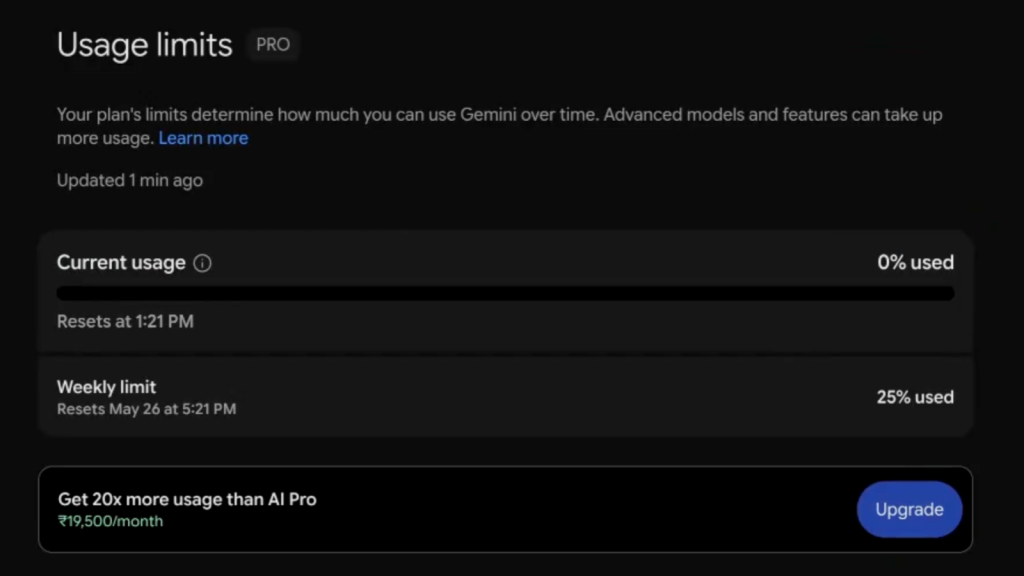
Over the recent operational cycle, the discourse surrounding Google’s continuous adjustments to its Gemini resource quotas has achieved such a persistent volume that the developer community has descended into an acute state of perceptual numbness. In a calculated move to mollify escalating subscriber resentment, Google recently enacted a threefold expansion across both its five-hour and cumulative weekly usage thresholds. Nevertheless, empirical assessments strongly indicate that the actual underlying compute metrics allocated to end-users remain profoundly depreciated compared to ancestral baselines. Furthermore, the platform appears plagued by latent system regressions that trigger an accelerated, anomalous depletion of allocated tokens.
The Rapid Deprivation of Temporal Quotas within a Brief Multi-Minute Window
A prominent soft-software engineer recently distributed telemetry via social media documenting an astonishing breakdown within the model’s resource-tracking engine. The practitioner initiated a workflow requiring Gemini to process a high-definition personal portrait and synthesize a transient, corresponding video sequence. Initially, the five-hour resource consumption index escalated at a standard, predictable rate. However, as the localized execution sequence transcended the four-minute mark without delivering a final output, the five-hour allocation matrix was instantaneously exhausted. The video generation task collapsed into absolute execution failure—leaving it mathematically ambiguous whether the process was choked by the immediate resource ceiling or terminated by an unhandled background exception within Gemini’s internal architecture.
Conversely, an analysis of the weekly baseline metrics during this precise incident revealed a deeply concerning divergence. Prior to task initialization, the developer’s cumulative weekly consumption index rested at 25%. Following the systemic collapse of the workflow, the five-hour metric registered at absolute saturation (100%), while the weekly resource debit had expanded to 30%. The realization that a localized, four-minute video transformation sequence commands the structural weight to deplete a full 5% of a developer’s weekly institutional allocation suggests two highly problematic realities: if this consumption rate is an intended engineering parameter, it confirms that Google has throttled consumer quotas to an unprecedentedly restrictive baseline; alternatively, and far more likely, it exposes a severe structural defect within the model’s telemetry auditing system.
The Strategic Reliance on Quota Resets as a Temporary Containment Metric
At the hour of this writing, Google’s site reliability engineers have acknowledged the viral technical disclosures, yet the core AI division has declined to publish a formal forensic analysis or remediation statement. Intriguingly, Google appears to have adopted a reactive operational playbook pioneered by OpenAI, relying heavily on programmatic resource resets to manage community friction. The enterprise has begun executing these baseline updates with near-daily regularity; precisely at 4:00 AM during the current cycle, Gemini’s active weekly utilization metrics were comprehensively cleared. This tactical maneuver represents an overt effort by Google to artificially suppress the systemic quota anxieties currently destabilizing its developer ecosystem.
However, substituting systemic code optimization with cyclical database flushes is an unsustainable long-term mitigation strategy. To preserve its market positioning, Google is confronted with a definitive strategic choice: the enterprise must either transparently restore high-capacity compute allocations to its premium subscription tiers, or passively observe its core consumer base abandon the Gemini framework to align with competing frontier platforms.
Support Our Threat Intelligence
Find our tech and OS security coverage helpful? Support our work today and unlock a 100% ad-free reading experience!
 Buy Me a Coffee
