 Do Son
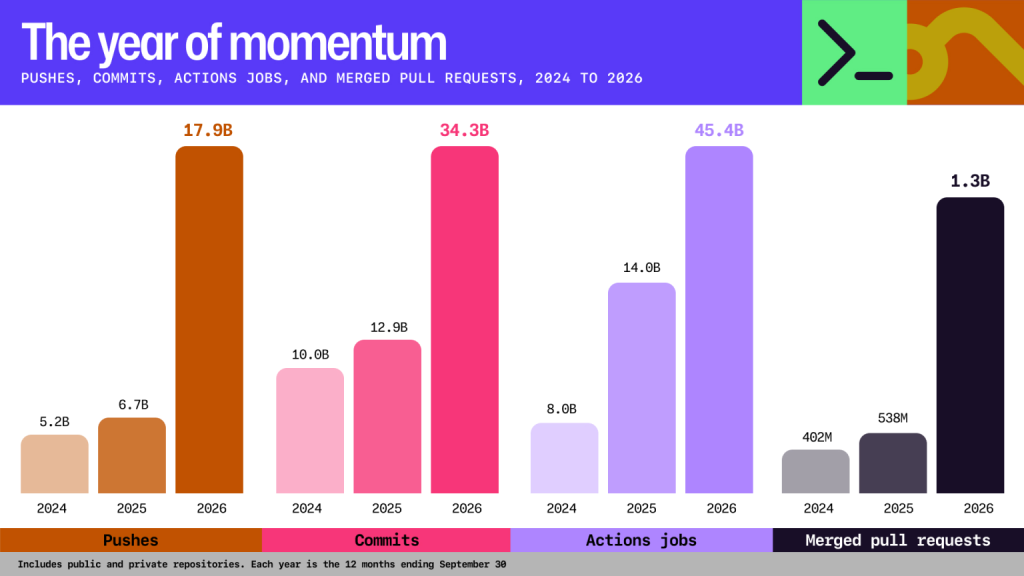
Software development reached unprecedented velocity as autonomous tooling transformed everyday engineering workflows. Specifically, GitHub announced an extraordinary surge in global platform engagement driven by artificial intelligence. During September 2026 alone, developers and automated assistants generated 7.38 billion commits. Consequently, this monthly milestone represents an astonishing 500 percent annual expansion. To sustain this relentless traffic, engineers provisioned 4 million CPU cores and 160 petabytes of high-speed storage. Furthermore, technicians expanded network throughput by 50 terabits per second across distributed datacenters.
Staggering Twelve-Month Platform Metrics
Annual developer contributions eclipsed historical benchmarks across every operational metric. According to the official Octoverse report on developer activity, programmers completed 17.9 billion code pushes. Remarkably, this twelve-month total surpassed the combined volume of the preceding two years. In addition, software projects accumulated 34.3 billion distinct code commits worldwide. Meanwhile, automation pipelines handled colossal operational burdens. GitHub Actions executed 45.4 billion individual jobs, averaging 124 million daily runs. Moreover, development teams successfully merged 1.3 billion pull requests during this period. Therefore, maintainers approved approximately 3.5 million pull requests every single day.
Autonomous Agents Drafting Pull Requests
Autonomous coding agents have rapidly assumed primary drafting responsibilities across modern software repositories. By September 2026, over 40 percent of all pull requests originated from automated agent drafts. In contrast, agent drafts accounted for merely 17 percent of new requests in March. During September alone, synthetic assistants composed 110 million pull request proposals. Human developers now primarily review code differentials, discuss architecture, and guide final merges. Furthermore, adopting autonomous agents dramatically accelerates project cadence. New repositories featuring agent configuration files generated eight times more commits than standard projects. Consequently, teams adopting agent workflows demonstrate significantly denser development velocity.
Overhauling the Underlying Git Architecture
Surging commit volumes create heavy compounding demands on peripheral infrastructure. Whenever an agent pushes fresh code, the platform initiates numerous concurrent background tasks. For example, server clusters trigger automated test suites, scan security vulnerabilities, and notify team collaborators. Because hundreds of agents operate in parallel, these execution bursts stress legacy systems. Therefore, GitHub is thoroughly rebuilding its core Git architecture to ensure smooth scalability. Specifically, system architects are decoupling compute resources from storage tiers. In addition, engineers are simplifying internal components to eliminate operational coordination bottlenecks. Ultimately, these strategic optimizations ensure the platform withstands massive concurrent read and write operations.
Support Our Threat Intelligence
Find our tech and OS security coverage helpful? Support our work today and unlock a 100% ad-free reading experience!
 Buy Me a Coffee
