Google Reports Agentic Threat Activity Reaches New Threshold With Autonomous Attacks and LLMJacking
 Do Son
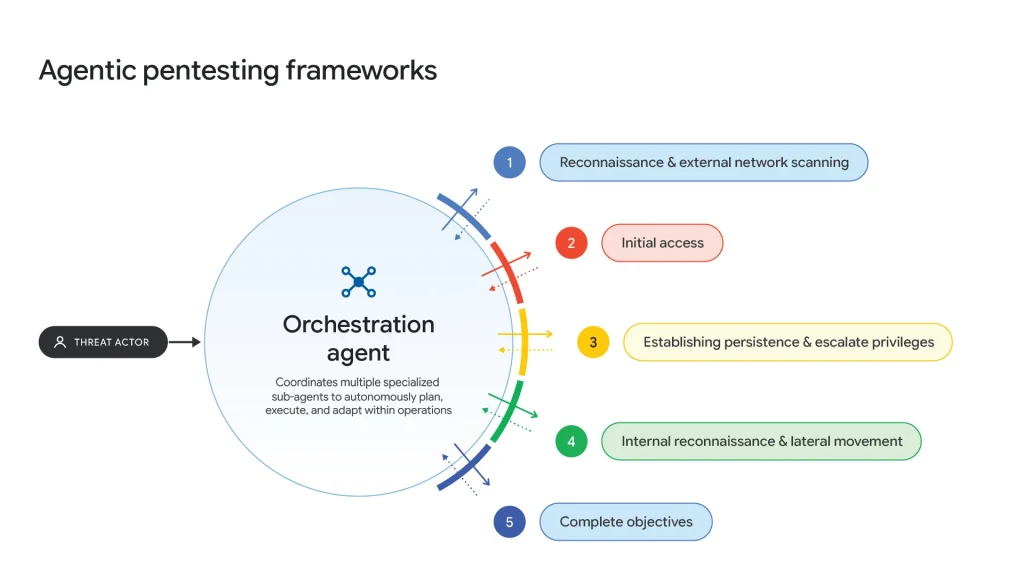
Multi-agent LLM offensive frameworks
TL;DR
Adversaries have moved past basic chatbot prompting to launch live network intrusions driven by autonomous agentic threat activity. According to a new analysis of Google agentic threat activity from the Google Threat Intelligence Group (GTIG) and Mandiant, state-backed hackers and cybercriminals now use multi-agent harnesses to reverse-engineer security patches. They also hijack cloud compute quotas, and poison developer configurations at machine speed.
What Happened Across the Threat Landscape
Over the past quarter, incident responders observed threat actors deploying open-source, multi-agent penetration-testing tools during live breaches. According to the joint report on how agentic threat activity crosses a significant threshold by GTIG and Mandiant, attackers are actively running frameworks such as ARTEX, CAIRN, CyberStrikeAI, HexStrike AI, and PentAGI. For example, attackers used CAIRN against U.S. aerospace targets. Meanwhile, another operator used a customized PentAGI platform between late August and early October 2026. They used it to scan organizations across Asia.
“In the past quarter, GTIG identified threat actors using LLM frameworks to fully automate vulnerability discovery and exploitation without a human in the loop for the first time,” the researchers wrote. Specifically, analysts uncovered an exposed staging server with Russian-language configuration comments running a multi-agent tool named exploit_agent. This tool compared software code before and after patch announcements including version 2.19.25 of the Spectra WordPress plugin. It then drafted and launched exploits against French media, entertainment, and education websites without human intervention.
Automated N-Day Exploitation and LLMJacking
Independent research from Huntress and GreyNoise reinforces this acceleration in patch weaponization. After two zero-day flaws in PaperCut print management servers (CVE-2026-81578 and CVE-2026-82078) were disclosed in late August 2026, Huntress used language models to build working proof-of-concept exploits within 24 hours. Just four days later, GreyNoise tracked a threat actor likely using language models to attack hundreds of organizations. The actor reached domain administrator privileges within minutes.
Meanwhile, financially motivated groups targeted enterprise cloud networks in North America, South America, and the Asia-Pacific region to conduct “LLMJacking.” In at least one intrusion, an attacker exploited a sandbox escape flaw in LiteLLM (CVE-2026-40217) to turn limited virtual keys into full administrative credentials. “In some cases, single-day fraudulent charges exceeded $100,000 USD. In the most severe cases, cumulative resource abuse reached $1 million USD before remediation,” Mandiant reported. Further, criminals then resold this stolen compute capacity through underground “LLM Mixers” such as APIMart and JetNight. They charged $0.10 to $25 USD per million tokens.
Who Is Behind the Activity
GTIG and Mandiant attribute these evolving operations with moderate-to-high confidence across several state-sponsored and criminal clusters. Iranian group CALANQUE ION (formerly tracked as APT42) continued using language models for reconnaissance and social engineering. Meanwhile, suspected Chinese contractor LEAKY CASTLE used models to translate and analyze stolen data for intelligence reports. Another suspected Chinese group abused a frontier model’s file-hosting backend as a dead-drop command server.
Furthermore, a suspected North Korean cluster dubbed MIDNIGHT NEPTUNE targeted North American and European cryptocurrency firms using fake recruiter profiles containing SynthID watermarks and ClickFix video-meeting lures. Once inside internal code repositories, the attackers modified .claude/settings.json files. As a result, launching Anthropic’s Claude Code automatically downloaded the SOMBERMEME backdoor. This also masked lateral movement with GitHub tokens named after Microsoft Copilot. Separately, cybercriminals updated the Chinese-language Jieyou Phishing-as-a-Service platform in June 2026 with a natural-language chatbot builder. Moreover, commercial Influence-as-a-Service (IaaS) contractors built cloud phone farms to run over 100,000 synthetic social media accounts.
Impact and Operational Trade-Offs
While overall vulnerability disclosures and exploits nearly doubled between January and August 2026, zero-day exploits rose only slightly before spiking to 22 in August. This shows that automated tools primarily shrink the patching window for known n-day flaws. In addition, after PHP vulnerabilities CVE-2026-109618 and CVE-2026-109619 were patched on October 21, 2026, hundreds of non-functional, AI-generated proof-of-concept scripts flooded public repositories. This created verification headaches for defenders.
“Unrestricted autonomous execution generates forensic traffic, relies on recognizable identifiers, and leaves behind distinct code-level traces; while these artifacts increase the likelihood of detection and mitigation, these tools remain highly capable of achieving operational objectives,” GTIG noted.
How Organizations Can Stay Protected
To defend against Google agentic threat activity, security teams must deploy behavioral and volumetric detection rules capable of spotting machine-speed scanning bursts from frameworks like ARTEX and CAIRN. Cloud administrators should audit identity permissions and patch LiteLLM instances against CVE-2026-40217. They should also set strict billing and rate-limit alerts to catch LLMJacking spikes early. Finally, software engineering teams must inspect local repository configuration files such as .claude/settings.json for unauthorized execution hooks. They should also rotate exposed API keys immediately.
Support Our Threat Intelligence
Find our threat intelligence and malware analysis helpful? Support our work today and unlock a 100% ad-free reading experience!
 Buy Me a Coffee
