Inside the “Traffer” Economy: How a Thriving Cybercrime Ecosystem Professionalized Data Theft
 Do Son
The global cybercrime economy continues to expand, with new players and organizational structures emerging to maximize profits from stolen data. A recent report by S2W, a big data intelligence company, sheds light on one such structure: the “Traffer” economy, a crucial pillar of the Stealer malware ecosystem.
According to the report, “The Traffic Team is an organized group that distributes Stealer malware, sells logs from infected systems, and generates revenue. It is composed of Traffers and Traffic Team administrators, with additional roles such as technical specialists or settlement managers, depending on the team.”
This structured approach mirrors legitimate business operations—complete with recruitment channels, job boards, probationary periods, and performance-based revenue distribution. At the heart of it all are the Traffers: cybercriminal affiliates responsible for infecting as many users as possible.
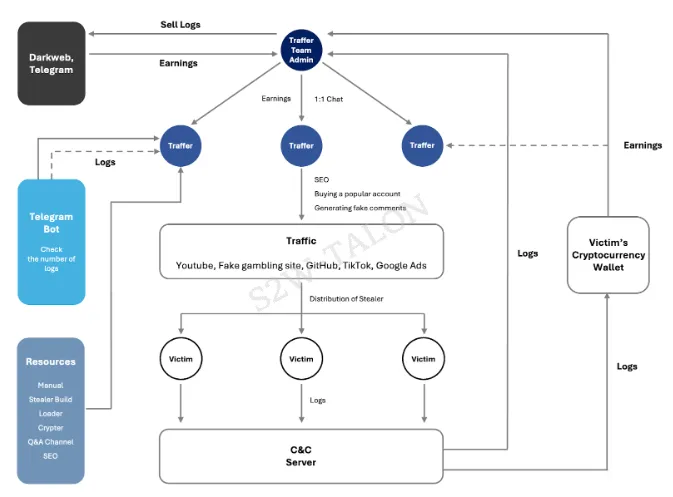
S2W describes a Traffer as “an attacker operating within the Traffic Team in the Stealer ecosystem, aiming to increase the number of infected users through activities such as cryptocurrency theft, distribution of phishing panels, and dissemination of malicious ads.”
Recruitment is brazenly public. Job postings appear across Russian-language forums like Lolz Guru, BHF, Exploit, and XSS, where prospective recruits are invited to apply via Telegram bots. Once onboard, new members are supplied with tools such as crypters, loaders, and SEO services to maximize infection rates.
The report highlights a diverse toolkit leveraged by traffers to spread malicious code:
- Cryptocurrency drainers that hijack wallet transactions by swapping recipient addresses.
- Phishing panels or fake login portals.
- Malvertising campaigns across YouTube, Instagram, TikTok, and other platforms.
One particularly alarming strategy is the abuse of SEO. “Traffers use various methods to distribute malware and utilize search engine optimization (SEO) to direct large amounts of traffic to malicious sites,” the report explains.
This includes keyword stuffing, cloaking, typosquatting, and even hijacking legitimate websites to insert redirects. The xemplex SEO Team, active on the Lolz Guru forum, reportedly uses “CTR manipulation, automatic link farm construction, and methods to evade Panda and Penguin algorithms.”
The report’s deep dive into one group—Dungeon Team—illustrates just how methodical these operations can be. The team, which actively recruits on Lolz Guru, offers new traffers free SEO services, a “FUD Loader” that bypasses Windows Defender, and custom crypters for stealers.
Profits are shared on a tiered basis: “If the wallet theft revenue exceeds $30, the Traffer receives 65% and the administrator 35% of the proceeds.”
Evidence collected by S2W includes screenshots of Telegram bot dashboards showing live infection logs, VirusTotal-clean builds distributed by admins, and stolen cryptocurrency wallets siphoned directly into attackers’ accounts. In some cases, traffers discovered hidden cryptominers embedded in their own loaders, ensuring admins took an even larger cut of illicit profits.
The Traffer economy highlights how cybercrime has professionalized. Today’s attackers operate in well-structured teams with clear hierarchies, support services, and monetization strategies. As S2W warns, “Data stolen through Stealers is traded on credential markets such as the Russian Market and Telegram, and the profits obtained from selling the data are distributed among the Stealer Operator, Traffic Team Admin, and Traffers.”
The ecosystem thrives by lowering the barrier to entry for aspiring cybercriminals. With just a Telegram account, a recruit can gain access to sophisticated malware, SEO exploitation techniques, and guaranteed revenue-sharing models.
Related Posts:
- 100 hacking organizations aimed at sabotaging the British economy and stealing government secrets
- ScarCruft APT Deploys VCD Ransomware, Uses PubNub & New Malware in Espionage Campaign
- Pig Butchers Enter the Gig Economy, Targeting Job Seekers in Cryptocurrency Scams
- Profit Time Machine: How you could have turned $600 into $1M
Support Our Threat Intelligence
Find our threat intelligence and malware analysis helpful? Support our work today and unlock a 100% ad-free reading experience!
 Buy Me a Coffee
