Skip to content
July 21, 2026
  • Linkedin
  • Twitter
  • Facebook
  • Youtube

Daily CyberSecurity

Zero-hour alerts. Unmatched analysis.

Primary Menu
  • Home
  • CVE Data
    • CVE Watchtower
    • Top Exploited CVEs
    • CVE Stats by Vendor
    • Q2 2026 Report
  • Cyber Criminals
  • Data Leak
  • Linux
  • Malware
  • Vulnerability
  • Submit Press Release
  • Weekly Recap
Light/Dark Button
  • Home
  • News
  • Technology
  • Google Chrome enabled the site isolation technology to protect against Spectre and Meltdown attack
  • Technology

Google Chrome enabled the site isolation technology to protect against Spectre and Meltdown attack

Do Son July 13, 2018 3 minutes read
Chrome site isolation
Add Daily CyberSecurity as a preferred source on Google

After months of testing, the Google Chrome development team has now enabled site isolation for desktop users to protect against Spectre and Meltdown flaws.

Spectre and Meltdown flaws are problems in the modern processor design process. Unfortunately, this vulnerability has a wide range of effects and cannot completely fix.

Attackers can use the vulnerability to read sensitive data from other threads, such as the password of the system login user or the application download or pending data.

Attacking malicious code through a browser is more convenient, and the Google Chrome development team uses site isolation technology to mitigate the vulnerability.

Spectre variants


Google Chrome defaults to site isolation technology:

The so-called site isolation technology means that all websites opened by users use different processes, and each process is isolated from each other and must not access each other’s data.

This multiple process sandboxing method prevents malicious code from exploiting the Spectre and Meltdown flaws of modern processors to read sensitive information from other processes.

Of course, the Google development team also stated that this method is only defence and mitigation, so it is not 100% completely preventing malicious code from exploiting processor vulnerabilities.

Unexpected circumstances allowed Google to enable the technology in advance:

Initially, this feature is still in the testing stage. In previous versions of the updated article, Blue Point Network mentioned that Google is collecting opinions from web developers.

Because this feature may cause compatibility or functional issues on some sites, developers need to test this before submitting it to the Google team.

But two researchers at the Massachusetts Institute of Technology’s Computer Science and Artificial Intelligence Laboratory recently discovered a more serious vulnerability to the Spectre.

Therefore, the Google development team decided to open this feature in advance to help users deal with potential attacks, and improve security for users who frequently browse the web.

Site isolation technology can also defend against UXSS attacks:

UXSS is a universal cross-site scripting attack that belongs to the branch of XSS cross-site scripting attacks. I haven’t seen too many attack cases using UXSS.

This type of vulnerability usually allows an attacker to bypass the same-origin policy of the renderer process, although it does not allow the attacker to control the process fully but is potentially harmful.

However, the child process and sandbox generated by the site isolation technology will take up more memory, but Google promises to continue to optimise the memory to improve response speed.

Known issues:

After opening the site isolation technology, the average memory occupied by Google Chrome is about 10% more than usual, and Google will continue to optimise to reduce the memory footprint.

For WEB developers: Google Chrome browser tools that enable this feature will not fully support cross-site iframe inline frame content.

Domestic users please manually open:


For some reasons, the Google Chrome cloud adjustment policy may not be sufficient for users, so users should manually enable the feature for security reasons.

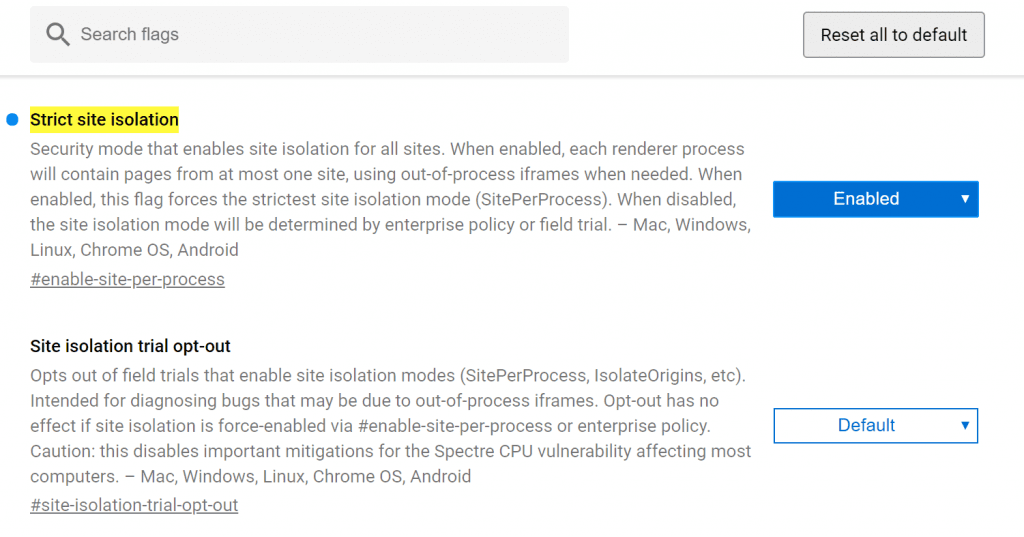
In the Google browser address bar, type chrome://flags/#enable-site-per-process  and change the default setting of the policy to Enabled.

Get Zero-Hour Vulnerability Alerts

Critical CVEs, CVSS scores, and PoC updates — straight to your inbox every week.


We respect your inbox. Unsubscribe anytime.

Related coverage

  • AT & T, Verizon, T-Mobile and Sprint will launch “Next-Generation Mobile Authentication Platform”
  • Google Cloud Mishap: Accidental Deletion of $125 Billion Pension Fund’s Account Raises Concerns
  • Microsoft 365 Gets iOS ‘Liquid Glass’ Makeover and Floating Navigation
  • AWS re:Invent: Agentic AI Launches with Nova Sonic Voice; Partners with Google Cloud on Networking
  • EU fines Google for $5 billion on Android monopoly
Track all actively exploited CVEs →

Support Our Threat Intelligence

If you find our CVE report and cybersecurity news helpful, consider supporting our work.

Buy Me a Coffee Logo Buy Me a Coffee PayPal
Crypto QR Code
USDT (TRC20):
TN8BdV8cp4T1Cd28gK9qTAnZknzzuwyUtm
USDT (ERC20):
0x3725e1a7d3bc5765499fa6aaafe307fabcd75bce

Share this article:

Facebook Post LinkedIn Telegram
Written by
@DdoS · Security Researcher

Do Son

Do Son is the Founder and Editor of SecurityOnline.info. Working in cybersecurity since 2013, he reports on vulnerabilities, malware, and emerging threats, providing timely analysis to help organizations and individuals stay ahead of evolving risks.

Tags: Chrome site isolation

Search

Translation

CVE WATCHTOWER
🚨

Receive alerts for vulnerabilities being exploited in the wild.

⚡

Get notified instantly when a Proof of Concept (PoC) exploit is published.

🔍

Access critical info on vulnerabilities even when marked as "RESERVED".

🧠

Insights powered by decades of expertise and global intelligence sources.

🎯

Customize alerts with up to 10 keywords for your specific tech stack.

📊

Export the raw CVE database for SIEM integration and reporting.

Upgrade Package

🚨 Active Exploits in the Wild

  • CVE-2026-50522CVSS 9.8
    Deserialization of untrusted data in Microsoft Office SharePoint allows an unauthorized attacker to execute code over a network.
    Admin intel📅 Updated: Jul 21, 2026
  • CVE-2026-63030CVSS 9.8
    WordPress 6.9.x before 6.9.5 and 7.0.x before 7.0.2 is affected by a REST API batch endpoint route confusion...
    Admin intelCISA KEV📅 Added to KEV: Jul 21, 2026📅 Updated: Jul 21, 2026
  • CVE-2026-60137CVSS 5.9
    WordPress 6.8.x before 6.8.6, 6.9.x before 6.9.5, and 7.0.x before 7.0.2 does not properly sanitise the author__not_in parameter...
    Admin intelCISA KEV📅 Added to KEV: Jul 21, 2026📅 Updated: Jul 21, 2026
  • CVE-2026-0770CVSS 9.8
    Langflow exec_globals Inclusion of Functionality from Untrusted Control Sphere Remote Code Execution Vulnerability. This vulnerability allows remote attackers...
    CISA KEV📅 Added to KEV: Jul 21, 2026
  • CVE-2021-27137CVSS 8.1
    An issue was discovered in router/upnp/src/ssdp.c in DD-WRT before 45724. An unsafe strcpy in the UPnP handling functionality...
    CISA KEV📅 Added to KEV: Jul 21, 2026
  • CVE-2026-6875CVSS 9.5
    ServiceNow has addressed a remote code execution vulnerability that was identified in the ServiceNow AI platform. This vulnerability...
    Admin intel📅 Updated: Jul 18, 2026
  • CVE-2026-39808CVSS 9.8
    A improper neutralization of special elements used in an os command ('os command injection') vulnerability in Fortinet FortiSandbox...
    CISA KEV📅 Added to KEV: Jul 16, 2026
  • CVE-2026-25089CVSS 9.8
    A improper neutralization of special elements used in an os command ('os command injection') vulnerability in Fortinet FortiSandbox...
    CISA KEV📅 Added to KEV: Jul 16, 2026
Powered by CVE Watchtower

🔴 Live Critical Threats

  • CVE-2026-47396CVSS 9.8
    PraisonAI is a multi-agent teams system. Prior to version 4.6.40, PraisonAI's call...
  • CVE-2026-47393CVSS 9.8
    PraisonAI is a multi-agent teams system. CVE-2026-44338 (GHSA-6rmh-7xcm-cpxj) documents that PraisonAI ships...
  • CVE-2026-47392CVSS 9.9
    PraisonAI is a multi-agent teams system. Prior to version 4.6.40 of PraisonAI,...
  • CVE-2026-47391CVSS 9.8
    PraisonAI is a multi-agent teams system. Prior to version 4.6.40, PraisonAI's first-party...
  • CVE-2026-28321CVSS 9.1
    SolarWinds Serv-U is affected by a broken access control vulnerability that could...
  • CVE-2026-28317CVSS 9.1
    SolarWinds Serv-U is affected by an insecure direct object reference (IDOR) vulnerability...
  • CVE-2026-28316CVSS 9.1
    SolarWinds Serv-U is affected by an insecure direct object reference (IDOR) vulnerability...
  • CVE-2026-28314CVSS 9.1
    SolarWinds Serv-U is affected by an insecure direct object reference vulnerability that...
  • CVE-2026-28313CVSS 9.1
    SolarWinds Serv-U is affected by an insecure direct object reference (IDOR) vulnerability...
  • CVE-2026-28312CVSS 9.1
    SolarWinds Serv-U is affected by a privilege escalation vulnerability. This would elevate...
Powered by CVE WATCHTOWER

Our Websites
  • Penetration Testing Tools
  • The Daily Information Technology
  • Top Exploited CVEs
  • Daily CyberSecurity

    • About SecurityOnline.info
    • Advertise with us
    • Announcement
    • Contact
    • Contributor Register
    • Login
    • Disclaimer
    • DCMA
    • Privacy Policy
    • About SecurityOnline.info
    • Advertise on SecurityOnline.info
    • Contact Us

    When you purchase through links on our site, we may earn an affiliate commission. Here’s how it works

    • CVE Watchtower
    • CVE Statistics by Vendor 2026
    • Q2 2026 Report
    • Top Exploited CVEs
    • Linkedin
    • Twitter
    • Facebook
    • Youtube
    © 2017 - 2026 Daily CyberSecurity. All Rights Reserved.