Google DeepMind Partners with CFS to Use AI for Optimizing SPARC Fusion Reactor Efficiency
 Do Son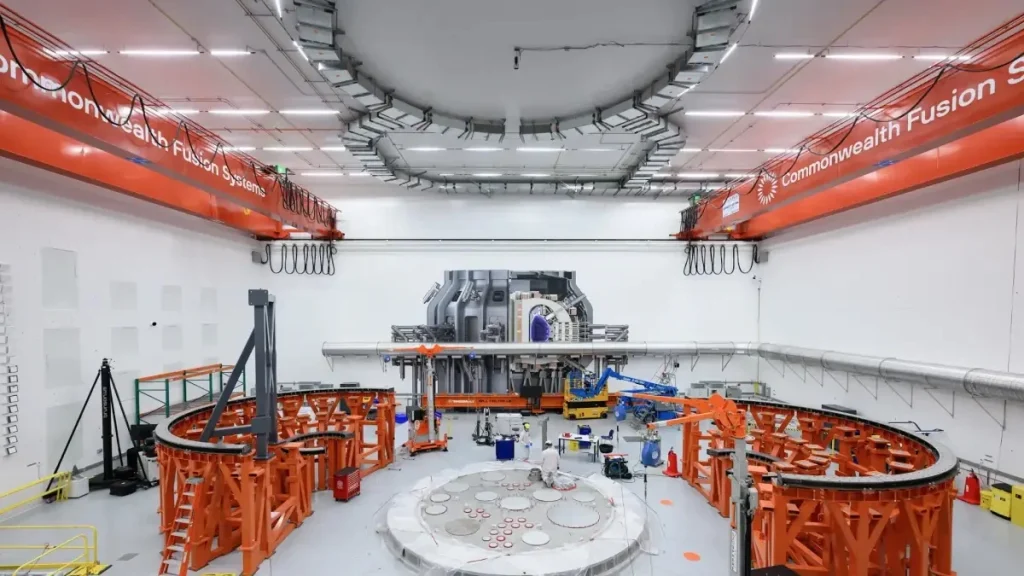
Google DeepMind has announced a partnership with U.S.-based nuclear fusion startup Commonwealth Fusion Systems (CFS) to leverage AI technologies in optimizing the operational efficiency of its fusion reactor, SPARC—a collaboration poised to significantly accelerate the path toward the commercialization of clean energy.
The Massachusetts-based CFS recently secured $863 million in a new funding round, attracting a formidable roster of investors including NVIDIA, Google, and Breakthrough Energy Ventures, the clean-energy investment fund backed by Microsoft founder Bill Gates. The round also drew participation from major global players such as Morgan Stanley, legendary investor Stanley Druckenmiller, and Japanese conglomerates Mitsui & Co. and Mitsubishi Corporation, underscoring the immense global confidence in fusion energy’s potential.
Nuclear fusion, long hailed as one of the most promising clean energy sources of the future, offers the advantage of generating no long-lived radioactive waste. Yet achieving fusion power remains one of modern science’s greatest challenges—it requires heating plasma to temperatures exceeding 100 million degrees Celsius and maintaining it in a stable state within a reactor chamber.
CFS is currently developing a prototype tokamak reactor, a compact device that confines and compresses plasma using superconducting magnets to unleash vast amounts of energy. The company aims to achieve, by 2027, the world’s first net energy gain from fusion—producing more energy than is consumed in the process, a milestone that would redefine the future of energy.
In this collaboration, DeepMind will draw upon its extensive experience in using deep reinforcement learning to control tokamak plasma, providing CFS with several key AI-driven technologies:
- TORAX, an open-source plasma simulator capable of performing rapid, high-precision fusion simulations, allowing CFS to conduct millions of virtual experiments and fine-tune operational parameters before SPARC’s first ignition.
- AlphaEvolve, an AI agent system designed to explore countless simulated operational scenarios and identify the most efficient pathways toward achieving net energy gain.
- Real-time AI navigation systems, specialized “AI navigators” capable of dynamically controlling plasma during SPARC’s full-power operations—distributing extreme heat concentrations to prevent material damage near the plasma boundary.
The ultimate vision of this partnership is to lay the foundation for intelligent, adaptive control systems in the fusion power plants of the future. DeepMind emphasizes that forthcoming AI navigators will be capable of learning far more complex adaptive strategies than human engineers can design, balancing multiple constraints and objectives to continually refine control algorithms in real time.
Notably, Google itself is also an investor in CFS, further supporting the company’s mission to bring its fusion technology to market. This collaboration represents not only a pioneering application of AI in the energy sector but also a potential revolutionary breakthrough in global sustainable energy. As the 2027 target approaches, the results of this partnership will serve as a crucial indicator of whether nuclear fusion can finally fulfill its long-promised vision of clean, limitless power.
Related Posts:
- Directory Traversal Vulnerability Discovered in Reactor Netty HTTP Server
- Nuclear Fusion Race Heats Up: A $863M Boost for CFS
- Microsoft’s Microfluidics Breakthrough: A New Era for AI Cooling
- Broadcom’s Game-Changing Move: VMware Fusion and Workstation Now Free for All Users
Support Our Threat Intelligence
Find our tech and OS security coverage helpful? Support our work today and unlock a 100% ad-free reading experience!
 Buy Me a Coffee
