Beyond Text: How Google Gemini’s New Multimodal RAG Turns Images and PDFs into Actionable Intelligence
 Do Son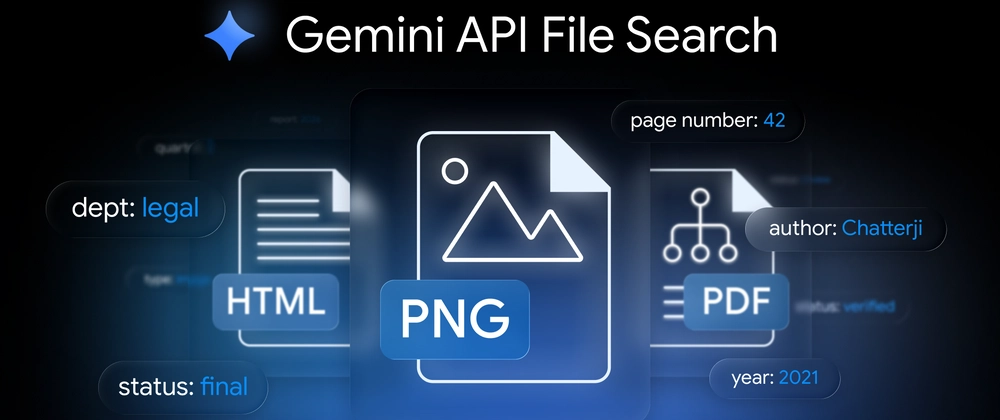
Google recently announced a significant expansion of the file search capabilities within the Google Gemini API, furnishing developers with a more sophisticated Multimodal Retrieval-Augmented Generation (RAG) framework. The quintessence of this update includes integrated support for hybrid image and text retrieval, custom metadata filtering, and precise page-level citations, all designed to bolster the accessibility and veracity of AI systems in enterprise knowledge bases, document-centric Q&A, and autonomous agents.
According to official Google documentation, the revitalized file search functionality transcends traditional text-based vector searches. Powered by the unified multimodal embedding capabilities of Gemini Embedding 2, the system can simultaneously decipher visual and textual content within images, PDFs, and diverse documents. Consequently, developers can orchestrate a comprehensive RAG workflow directly within the Gemini API, bypassing the necessity of constructing labyrinthine vector databases, embedding pipelines, or complex document-partitioning systems.
In conventional RAG architectures, visual elements—such as diagrams, charts, and technical schematics—often remain elusively indexed, resulting in AI responses that lack holistic contextual understanding. The newly inaugurated multimodal search within the Gemini API natively recognizes visual data, establishing a unified index alongside textual information. For instance, an enterprise might upload a PDF containing product imagery and architectural blueprints; the AI can then synthesize an answer by interpreting both the visual nuances and the accompanying text.
Google posits that this capability is uniquely suited for the development of enterprise-grade knowledge assistants, customer service bots, and intelligent agents. By enabling models to reason across internal documentation without the burden of maintaining independent image retrieval systems, organizations possessing vast repositories of mixed-media data can achieve reduced deployment complexity and superior retrieval accuracy.
Furthermore, the introduction of custom metadata filtering empowers developers to append tags—such as category, temporal data, or departmental origin—to uploaded files. This facilitates high-precision filtering during the retrieval phase, optimizing efficiency and ensuring that only the most pertinent content occupies the AI’s context window.
A final, pivotal addition is page-level citation. When generating a response, Gemini can now explicitly demarcate the exact page from which information was derived, rather than merely citing the document in its entirety. This transparency allows users to instantly verify the accuracy of the AI’s output and consult the original source for broader context.
The enhanced Google Gemini API file search functionality is currently accessible to all developers via Google AI Studio and Google Cloud.
Support Our Threat Intelligence
Find our tech and OS security coverage helpful? Support our work today and unlock a 100% ad-free reading experience!
 Buy Me a Coffee
