 Do Son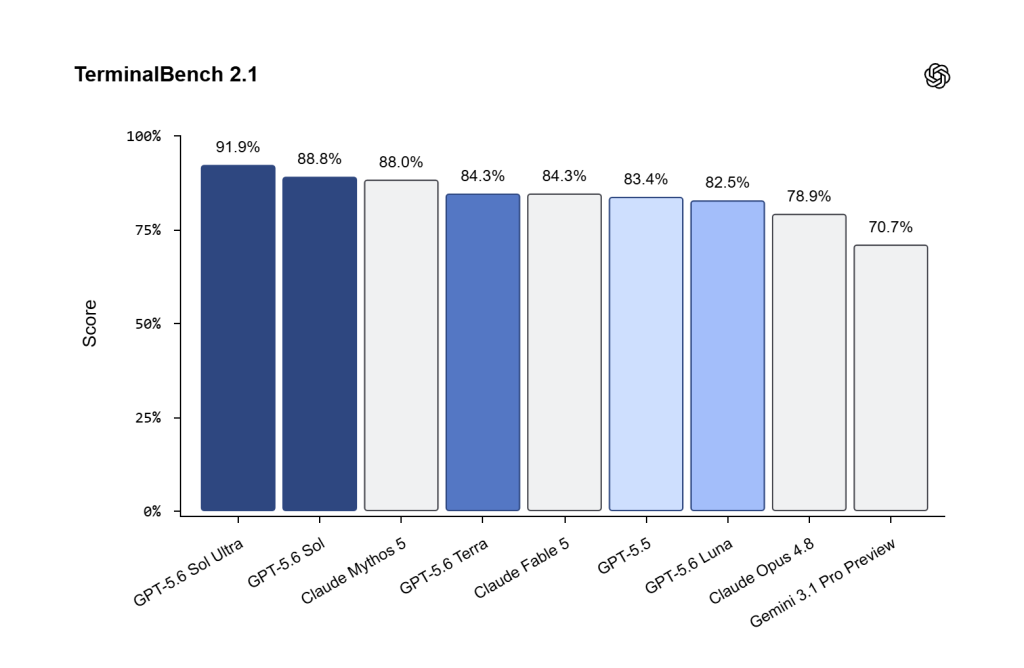
Source: OpenAI
The evolution of generative AI technology is now officially intertwined with geopolitics and national security. Previewing GPT-5.6 Sol and the broader series, OpenAI recently unveiled its next-generation AI models. Furthermore, the company drastically altered its naming conventions for the first time. Consequently, they introduced three distinct model tiers: “Sol,” “Terra,” and “Luna.”
However, the Trump administration recently signed a cybersecurity executive order. This mandate significantly pressured the tech giant. Therefore, OpenAI abandoned its traditional practice of immediate, public releases. Instead, they opted for a highly restricted preview. Specifically, only a select few government-approved, trusted partners can currently access this framework.
OpenAI issued a public statement to express their strong opposition. They emphasized that government review mechanisms must not become a permanent standard. Otherwise, defenders and global enterprises will rapidly lose touch with cutting-edge technology.
A New Trilogy: Generations and Tiers
Starting with GPT-5.6, OpenAI completely overhauled its previous naming logic. Numbers now represent the hardware and architectural “generation.” Meanwhile, Latin words designate the specific “tier.” Thus, developers can precisely allocate resources based on computing power, speed, and overall cost.
- GPT-5.6 Sol (Sun): The premier flagship model. It specializes in deep coding, biological research, and complex cybersecurity operations.
- GPT-5.6 Terra (Earth): A balanced model tailored for daily business tasks. Officially, it maintains top-tier performance comparable to GPT-5.5. However, OpenAI slashed the API prices entirely in half.
- GPT-5.6 Luna (Moon): A highly lightweight model. It features ultra-fast response times and remarkably low operational costs.
Technically, GPT-5.6 introduces two entirely new operating mechanisms. First, the “max” mode caters specifically to deep thinking and prolonged reasoning. Second, the “ultra” mode actively mobilizes multiple sub-agents. Consequently, this architecture dramatically accelerates the automation of highly complex tasks.
Regarding API billing, OpenAI fundamentally restructured its prompt caching mechanism. Cache writing now costs 1.25 times more, while reading remains at a 90% discount. Furthermore, they announced a July infrastructure integration for the “Sol” model. It will run on high-speed hardware from Cerebras Systems, a prominent California-based chip company. As a result, select customers will experience transmission rates reaching up to 750 tokens per second.
The Trump Administration Intervenes
The Trump executive order strikes! The US government effectively intercepted GPT-5.6 due to its formidable cyberattack capabilities. Despite stellar hardware and performance, the GPT-5.6 launch proved incredibly turbulent.
Axios reported that President Trump signed a new executive order on June 2. This directive requires federal agencies to establish a stringent review framework. Specifically, it targets “Covered Frontier Models” possessing advanced cybersecurity capabilities. Ultimately, the government gains a 30-day preliminary assessment period before any public release.
White House officials subsequently revealed their post-assessment conclusions. They noted that GPT-5.6 Sol shattered industry records in the “Terminal-Bench 2.1” command-line performance benchmark. Indeed, its demonstrated cybersecurity prowess easily rivals Anthropic’s previously banned flagship model, “Mythos.” Citing national security concerns, the government forcefully demanded that OpenAI restrict its initial release audience.
OpenAI CEO Sam Altman publicly described the executive order as “fairly balanced.” Nevertheless, the company’s official announcement displayed undeniable corporate backbone. They bluntly stated that case-by-case government access approvals create substantial technological barriers. If this process becomes standard practice, it will exclude civilian cybersecurity defenders who desperately need these tools.
Anthropic’s Mythos 5 Sees Partial Revival
Simultaneously, Anthropic’s “Mythos 5” experienced a sudden, partial revival. However, the standard “Fable 5” remains completely frozen. On the exact same day OpenAI announced its compromise, fierce rival Anthropic issued a statement. They confirmed receiving a formal letter from US Secretary of Commerce Howard Lutnick.
The letter highlighted Anthropic’s substantial progress in risk prevention over the past two weeks. Consequently, the government finally recognized their adequate safety measures. Therefore, officials permitted a partial reboot of the formidable “Claude Mythos 5” model. Initial access extends to approximately 100 specific entities. These include government agencies and private enterprises responsible for defending critical US infrastructure.
Unfortunately, their other next-generation flagship model faces a distinctly different fate. “Claude Fable 5,” originally intended for the general public and everyday engineers, remains under a total service ban.
Analysis: The Chilling Effect on Silicon Valley
Will the 30-day preliminary review become a restrictive spell? Can Silicon Valley truly maintain its rapid innovation speed? The restricted launch of GPT-5.6 and the selective revival of Mythos 5 paint a clear picture. Together, they draw a distinct political red line for the global AI industry in mid-2026. Frontier models have definitively exited the era of unchecked freedom. Now, they fall squarely under the strict jurisdiction of the American state apparatus.
The most crucial detail is the Trump administration’s 30-day prior access review. Nominally, officials describe it as a mere “voluntary framework.” Yet, powerful commercial giants like OpenAI must dutifully brief the White House before any release. They even surrender initial API permissions for official, case-by-case approval. Consequently, this mechanism wields compulsory power equivalent to strict weapons export controls.
Understandably, OpenAI strongly opposes this cumbersome mechanism. For commercial enterprises, AI competition moves in mere weeks, or even days. Future models, like GPT-6, might face mandatory 30-day confinements in the Pentagon or Commerce Department. This delay would severely hamper monetization efficiency and rapid iteration. Furthermore, it could completely disrupt the deployment rhythm of the entire software ecosystem.
However, we must carefully consider another perspective. OpenAI specifically emphasized a key point during their official briefing. They claimed the “Sol” model has not yet reached their internally defined critical cyber-crisis level. Furthermore, they proactively disclosed extensive test results across Chromium and Firefox browser environments. The model reportedly failed to autonomously string together a complete attack chain.
This defensive “self-weakening” narrative reveals a remarkably strong survival instinct. Silicon Valley giants desperately employ this strategy to secure broad commercial availability under Washington’s tightening regulatory grip. In 2026, AI reasoning capabilities and agent autonomy will undergo a massive qualitative transformation. Tech companies must carefully navigate a highly treacherous tightrope. They must successfully balance commercial innovation with demanding geopolitical censorship. Truly, this incredibly difficult high-stakes game is only just beginning.
Support Our Threat Intelligence
Find our tech and OS security coverage helpful? Support our work today and unlock a 100% ad-free reading experience!
 Buy Me a Coffee
