 Do Son
A highly dangerous threat vector is actively menacing global financial networks. Specifically, the notorious Grandoreiro banking trojan has resurfaced with a stealthy distribution mechanism. Cybercriminals are launching aggressive phishing campaigns to target banking customers across Europe and Latin America. Furthermore, recent telemetry from WatchGuard highlights how these malicious operators exploit trusted applications to compromise systems. Financial organizations must adapt their defenses to counter these evolving tactics immediately.
The Resilience of a Widespread Financial Threat
Law enforcement agencies have previously attempted to dismantle this specific threat group. Despite multiple joint international operations, the criminal enterprise remains highly active. According to security experts, “Grandoreiro has been active since at least 2016 and is now one of the most widespread banking trojans globally.” Although authorities arrested several gang members in recent years, unarrested threat actors simply continued the operations. Consequently, the gang regularly updates its software to bypass modern security controls.
Exploring the DLL Side Loading Technique
The latest campaign showcases advanced technical sophistication to avoid detection by standard endpoint sensors. Specifically, the adversary utilizes a clever DLL side loading technique to execute malicious payloads silently. The attackers abuse legitimate software components like FastStone Image Viewer and MinGW compilers to inject their code. For instance, “WatchGuard telemetry identified a campaign associated to Grandoreiro that uses the DLL Side-Loading technique abusing four different softwares, targeting banks in Portugal.”
Obfuscating Network Communications
To ensure stable connectivity, the malware embeds specialized real-time communication modules within its dynamic libraries. Moreover, these components leverage common web-conferencing protocols to communicate with adversary-controlled infrastructure. Security analysts noted that “The advantage for threat actors to use web conferencing traffic in their campaigns is due to this traffic be noisy, being difficult to be monitored”. This clever layout allows the stolen financial data to blend seamlessly into legitimate office background traffic.
Deceptive VBS Campaigns and Social Engineering
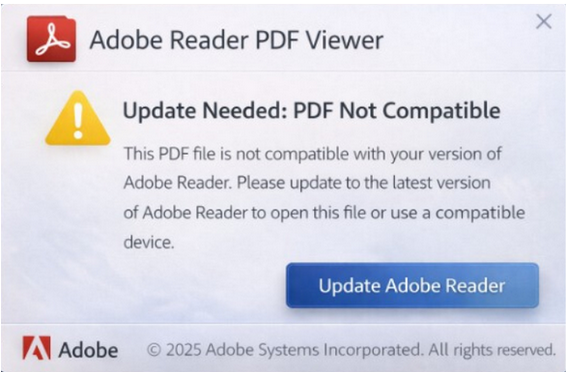
In addition to binary exploitation, investigators discovered an alternative distribution method targeting corporate endpoints. This second infection track relies heavily on highly obfuscated visual basic scripts sent via phishing links. Once triggered, the script pulls a malicious executable from common cloud hosting environments. Then, a fake prompt appears on the screen instructing the victim to update Adobe Reader. If the user clicks the button, the system quietly executes the primary financial malware strain.
Advanced Anti-Analysis Measures
Before executing its final banking overlays, the program performs rigorous environment verification checks. The code deliberately forces specific execution errors to disrupt common debugging utilities. Additionally, it uses Windows management tools to scan the host device for popular security software and system utilities. If the script detects any reverse-engineering environments, it halts operations instantly to evade discovery. Therefore, standard sandbox analysis tools frequently fail to catch this elusive malware threat.
Strengthening Enterprise Financial Defenses
The continuous evolution of the Grandoreiro banking trojan demands a proactive and layered approach to endpoint security. Organizations can no longer rely solely on signature-based detection models to stop these advanced intrusions. Instead, network administrators must monitor unauthorized DLL modifications within trusted software environments. Finally, implementing strict application control policies will significantly mitigate the risk of background script execution. Staying vigilant is the only definitive way to defend sensitive financial environments from these organized syndicates.
Support Our Threat Intelligence
Find our threat intelligence and malware analysis helpful? Support our work today and unlock a 100% ad-free reading experience!
 Buy Me a Coffee
