 Do Son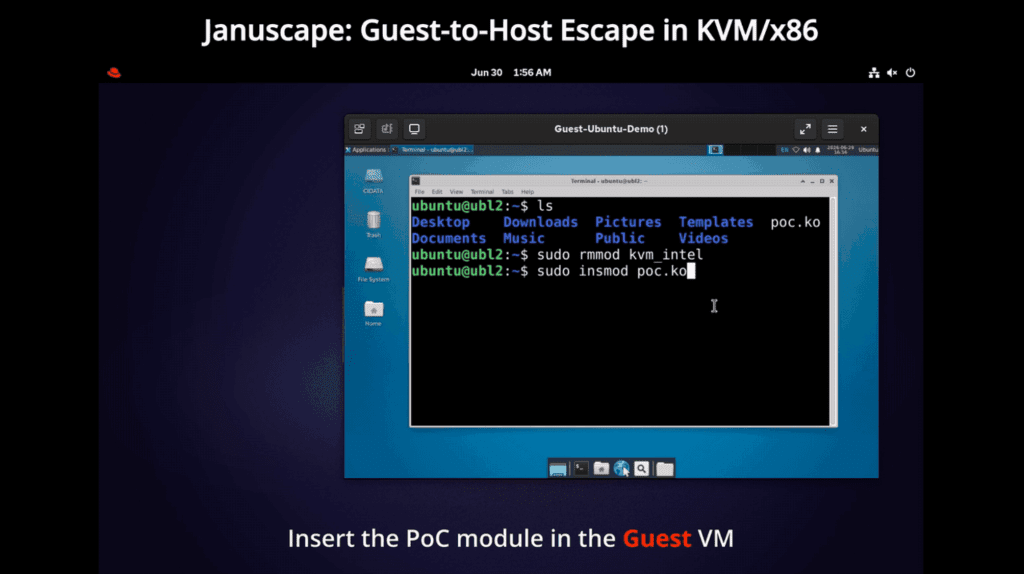
- CVE: CVE-2026-53359
- CVSS: 8.8 (High · CVSSv3)
- Product: Linux
- Affected: 2032a93d66fa282ba0f2ea9152eeff9511fa9a96, 2.6.36
- Impact: KVM: x86: Fix shadow paging use-after-free due to unexpected role
- Status: No confirmed exploitation yet
- Patched in: 0b5e8ead71e683bcf6232db16234cf7e6d553a23, b1337aae5e194324e4810d561764e7793f8b3864, 9291654d69e08542de37755cebe4d5b02c3170d1, 2ad3afa40ac6aa340dada122f9abfa46c0a6eb35 (+10 more)
- EPSS: 1.0% (30-day)
- Action: Update to 0b5e8ead71e683bcf6232db16234cf7e6d553a23, b1337aae5e194324e4810d561764e7793f8b3864, 9291654d69e08542de37755cebe4d5b02c3170d1, 2ad3afa40ac6aa340dada122f9abfa46c0a6eb35 (+10 more) now
Security researcher Hyunwoo Kim recently published technical details and a proof-of-concept for the Januscape KVM escape vulnerability. This flaw tracks officially as CVE-2026-53359. Januscape is a severe use-after-free vulnerability affecting the shadow memory management unit within x86 KVM environments. Attackers used this zero-day actively during the Google kvmCTF event. Now, the public release of the Januscape flaw elevates the risk for unpatched systems.
TL;DR
Januscape (CVE-2026-53359) is a critical guest-to-host vulnerability triggered through guest-side actions alone. It exploits a use-after-free memory flaw within the x86 KVM shadow MMU code. A malicious guest can use this bug to panic the host kernel, execute code with root privileges on the host, or perform local privilege escalation (LPE).
Why It Matters
This vulnerability directly threatens the isolation between guests and hosts in virtualized environments. Major public cloud providers often accept untrusted guests. Furthermore, they frequently expose nested virtualization capabilities. Consequently, an attacker renting a single cloud instance could trigger a host panic. This action would crash all other tenant virtual machines on the same physical server.
Moreover, the Januscape KVM escape works seamlessly across both Intel and AMD processors. It does not limit itself to a single architecture. Finally, local attackers can exploit this flaw on distributions where `/dev/kvm` is world-writable. Unprivileged users can escalate their permissions to root reliably. CISOs must prioritize patching to protect multi-tenant infrastructure.
How the Attack Works
The core issue stems from the x86 KVM shadow MMU implementation. KVM must translate guest virtual addresses into host physical addresses. Hardware handles this automatically on modern systems via two-stage paging. However, nested virtualization forces the host kernel to track page tables in software. This process uses the legacy shadow MMU. The host kernel handles all related faults directly. They never reach userspace applications like QEMU.
During this nested shadowing process, the system attempts to reuse existing shadow pages. The software checks the guest frame number but ignores the page role. The role dictates whether KVM shadowed a guest table directly or split a large page. Because the system ignores the role, it might reuse a direct split page incorrectly.
This role confusion breaks the lifetime tracking of the shadow page structure. Consequently, a use-after-free condition occurs. The kernel frees the shadow page but retains an orphaned pointer. Later, a cleanup routine writes a fixed constant into the newly reallocated memory. Attackers control the offset of this memory write.
Alternatively, attackers can force the host kernel to detect the data corruption. The KVM integrity check fires when it finds a mismatched entry. This detection instantly triggers a host panic and causes a denial of service. The public exploit code focuses entirely on this host panic pathway.
Dual-Architecture Exploitation
The Januscape KVM escape operates flawlessly across distinct hardware architectures. The vulnerability resides entirely within the architecture-independent shadow MMU code. Therefore, the exploit runs identically on both Intel and AMD systems.
Attackers simply swap the architecture-specific page table bits. The exploit module uses an abstraction layer to select the correct backend. On Intel, it utilizes `vmxon` and `vmlaunch` commands. On AMD, it triggers the nested page tables via `vmrun`. Both execution paths result in the exact same memory corruption on the underlying host.
Cloud Instance Threat Model
Transitioning this proof-of-concept into a live cloud attack requires minimal setup. The public exploit functions as a loadable kernel module. Cloud tenants naturally possess root access within their own rented instances. Therefore, they meet the basic requirement to load the malicious module immediately.
The target instance only needs exposed nested virtualization features. The attacker disables the default in-tree KVM module. Next, they insert the malicious module to trigger the vulnerability. All these actions appear as normal nested virtualization operations. They do not require any special host-side cooperation.
Affected Versions
The Januscape vulnerability remained undetected in the Linux kernel for nearly sixteen years. The vulnerable code spans from a commit released on August 1, 2010. It persists until the release of the official fix in June 2026. The flaw specifically impacts Intel and AMD architectures. Conversely, ARM64-based KVM hosts remain completely unaffected by this specific bug.
Patch or Mitigation Steps
Administrators must apply kernel patch `81ccda30b4e8` immediately. This patch resolves the root cause by adding a role validation check. The system now verifies both the guest frame number and the page role before reusing a shadow page. This prevents the initial role confusion entirely.
Additionally, you should disable nested virtualization if your environment does not require it. This action removes the primary attack surface used by the exploit. Finally, check file permissions on `/dev/kvm` within your systems. Restrict write access to prevent unprivileged users from attempting local privilege escalation. Ensure you also patch any remaining instances of the older ITScape vulnerability (CVE-2026-46316).
Support Our Threat Intelligence
Find our vulnerability reports and weekly recaps helpful? Support our work today and unlock a 100% ad-free reading experience!
 Buy Me a Coffee
