 Do Son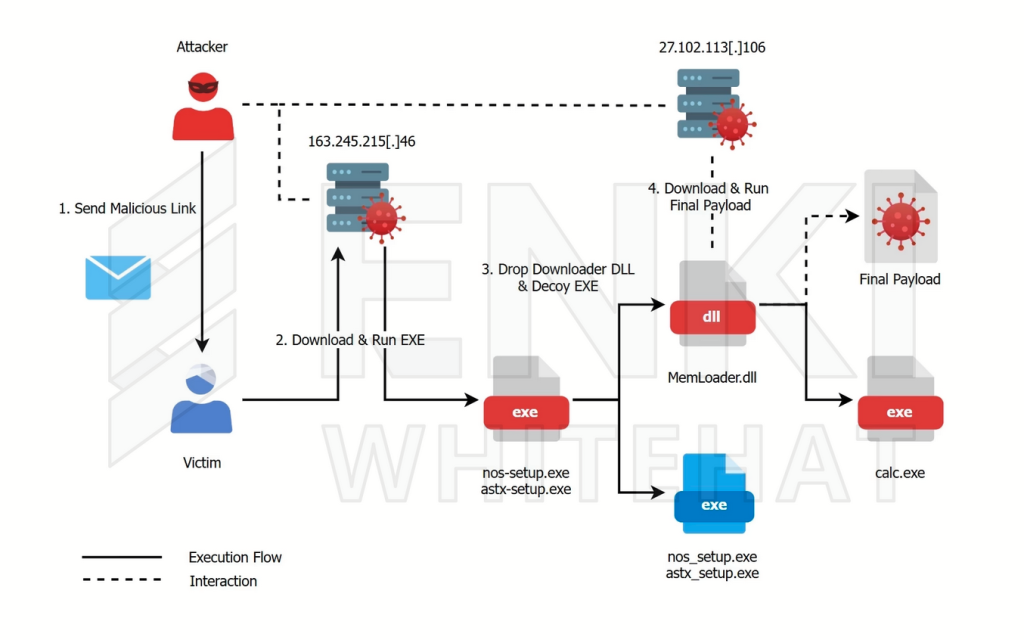
Security software spoofing attack overview | Image: The ENKI Whitehat Threat Research Team
The ENKI Whitehat Threat Research Team recently exposed an advanced cyber espionage operation. Specifically, the notorious Kimsuky HttpSpy malware campaign aggressively targets South Korean military and corporate organizations. This DPRK-nexus threat group has completely revamped its traditional toolkit to compromise high-value networks. Furthermore, the latest attacks combine highly sophisticated social engineering with real-time tracking mechanics. Security administrators must implement immediate defensive measures to secure their local systems against these persistent intrusions.
Tailored Social Engineering Tactics
To initiate the compromise, threat actors create highly deceptive websites that mimic legitimate services. For example, investigators discovered an artificial web portal around March 2026. This malicious site effectively impersonated a security software installation platform for a South Korean business messaging service. Interestingly, the hackers copied the foundational code from Woori Bank’s actual web interface. Subsequently, they modified the appearance by applying the messaging provider’s corporate logo. Consequently, unsuspecting messaging administrators downloaded dropper utilities thinking they were routine components.
Exploiting Real Meeting Data
Additionally, the group crafted separate malicious pages mimicking the popular Webex online meeting service. The attackers gathered precise meeting details by first compromising an individual participant’s account. “With this information, Kimsuky leveraged meeting schedule information from a presumably already-compromised victim to craft a fake meeting page and distribute malware to other participants.” This precise context made the lure look incredibly authentic to other scheduled attendees. After five seconds, a fake update warning prompts users to deploy a malicious camera script.
Unveiling the JSONPing Execution Check
The threat group added a novel verification mechanism to confirm successful local infections. Researchers officially designated this strategic real-time tracking technique as a JSONPing execution check. To achieve this, the malicious web pages query a localized background server that the dropper deploys. Because web browsers do not apply the Same-Origin Policy to script tags, the external page communicates freely with localhost.
Real-Time Infection Monitoring
Subsequently, the local server returns a formatted response to the web script. If the returned value indicates that the file is not running, the platform prompts the user to download the package. This allows the actors to monitor infection status dynamically. As a result, they can maximize delivery success without alerting network defenders.
The Evolving HttpSpy 3-Stage Chain
The architectural design of the core payload shows a notable shift in development philosophy. In contrast to historical models, the current Kimsuky HttpSpy malware campaign adopts a complex three-stage architecture. This structural distribution includes a specialized installer, a stealth loader, and the core remote access trojan module. “Unlike previous versions of HttpSpy that operated as a single binary, this variant splits the installation process into three stages.”
Analyzing the Malware Components
Initially, the victim runs an obfuscated script loader or an executable dropper. The system then decodes a secondary loader named MemLoader.dll or loadDll.dll into memory. This utility creates unique hardware identifiers and checks for virtualization software like VMware or VirtualBox. If the environment is safe, it communicates with external servers to pull down the primary implant.
Remote Command Structures and Control
The final operational stage deploys an advanced remote access tool into active memory space. Once active, the main module leverages a wide range of custom command parameters via HTTP POST protocols. For instance, operators can execute shell commands, take system screenshots, or manipulate local documents remotely. The threat handles outward data transmission securely by using localized RC4 encryption routines. Therefore, identifying the underlying communication stream remains highly challenging for traditional firewalls.
Infrastructure Overlaps and Defenses
The threat research group established clear attribution links by analyzing infrastructure commonalities. Specifically, investigators found that the threat actors repeatedly apply a default XAMPP certificate across their servers. Furthermore, almost all identified tracking servers operate within a highly specific pool of autonomous system numbers. “Neither the default XAMPP certificate nor the specific ASNs are unique to Kimsuky on their own, but their co-occurrence serves as a reliable indicator for identifying Kimsuky infrastructure.”
Visual Clues and Machine Learning Evidence
Interestingly, the phishing pages also contain extensive Korean-language commentary inside the source code. This design suggests that the native authors utilized large language models to streamline development. To mitigate these complex threats, users must meticulously verify URL extensions before executing unknown packages. Enabling file extensions in Windows Explorer can also prevent users from launching hidden scripts accidentally. Ultimately, practicing comprehensive digital hygiene will protect your enterprise from advanced nation-state attacks.
Support Our Threat Intelligence
Find our threat intelligence and malware analysis helpful? Support our work today and unlock a 100% ad-free reading experience!
 Buy Me a Coffee
