 Do Son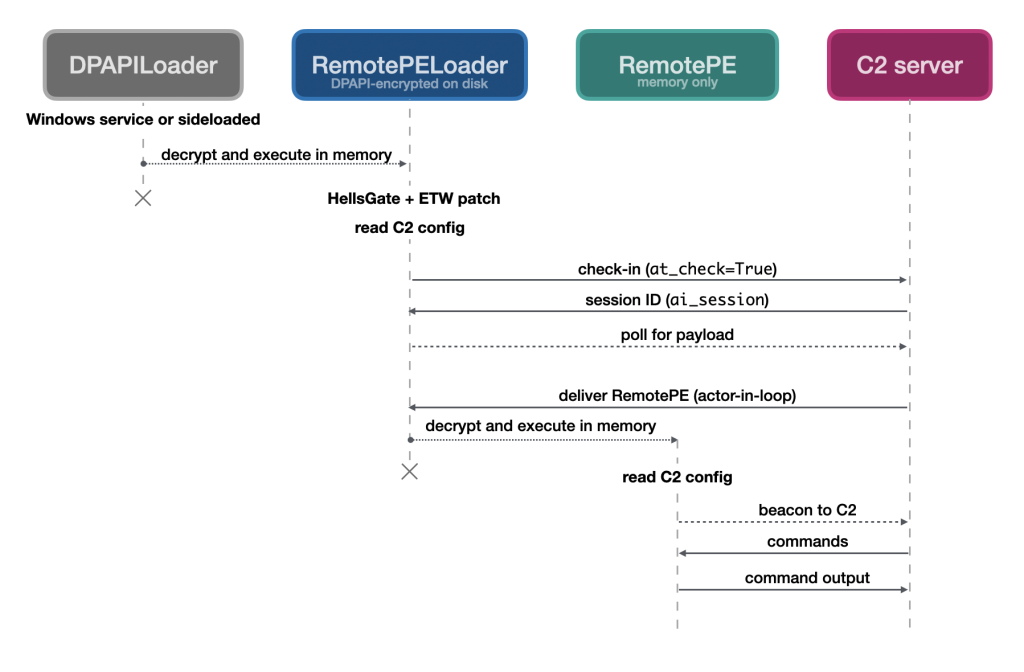
The three-stage chain | Image: Fox-IT
Security researchers recently uncovered a highly sophisticated cyber espionage campaign targeting international financial entities. Specifically, Fox-IT analyzed a dangerous execution framework deployed by a North Korean threat syndicate. This malicious operation overlaps with historic campaign activity from groups like AppleJeus and Gleaming Pisces. Furthermore, the threat actors recently replaced their older ThemeForestRAT and PondRAT implants. Instead, the group opted to transition toward an incredibly stealthy Lazarus memory-only toolset. Consequently, this architectural upgrade minimizes standard digital footprints on compromised host devices. To begin with, the team identified three distinct malware components working in tandem. These newly discovered families include DPAPILoader, RemotePELoader, and the final RemotePE implant. Therefore, network defenders must update their active detection heuristics immediately to safeguard systems.
First-Stage Environmental Keying
To begin with, the initial intrusion phase relies on a specialized, environmentally keyed file loader. The threat actors implement DPAPILoader as a dynamic link library to establish stealthy persistence. In a real incident case, researchers discovered the file operating as lassvc.dll inside the system folder. Specifically, the malware installs itself under the official service name “Internet Authentication Service”. Consequently, this configuration lets the payload run automatically during system startup sequences. Furthermore, the loader uses unique operating system properties to decrypt its secondary stage. The report states: “DPAPILoader is implemented as a DLL whose purpose is to decrypt and load an encrypted payload from disk using DPAPI.” For example, a sample uploaded to VirusTotal remains completely useless to security researchers. Meanwhile, the malware checks the host process and loops over specific device metadata paths. Subsequently, any custom file passing checks enters system memory via reflection.
Advanced EDR Evasion and C2 Polling
Subsequently, the execution sequence transitions to the second stage of the threat architecture. RemotePELoader serves as an operator-controlled loader responsible for retrieving follow-on payloads. However, the program applies aggressive evasion techniques before performing any network communication. Specifically, the malware uses a version of HellsGate to scan system libraries for untouched stubs. Consequently, it remaps core libraries from trusted kernel mappings to bypass user-mode security hooks. In addition, the malware directly targets Event Tracing for Windows to suppress local telemetry. The analysis notes that “Remote PELoader patches function EtwEventWrite() in the current process using a well-known technique, overwriting it with the following bytes.” Therefore, this patch causes the function to return zero immediately. As a result, endpoint security solutions fail to receive runtime process events. It then initiates an encrypted HTTP communication loop with remote servers.
RemotePE: In-Memory Remote Access Capabilities
Ultimately, the polling loop delivers the final stage implant directly into active memory. Researchers identified RemotePE as a fully-fledged remote access Trojan written in C++. This backdoor executes entirely in RAM and never writes artifacts to the local disk. For example, the first thread handles outbound connection logic with active command infrastructure. Meanwhile, the secondary thread processes incoming instructions from the operators. Furthermore, the Trojan incorporates specialized subroutines to destroy sensitive files securely. The report highlights that “RemotePE also implements a plugin system that allows the operator to dynamically register DLL payloads at runtime.” In contrast to standard malware, the file deletion function overwrites files seven times with constant bytes before removal. Clearly, the Lazarus memory-only toolset presents extreme challenges to traditional enterprise security forensics.
Infrastructure and Operational Patterns
To begin with, the command network utilizes reliable shared hosting systems to hide malicious traffic. The threat group hosts its active domains primarily on Namecheap systems. Consequently, traditional IP-based blocking remains largely ineffective because the servers also host legitimate websites. In addition, the network packets utilize HTTP cookie names that mimic the Microsoft ecosystem. For instance, headers incorporate fields like MSCC and MicrosoftApplicationsTelemetryDeviceId to appear authentic. Therefore, the malicious data blends perfectly into standard enterprise web traffic. Furthermore, forensic analysis revealed a distinct actor-in-the-loop operational delivery model. Instead, operators manually review connections before transmitting the encrypted Trojan file. Interestingly, telemetry records show that successful payload deliveries occur almost exclusively during daytime hours in the Korea Standard Time zone.
Defensive Recommendations for Enterprise Security
Ultimately, organizations must adapt their monitoring strategies to handle these fileless threats. Standard disk-based antivirus solutions cannot identify payloads residing solely in active memory. Therefore, security teams must pivot toward comprehensive host-based behavioral detection models. The report concludes: “Defenders should focus on host-based detection.” Specifically, administrators should monitor unusual directory paths for unexpected DPAPI-encrypted blobs. In addition, network-based tracking provides valuable hunting opportunities for modern defenders. Teams can inspect Server Name Indication fields and parse internal DNS logs for known command infrastructure. However, teams must execute these checks carefully to avoid false positives. Ultimately, proactive hunting remains the best method to stop the Lazarus memory-only toolset before major data theft occurs.
Support Our Threat Intelligence
Find our threat intelligence and malware analysis helpful? Support our work today and unlock a 100% ad-free reading experience!
 Buy Me a Coffee
