 Do Son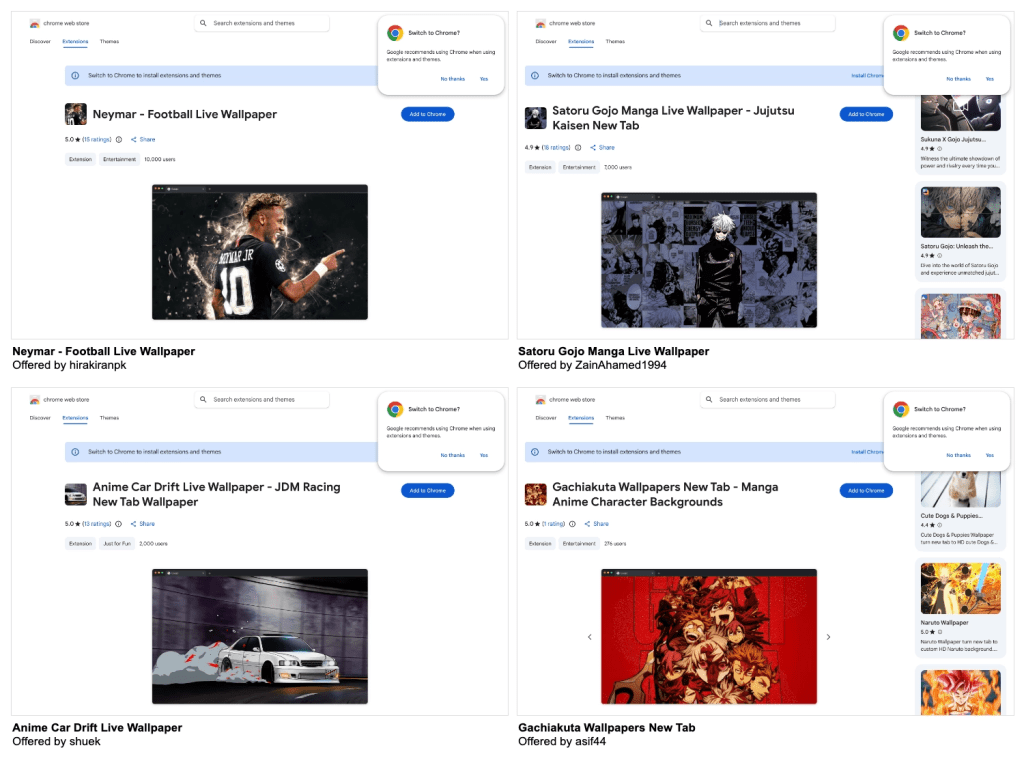
The same live wallpaper template published under four different Chrome Web Store accounts | Image: Socket
Cybersecurity researchers recently uncovered a massive ad-fraud campaign hiding on the official web store. Socket’s Threat Research Team identified a sprawling family of 152 malicious Chrome extensions built from a single codebase. These extensions pose as harmless “live wallpaper” add-ons. However, they secretly log user data and generate deceptive web traffic. This discovery highlights the ongoing challenges of securing browser ecosystems.
The Evasion Strategy Behind the Network
The operation uses highly effective evasion techniques to remain active. Instead of publishing from a single account, the threat actors distributed the apps across 38 separate publisher accounts and three distinct brand backends. Consequently, no single takedown by Google can easily destroy the entire infrastructure. Together, these extensions racked up approximately 105,000 reported installations. Although each listing deceptively claims that it will not collect or use your data, the actual linked privacy policies clearly state the opposite.
Deceptive Traffic Laundering Tactics
A significant portion of this campaign focuses purely on traffic laundering. Specifically, a 54-listing subset leverages a newer template to fake Google organic-search attribution. They purposefully manipulate destination URLs to make automated traffic look like genuine human interest. According to the original report, these extensions forge “Google organic-search attribution and disguises its uninstall ping as a Google search-result click, laundering extension-driven traffic into what looks like earned Google organic search.” This technique heavily pollutes real tracking analytics.
Forging Organic Search Signals
Why do threat actors want to forge organic traffic? Organic search signals represent the most valuable visitor type for digital advertisers. This is because organic hits show genuine, unforced interest. Conversely, these malicious Chrome extensions completely manipulate that valuable signal. The extension automatically opens a hidden tab behind the scenes and tags the visit as an organic Google hit. Therefore, ad partners inadvertently pay for fabricated numbers.
Technical Details and Monetization Funnels
The operational mechanism relies entirely on user funnels rather than dangerous script injections. For example, when a user installs the app, the background worker force-opens a promotional catalog page. These target domains load live programmatic ad stacks containing full-screen advertisements. To better understand this structure, you can read the comprehensive breakdown of how these 152 Chrome live wallpaper extensions hid ad tracking on Socket’s official blog. This setup turns silent browser installs into consistent advertising revenue.
Hidden Anti-Forensic Capabilities
Beyond ad fraud, the software includes a noteworthy anti-forensic routine. On every background service-worker start, the code systematically attempts to wipe out local IndexedDB databases. Even though this routine currently deletes nothing because the extension keeps its state in local storage, its presence reveals a dark intent. The researchers noted that this script represents “an indiscriminate, undisclosed deleteDatabase loop on every service-worker start, shipped to all 141 members, that would silently clear any IndexedDB state in the extension’s own origin.”
Direct Violations of Web Store Policies
This blatant contradiction between store declarations and actual behavior violates core platform guidelines. Google explicitly mandates that all developer dashboard disclosures must remain entirely accurate. Discrepancies can lead to a permanent ban of the entire publisher entity. Nevertheless, the identical deceptive disclosure appears across all live listings in this network. Affected users suffer from undisclosed telemetry, privacy leaks, and continuous ad tracking.
Securing the Browser Environment
Ultimately, this widespread campaign shows that massive ad-fraud operations can still bypass web platform reviews. Users should always evaluate browser extensions carefully before installation. Furthermore, organizations must monitor enterprise browser environments to block these sneaky adware threats. As security teams continue to identify these malicious Chrome extensions, user awareness remains our strongest line of defense against stealthy digital fraud.
Support Our Threat Intelligence
Find our threat intelligence and malware analysis helpful? Support our work today and unlock a 100% ad-free reading experience!
 Buy Me a Coffee
