 Do Son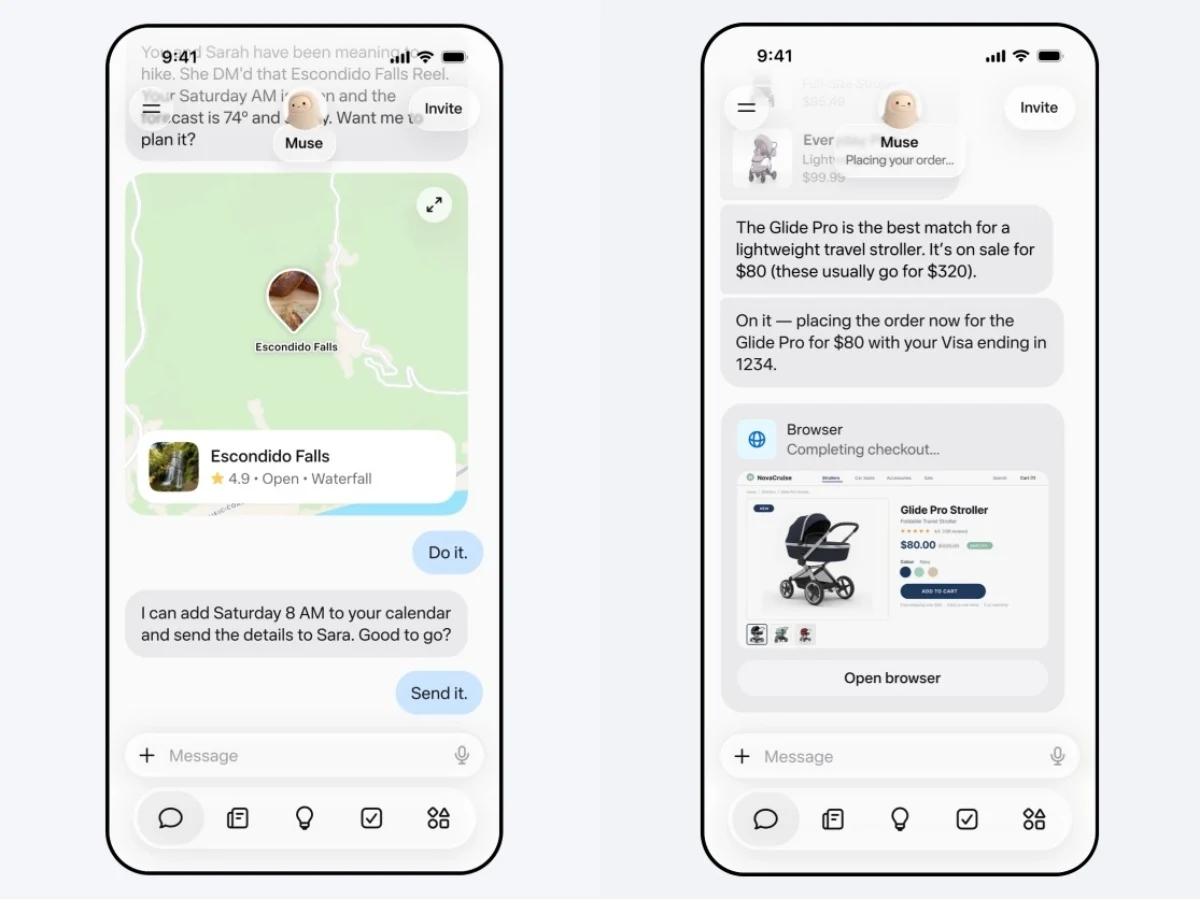
Meta has formally unveiled Muse, its long-prepared personal AI agent product. Unlike developer-focused agent platforms that demand elaborate configuration, Meta emphasizes that Muse is an end-to-end autonomous agent system. Moreover, it requires absolutely no technical background to operate. Users need only state a goal, and Muse autonomously advances the work in the background. For example, it handles tasks such as online price comparison and purchasing, drafting and sending emails, and planning cross-platform travel itineraries.
From Conversational Assistant to Autonomous Executor
Meta CEO Mark Zuckerberg has repeatedly articulated a vision of AI as “superintelligence” capable of proactively solving human problems. Muse is the concrete embodiment of that blueprint. In contrast to Meta’s previous AI chatbot, which could only field questions, Muse possesses its own dedicated app and web interface. Additionally, it can autonomously plan and execute complex tasks. When a user assigns Muse a goal, it breaks the objective into steps. It coordinates the user’s time and resources. Then, it independently advances each stage in the cloud.
Muse’s capabilities are determined by how much digital-life access the user is willing to grant. Beyond deep integration with Meta’s own Facebook and Instagram data, Muse can bridge third-party services including Google Workspace, Ticketmaster, OpenTable, Spotify, and Apple Health. For instance, a user could ask Muse to gather all cooking videos saved on Instagram and distill them into structured recipes. Muse could then automatically compile a shopping list, compare prices across retailers, and even place a grocery delivery order on the user’s behalf.
Payments are handled through Link, built by Stripe, with one-time-use virtual cards so the user’s real card details remain hidden. Muse is also the first AI agent covered by Link’s purchase protections. This includes coverage for damaged or lost items and no-fee returns.
Muse Secure VM: Dedicated Isolation and Defense-in-Depth
Entrusting an AI agent with full control over one’s accounts and finances inevitably carries significant security and privacy risks. To address this, Meta has engineered Muse Secure VM, a dedicated virtual machine that runs each user’s agent in total isolation from all others. A separate Sentinel agent runs on the same machine, kept apart from Muse at the system level. Nothing Muse does reaches the internet unless the Sentinel approves it.
Muse has no visibility into passwords or payment methods – credentials go into secure storage so Muse can use them without seeing them. Before sensitive actions such as sending an email or making a purchase, Muse always seeks explicit user confirmation. It presents a complete audit trail of everything it has done and plans to do.
Later this year, Meta will introduce Muse Confidential VM. In this version, the entire virtual machine, including the user's data and conversations, is encrypted with a key only the user holds. As a result, even Meta is unable to access it.
Privacy Commitments and a Freemium Business Model
On privacy, Meta takes a comparatively restrained stance. Users may opt out of having their Muse interactions used to train future AI models, and Meta commits that conversation details will not be shared directly with its advertising systems, though it acknowledges that commercial interactions such as online shopping may indirectly influence the ads a user sees.
As for pricing, most core Muse functionality will be offered free of charge. Users who require heavier compute loads or more complex task execution may need to subscribe to a premium tier. Muse is launching in the United States on iOS, Android, and the web. Additionally, support for AI glasses is coming soon.
The Race for the Personal Digital-Life Gateway
Meta’s launch of Muse signals that competition in generative AI has shifted decisively from “whose model writes more fluently or reasons more powerfully” to “who can most seamlessly take over the user’s actual daily behaviors.” For Meta, with its unrivalled social graph, this is the most potent card it holds against Google and Apple. Google commands search and Workspace workflows. Apple controls the device layer through the operating system. Meta, however, holds the most authentic record of billions of people’s social interactions, interests, and daily lives. Now, when Muse can in a single step connect Instagram’s interest-discovery layer to real-world purchasing on the user’s behalf, the social platform has effectively evolved into a vast, autonomous commercial ecosystem.
Yet the foremost test this technology faces remains one of trust. At a moment when many consumers remain guarded about Meta’s data-privacy track record, how many will be willing to hand over email access, calendar scheduling, and even payment authority to a virtual agent operating silently in the background? That is the most formidable psychological barrier Meta must surmount beyond proving its technical prowess.
Support Our Threat Intelligence
Find our tech and OS security coverage helpful? Support our work today and unlock a 100% ad-free reading experience!
 Buy Me a Coffee
