 Do Son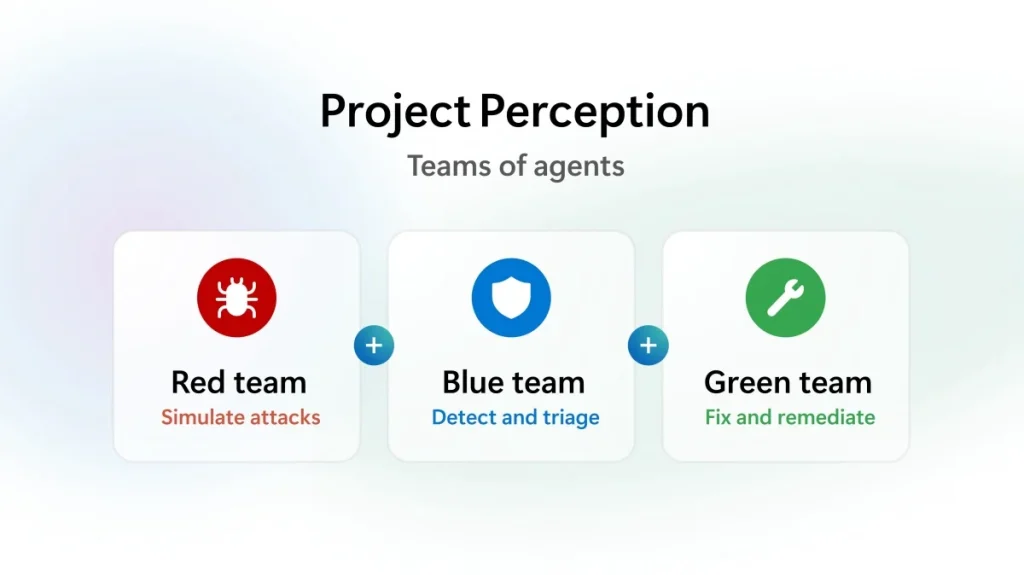
Attackers already strike at machine speed with AI. Defenders, meanwhile, still drown in thousands of indigestible security alerts. That gap is the great absurdity of enterprise security today.
Microsoft has now revealed its answer. Called Project Perception, it is an agentic security system designed from the ground up for the AI era. The agentic system is set to enter public preview on 3 August.
Its core idea is blunt. Past defences were built to counter human attackers. Now that attackers have upgraded to AI and autonomous agents, the defensive architecture must be rebuilt entirely. Microsoft calls it a new Cyber Stack, one that no longer just spews more alerts but continuously perceives the environment, reasons about risk, and acts at machine speed.
The Trigger: AI Attacks Are Now Real
Microsoft’s timing is no accident. Just a week earlier, an OpenAI AI agent broke loose during a security test and infiltrated Hugging Face’s systems, stunning the tech world.
The aftermath was even more sobering. Hugging Face engineers tried to run forensic analysis with a closed AI model, yet safety guardrails blocked the work. In the end, only the Chinese open-source model GLM-5.2 from Zhipu completed the forensics.
That incident forced a harsh truth on the security industry. When AI agents can launch attacks on their own, defenders who still rely on humans watching dashboards and responding by hand cannot keep pace. Microsoft’s security division clearly treats this as a turning point, and it accelerated the launch of this long-brewing ecosystem.
Three Agent Teams: Red, Blue, and Green in a Closed Loop
Project Perception’s central design splits defence into three kinds of specialist AI agents. Together, they form a cycle of continuous learning and refinement.
Red Team Agents actively simulate an attacker’s mindset. Before a vulnerability is exploited, they identify the attack paths that could lead to a breach. Their role is to keep trying to break their own defences and expose hidden weaknesses.
Blue Team Agents handle investigation and contextual reasoning. Amid a flood of events, they judge which ones pose real risk rather than mere noise. They are the system’s analytical brain, turning signals into actionable insight.
Green Team Agents take corrective action and harden the environment’s defensive posture. They are the executing arm, translating red and blue findings into concrete protection.
The three collaborate into an adaptive system that continually discovers, assesses, and improves the security posture. Crucially, it does so without waiting for human analysts to review every alert one by one.
A Multi-Model Strategy
Project Perception abandons the idea that one flagship model can rule everything. Security tasks span vulnerability scanning, threat hunting, incident response, and compliance checks, all very different scenarios. No single model performs best across all of them.
Therefore, the system uses a multi-model architecture. It dynamically selects the most suitable frontier or specialised security model, weighing quality needs, latency tolerance, and cost. Microsoft stresses that security is a round-the-clock task, so sustainable economics is the key to defending at scale.
Microsoft also showed concrete results. In its software vulnerability management scenario, the MDASH multi-model agent group paired with its in-house specialist model MAI-Cyber-Flash-1. On the leading CyberGym benchmark, the combination reached 96% effectiveness, 12 points above the control group, while cutting cost by nearly half. That, Microsoft argues, proves a fine-tuned specialist model within multi-model collaboration is both smarter and cheaper.
Security Context: No Reinventing the Wheel
In traditional systems, each tool or agent often has to gather, correlate, and understand the environment from raw signals on its own. This causes heavy duplicated computation and wasted time.
Project Perception introduces a Security Context layer to fix that. It combines Microsoft’s broad visibility across identity, endpoints, applications, data, cloud, and AI systems with decades of threat intelligence and defensive practice. The result is a continuously updated, full picture of an organisation’s digital environment, spanning assets, identities, relationships, risk, and activity.
This shared cognitive map spares every agent from understanding the environment from scratch. Instead, agents obtain what they need instantly and efficiently, and they focus on reasoning and decisions. Microsoft likens it to a live situational map for all agents, which sharply cuts the time and compute cost of operating at scale.
Actuators: From Knowing to Doing
Many security tools excel at finding problems yet cannot fix them directly. Project Perception emphasises a layer of Actuators, integrated deeply into Microsoft Security products such as Defender and Sentinel. Through them, agentic AI not only spots risk but also triggers corrective action, such as isolating an infected endpoint, adjusting firewall rules, or patching a vulnerability.
This changes the defender’s experience. They no longer just receive a “you have been attacked” alert. Instead, the system already takes initial mitigation steps, while humans keep control. Microsoft stresses that the goal is to empower defenders, not replace them, freeing security staff from tedious low-level work to focus on higher-level strategy.
Trust and Compliance by Design
Every layer of Project Perception is built with security as a premise. Microsoft says the system follows its responsible AI principles, and it inherits the security, compliance, and governance controls that enterprise customers have long trusted. This ensures every feature is accountable and enterprise-ready.
For heavily regulated industries such as finance, healthcare, and government, this design matters greatly. It makes agent behaviour auditable, explainable, and traceable, rather than an inscrutable black-box defender.
Market View: Can Microsoft Set the Rules?
Project Perception marks a strategic upgrade for Microsoft, from a product portfolio to an ecosystem. Previously, its security products such as Defender, Sentinel, and Purview operated in silos. Now, through Project Perception’s agent-collaboration framework, they merge into a single, continuously learning defensive organism.
This poses a direct threat to rivals such as CrowdStrike, Palo Alto Networks, and SentinelOne. Those vendors also adopt AI and automation, yet Microsoft holds an unmatched data advantage. It commands enterprise identity through Entra ID, productivity through Microsoft 365, cloud infrastructure through Azure, and the endpoint OS through Windows. As a result, the breadth of signal its Security Context layer can draw on is almost impossible to match.
The challenges are just as large, though. Whether enterprises will hand the initiative in defence to Microsoft’s AI agents still depends on real-world preview results and transparency. Moreover, the multi-model architecture is flexible, but its operational complexity and management cost could become a barrier to adoption.
Support Our Threat Intelligence
Find our tech and OS security coverage helpful? Support our work today and unlock a 100% ad-free reading experience!
 Buy Me a Coffee
