 Do Son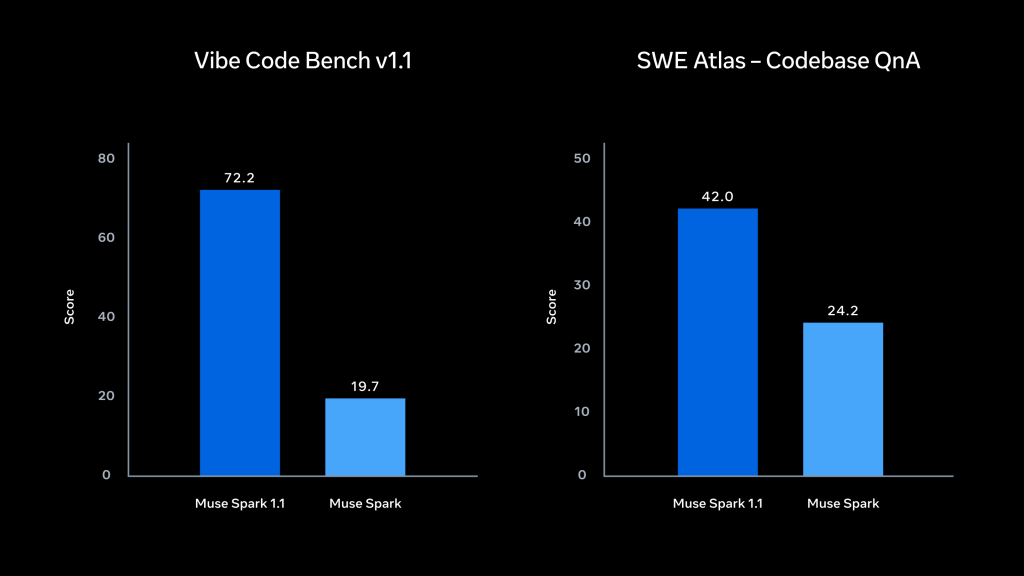
Social media giant Meta introduces Muse Spark 1.1, a novel artificial intelligence model. This sophisticated model primarily targets intelligent agents, advanced programming, and complex multimodal tasks. Regrettably, Meta did not release this model as open-source software. To be precise, Meta has seemingly pivoted entirely toward closed-source commercial models. Furthermore, the company will likely cease publishing open-source models for the AI community in the future.
Enhancing Intelligent Agents and Computer Operations
The core enhancement of Muse Spark 1.1 lies in its profound agent capabilities. Consequently, this model trains extensively to orchestrate multi-agent systems efficiently. This optimization significantly reduces end-to-end latency. As a primary agent, it gathers contextual data and formulates strategic plans. Subsequently, it delegates specific tasks to multiple parallel sub-agents. Conversely, as a subordinate agent, it thoroughly understands its unique responsibilities. It utilizes available tools adeptly and escalates complex issues to the primary agent when necessary.
Regarding computer operations, Muse Spark 1.1 seamlessly manages workflows across multiple applications. It adapts dynamically to constantly changing information during complex tasks. Additionally, Meta emphasizes a very crucial distinction. The model does not merely click desktop interfaces mechanically. Instead, it intelligently determines when to write automation scripts. Alternatively, it recognizes when direct interface clicks are simply more efficient. Therefore, it can generate bulk operations at every single step.
Such capabilities remain absolutely vital for modern AI agents. After all, real-world workflows rarely involve simple, single-page interactions. Typically, these tasks require navigating fluidly between web browsers and spreadsheets. Furthermore, they involve manipulating documents, managing emails, and traversing complex enterprise systems.
Coding Capabilities Show Moderate Results
Muse Spark 1.1 impressively supports a one-million-token context window. Meta continually strives to improve the coding proficiency of the Muse Spark series. However, official benchmark tests reveal somewhat underwhelming performance in this specific domain. For instance, Muse Spark 1.1 scored 61.5 on the rigorous SWE-Bench Pro evaluation. This result safely surpasses the 55.0 score of Gemini 3.1 Pro. Yet, it falls significantly behind the impressive 69.2 achieved by Claude Opus 4.8.
Interestingly, GPT-5.5 only managed a modest score of 58.6 on this exact same SWE-Bench Pro test. Furthermore, OpenAI recently published an insightful blog post addressing this issue. They argued that SWE tests no longer accurately measure true model coding capabilities. Consequently, future iterations of the GPT series will likely de-emphasize these specific evaluations.
Model API Pricing and Availability
Currently, Muse Spark 1.1 offers a public preview exclusively through the Meta Model API platform. At this stage, access remains strictly limited to developers based in the United States. Upon registering for this platform, users receive a generous $20 credit for model invocations.
The specific pricing structure for Muse Spark 1.1 seems quite straightforward. It costs $1.25 per million input tokens. Output tokens cost $4.25 per million. Finally, utilizing the integrated web search feature incurs a fee of $2.50 per 1,000 requests.
Support Our Threat Intelligence
Find our tech and OS security coverage helpful? Support our work today and unlock a 100% ad-free reading experience!
 Buy Me a Coffee
