OpenAI and Semiconductor Titans Join Forces to Build the First AI Agent Smartphone
 Do Son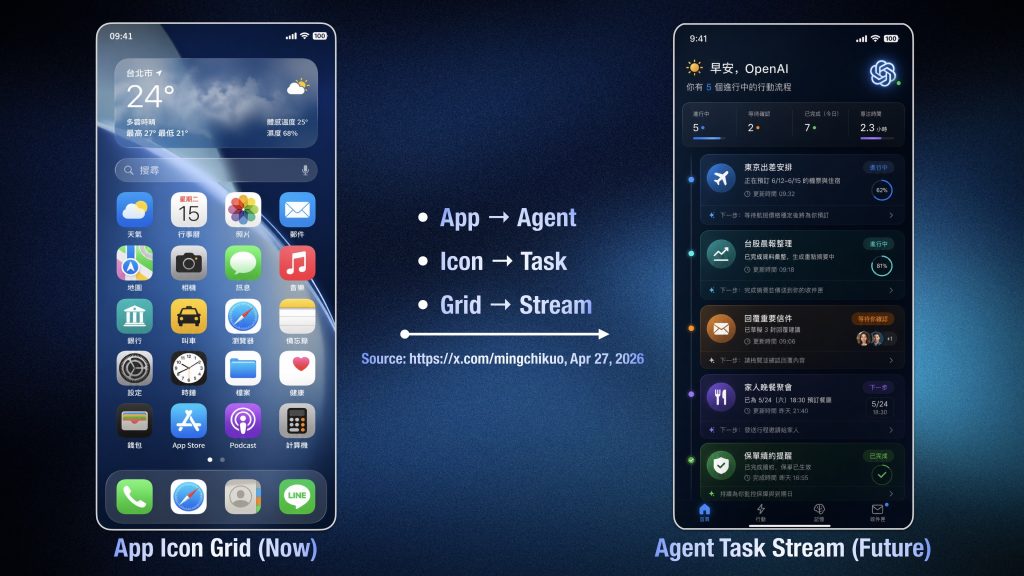
The distinguished analyst Ming-Chi Kuo recently disseminated a seminal industry report, revealing that OpenAI is currently collaborating with an illustrious cohort of partners—including semiconductor titans MediaTek and Qualcomm, and the manufacturing vanguard Luxshare Precision—to engineer a smartphone predicated entirely upon AI agents.
While contemporary smartphones serve as conduits for disparate third-party applications, OpenAI’s vision fundamentally subverts this established paradigm. Their device eschews the traditional necessity for manual application installation, instead empowering the smartphone itself to execute tasks and satisfy user requisitions autonomously. The rationale for this venture is elementary yet profound: absolute mastery over the hardware and software substrate is essential to delivering a comprehensive AI agentic experience. Furthermore, the smartphone remains the only device capable of capturing a user’s real-time state, providing the ephemeral data required for instantaneous AI reasoning within the world’s most pervasive hardware ecosystem.
This strategic shift mirrors the collaboration between ByteDance and ZTE for the customized Doubao handset. System-level integration grants the AI agent unbridled permissions, circumventing the restrictions that third-party applications impose due to security protocols or competitive interests. In OpenAI’s vision, as the era of independent applications recedes, the handset evolves into a unified vessel for the AI agent.
However, such a transition is fraught with formidable technical obstacles. The device must perpetually comprehend user intent, necessitating a revolution in battery longevity and hierarchical memory management. Moreover, the processor must possess the requisite fortitude to execute localized small language models, while delegating more computationally intensive tasks to the cloud.
OpenAI’s competitive advantage resides in its preeminent consumer brand, an extensive reservoir of user insights, and its vanguard AI architectures. By leveraging the maturity of the existing supply chain, OpenAI can cultivate a novel ecosystem where subscription models are intricately bundled with hardware.
Kuo further elucidated the implications for the supply chain: MediaTek and Qualcomm, as primary silicon partners, are poised to benefit from the revenue surge generated by this new replacement cycle. Similarly, while Luxshare Precision faces the daunting challenge of eclipsing Foxconn within Apple’s sphere, the OpenAI smartphone represents a strategic opportunity to secure an early foothold in the next epoch of mobile technology.
Support Our Threat Intelligence
Find our tech and OS security coverage helpful? Support our work today and unlock a 100% ad-free reading experience!
 Buy Me a Coffee
