 Do Son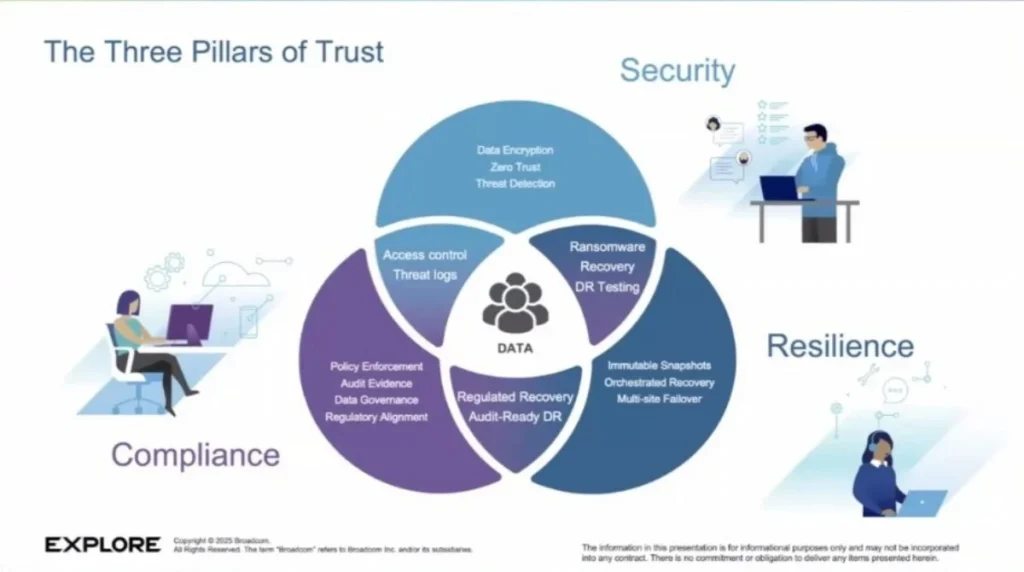
In addition to introducing privatized AI services within VMware Cloud Foundation (VCF) 9.0, enabling enterprises to natively run both AI and non-AI workloads, Broadcom has also announced the integration of Advanced Cyber Compliance services. Enhancements have been made to both VMware vDefend and the VMware Avi Load Balancer, further strengthening the security resilience and regulatory compliance of modern private cloud environments.
These new capabilities are specifically designed for highly regulated industries, such as finance and healthcare, which face stringent compliance requirements and emerging security risks associated with Agentic AI workloads.
Citing research data, Broadcom noted that 65% of large-scale enterprise attacks involve data encryption, 30% result in data exfiltration, and 71% of multinational companies struggle with cross-border regulatory compliance. This, the company emphasized, has made security and compliance critical challenges for both boards and IT departments. Broadcom underscored VCF’s role as a unified private cloud platform, consolidating infrastructure hardening, threat defense, compliance, and recovery mechanisms—replacing fragmented legacy security solutions.
The new VCF Advanced Cyber Compliance service provides automated compliance and security governance for heavily regulated sectors across three key dimensions:
- Continuous Compliance Monitoring — Powered by SaltStack automation, ensuring VCF environments remain consistently compliant with real-time monitoring, remediation, secure data engine imaging, and automated patching.
- Automated Security and Data Recovery — One-click VM network isolation and clean execution environment restoration to help organizations swiftly respond to ransomware, natural disasters, or hardware failures. Built-in scanning tools detect both file-based and fileless malware.
- Platform Security and Incident Response — Enterprise-grade container image security, hardened compute protections, and proactive risk assessments to minimize attack surfaces and strengthen compliance effectiveness.
Within VMware vDefend, Broadcom is extending Zero Trust principles to AI workloads, offering:
- AI Lateral Security Protection (Tech Preview): Tailored for Agentic AI, leveraging strict access controls and secure channels to safeguard internal AI communications.
- Automated Zero Trust Deployment: Workflow-driven implementation of fine-grained protections at service and application layers, with firewall rule analysis to eliminate redundancies.
- Expanded Threat Detection: Introduction of NDR sensors to capture full data center traffic and detect large-scale attack activity.
- Fileless Malware Defense: Integration with Windows AMSI to intercept in-memory attacks executed through PowerShell, VBScript, and Jscript, addressing prior detection blind spots.
Meanwhile, the VMware Avi Load Balancer, originally part of NSX, has been enhanced with:
- Post-Quantum Cryptography (PQC): Adoption of NIST algorithms to mitigate the future risk of quantum computing breaking traditional encryption.
- Mutual TLS (mTLS): Enabling client-server mutual authentication within vSphere Kubernetes containerized environments.
- WAF Security Assessment Reports: Built-in tools for auditing Web Application Firewall configurations, assisting IT administrators in gradually expanding protections.
- MCP Traffic Security (Tech Preview): Added support for Model Context Protocol traffic inspection, session persistence, and authorization management to counter emerging AI-driven attack vectors.
Through VCF Advanced Cyber Compliance services, reinforced vDefend, and the upgraded Avi Load Balancer, Broadcom is merging compliance governance, Zero Trust defenses, and post-quantum security into a comprehensive private cloud security framework. As AI workloads become the new normal, these measures will help enterprises remain both secure and compliant throughout their digital transformation journey.
Related Posts:
- Broadcom Unveils VMware Cloud Foundation 9.0: A Unified Private Cloud for AI & Modern Workloads
- The EU unease about Broadcom attempts to buy Qualcomm: Privacy data may be leaked
- Researcher Exposes Critical Vulnerabilities in Google Cloud
Support Our Threat Intelligence
Find our tech and OS security coverage helpful? Support our work today and unlock a 100% ad-free reading experience!
 Buy Me a Coffee
