 Do Son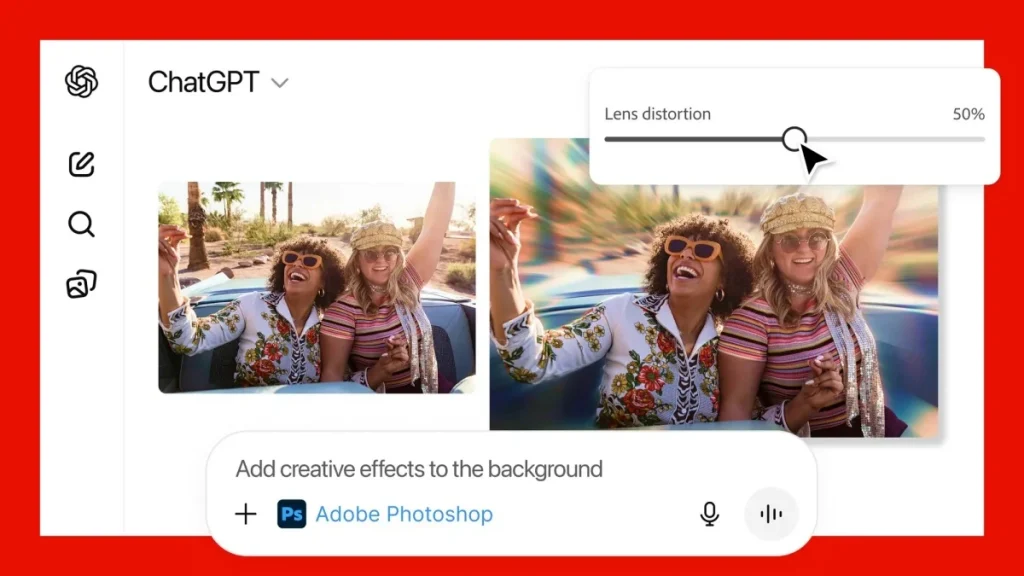
Following earlier integrations with Spotify and Canva, OpenAI has taken yet another decisive step toward its ambition of building an “AI super-app.” Adobe has announced that three of its flagship productivity tools—Photoshop, Acrobat, and Adobe Express—are now officially integrated into the ChatGPT platform. This means that more than 800 million ChatGPT users worldwide will no longer need to juggle multiple windows; they will be able to invoke Adobe’s powerful capabilities directly within the chat interface to edit images or handle documents.
This integration goes well beyond simple API calls. Instead, it is driven by OpenAI’s Model Context Protocol (MCP), enabling deep, structured interoperability. Users may issue natural-language commands—such as “brighten this photo for me”—or activate Adobe tools via the “+” menu, and ChatGPT will execute the request through Adobe’s services.
The most intriguing implementation is Photoshop’s behavior inside ChatGPT. Rather than merely returning a processed image, the interface dynamically generates interactive sliders tailored to the user’s command:
- Ask to brighten an image, and sliders for exposure, shadows, and highlights appear.
- Request special effects, and a set of relevant filter options is revealed.
This design ensures that AI-powered editing is no longer an opaque, untouchable black box. Users enjoy the speed of AI assistance while retaining granular control over the final result. Acrobat and Adobe Express also enable in-chat PDF generation and poster creation, though some features require signing in with an Adobe account.
Observers may wonder: given OpenAI already offers image-generation models like DALL·E, is Adobe not “raising a tiger that will one day devour it”? Aubrey Cattell, Adobe’s Vice President of Developer Platform, clearly disagrees.
Cattell likens Adobe’s MCP tools and command sets to “Lego bricks,” with ChatGPT acting as the system that interprets user intent and assembles those bricks into coherent workflows. He describes OpenAI’s newly released Apps SDK as akin to a new operating system—one on which Adobe can natively extend its applications. In his view, the partnership is naturally complementary.
It is, indeed, a strategic move for both sides. For OpenAI, this deepens ChatGPT’s role as the universal digital assistant. For Adobe, whose professional interfaces can intimidate casual users, ChatGPT’s natural-language front-end dramatically lowers the barrier to entry. Users can complete basic edits simply by speaking to the model; and when they discover that AI-generated results require finer adjustments, a single button transports them back into Adobe’s full web interface.
The result is not only a more accessible creative workflow, but also a powerful new funnel that could channel vast numbers of lightweight ChatGPT users toward Adobe’s broader ecosystem.
Related Posts:
- Microsoft Paint’s New Features Are Making It More Like Photoshop
- Adobe Acrobat and Reader Multiple Security Vulnerabilities
Support Our Threat Intelligence
Find our tech and OS security coverage helpful? Support our work today and unlock a 100% ad-free reading experience!
 Buy Me a Coffee
