 Do Son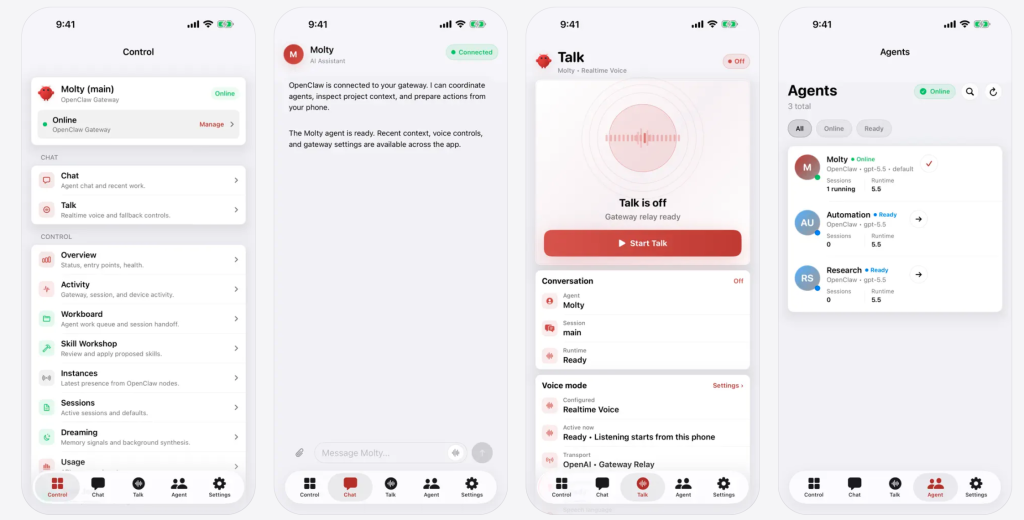
As generative AI gradually evolves toward “agentic AI” — systems that can carry out tasks on their own — the way we interact with smartphones is undergoing a major shift. OpenClaw, which rose to prominence as an open-source agent model, recently announced that it has launched standalone apps for both iOS and Android.
This move does more than place an agentic AI assistant on Apple’s App Store and Google’s Play Store. It also lets users grant the AI deep system permissions directly from their phone. As a result, the AI agent becomes a true super-assistant that can “get things done.”
Deep Hardware Control: Beyond Chat to System-Level Operations
In the past, AI apps on phones mostly stayed within text conversation or image generation. The OpenClaw app, however, brings genuine “agentic operation” capability.
Users can now chat with the AI assistant through this standalone app and authorize it to access several core components of the device. According to the official description, OpenClaw can obtain key low-level permissions, including the camera, screen contents, location, photo album, contacts, calendar, and reminders. In other words, the AI can follow user commands, read information across apps on its own, and handle tedious tasks for the user. Therefore, it completely changes how people interact with their smartphones.
The Founder Joined OpenAI; a Foundation Now Runs OpenClaw
OpenClaw rose at remarkable speed, climbing from a relatively niche project to a heavyweight player in the AI field.
The project currently operates in open-source form, mainly under the “OpenClaw Foundation.” The turning point came when founder Peter Steinberger announced earlier this year that he was joining OpenAI.
Despite the founder’s departure, the foundation still publishes and maintains the OpenClaw app. Moreover, the announcement of that personnel change mentioned that OpenAI would provide some form of support and endorsement for the non-profit, though without specifying the details.
Clearing Apple’s Strict Review: iOS Users No Longer Need Third-Party Apps
It is worth noting that a powerful, high-permission app reaching the iOS platform carries strong strategic significance for the industry.
For a long time, agentic AI has been a contentious and sensitive topic within Apple’s camp. Because Apple reviews apps very strictly, it previously blocked agentic AI tools on a large scale. The company worried about the potential security and privacy risks of such tools in “vibe coding” and automated operation.
Before the dedicated OpenClaw app arrived, iOS users who wanted these powerful AI agent features often had to bypass system limits through chatbots on third-party messaging apps like Telegram or WhatsApp. That approach offered limited functionality and a fragmented experience. Now that OpenClaw has officially launched, it seems to hint that Apple’s strict review line is beginning to loosen in the face of the agentic AI wave.
Analysis: From “Conversation” to “Agent” — A Permissions Test for Mobile Operating Systems
OpenClaw’s successful arrival as a standalone app on both iOS and Android marks an important watershed for mobile AI in 2026.
Past generative AI acted like an all-knowing “consultant”: you asked questions, and it gave answers. Yet the final “action” — such as sending an email, creating a calendar entry, or finding and sharing a photo — still required a human hand. Agentic AI, by contrast, gives the AI “hands and feet.” When OpenClaw gains direct access to your screen, camera, and calendar, the traditional sandbox security model between the OS and apps is being redefined.
For platform giants Google and Apple, this presents an anxious dilemma. On one hand, they do not want to fall behind in the AI agent contest, so they must open up API permissions to let third-party AI perform. On the other hand, handing low-level system control to an AI tool run by an open-source foundation carries privacy and security risks that are hard to estimate.
Apple’s willingness to let OpenClaw through may reflect a deeper strategic understanding with OpenAI. It also signals that the future smartphone war will no longer turn on whose app ecosystem is richer. Instead, it will turn on who can build — or accommodate — the smartest, most action-capable AI super-agent.
Support Our Threat Intelligence
Find our tech and OS security coverage helpful? Support our work today and unlock a 100% ad-free reading experience!
 Buy Me a Coffee
