
 Do Son
Security researchers from Trend Research have uncovered a sophisticated campaign — dubbed “Operation Zero Disco” — in...
Latest news

The Samba Team has released an urgent security advisory addressing two vulnerabilities, including a critical command injection...

Researchers from Palo Alto Networks’ Unit 42 have uncovered a multi-stage phishing campaign delivering a new stealthy...

A new investigation by The Symantec Threat Hunter Team has revealed that the Chinese APT group “Jewelbug”...

The Apache Software Foundation has issued a new security advisory addressing a critical vulnerability in Apache ActiveMQ’s...

Around 8:00 AM on October 16, 2025, multiple major online services — including YouTube, Netflix, X/Twitter, Steam,...

Researchers at Kaspersky’s Global Research and Analysis Team (GReAT) have published a detailed report on a newly...

A newly released report from ReliaQuest reveals how the China-backed advanced persistent threat (APT) group “Flax Typhoon”...

 cybernewswire
New York, United States, 15th October 2025, CyberNewsWire

New York, USA, New York, 15th October 2025, CyberNewsWire

Duarte Santos uncovered a critical vulnerability, CVE-2023-50447, that could potentially allow attackers to execute arbitrary code.

Jamf Threat Labs researchers Ferdous Saljooki and Jaron Bradley discovered a new macOS malware campaign lurking within pirated software

Zloader's journey from a banking trojan to a vehicle for ransomware attacks mirrors the adaptability of cyber threats.

A critical vulnerability, identified as CVE-2023-40051 (CVSS 9.1), has been spotlighted within several iterations of the PASOE

The subsequent investigation unveiled a sophisticated RAT deployment masquerading as a standard Microsoft update process.
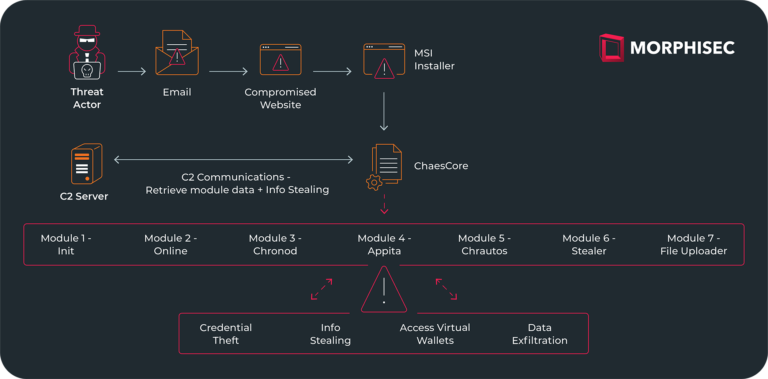
Chae$ 4.1 malware uses deceptive websites and compromised sites to distribute its payload, showcasing the attackers' adaptability

Midnight Blizzard employed a password spray attack to breach a legacy non-production test tenant account within Microsoft's corporate systems

Users employing these versions are unwittingly exposed to CVE-2024-21733 which could potentially leak sensitive information.

When it comes to making a grand entrance at special evening occasions, your choice of attire plays...

As of January 17, 2024, VMware has reported evidence that the CVE-2023-34048 RCE bug is currently being exploited in attacks

Slippy-Book, identified as CVE-2023-44451 for Xreader and CVE-2023-52076 for Atril, targets the very core of file parsing in Linux’s prominent document

A key discovery in Volexity's investigation was the GIFTEDVISITOR webshell. Over 1,700 compromised Ivanti Connect Secure VPN devices

The NETSCOUT ASERT team has recently unearthed alarming patterns of behavior indicative of an upsurge in malicious botnet activities

CVE-2023-35636 is a security vulnerability found in Microsoft Outlook, specifically in the calendar sharing function.

7777-Botnet is known to exploit a range of vulnerabilities in various devices, including TP-Link routers, Xiongmai devices, and Hikvision cameras

Assigned a base score of 9.8 on the Common Vulnerability Scoring System, the CVE-2023-50643 vulnerability is classified as "Critical."

Further investigation revealed that this JSP code was from an open-source web shell known as the Godzilla Webshell.

Check Point Research has exposed a large-scale, sophisticated NFT scam campaign, marking a new era in digital asset fraud

SPICA backdoor represents a significant advancement in COLDRIVER's capabilities, marking its first foray into custom malware development
the digital underworld witnessed the reemergence of TA866, a formidable threat in the realm of email-based cyber-attacks

Cado Security Labs researchers have uncovered a striking and innovative campaign that specifically targets vulnerable Docker services

Mimus ransomware employs AES-256 encryption, changing file extensions to ".encrypted" and generating ransom notes with Bitcoin wallet