 Do Son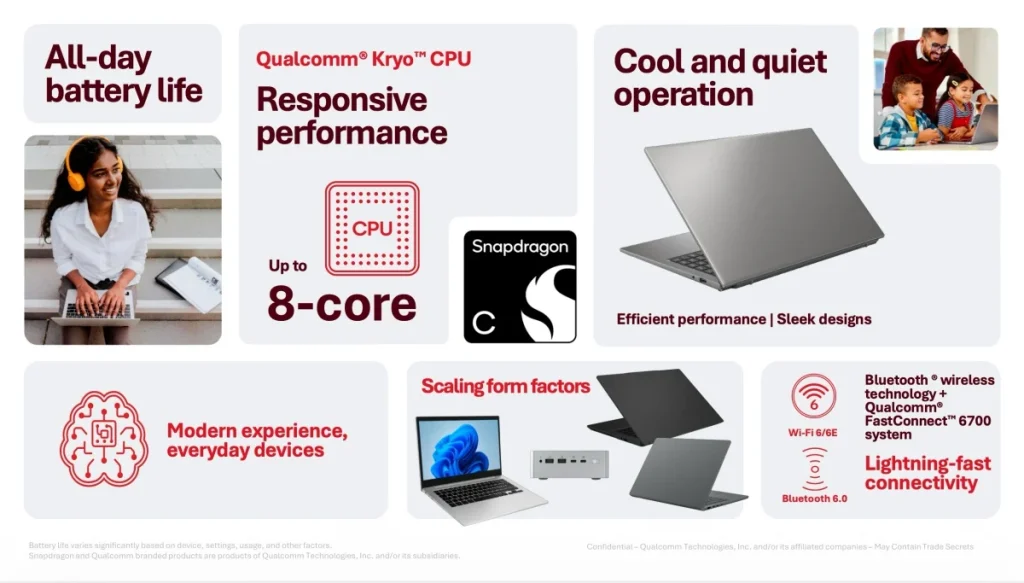
At COMPUTEX 2026, Qualcomm officially unveiled its new Snapdragon C computing platform, purpose-built for entry-level Windows laptops. The platform targets students, families, small businesses, and frontline workers, aiming to redefine the baseline laptop experience through exceptional battery longevity and a cool, silent design. As the specific details of this platform came to light, it became clear that many of its specifications actually resemble those built for smartphones – a notably different design philosophy from the Snapdragon X series.
Acer Leads the Launch With the Aspire Go 15
The first product to adopt this platform is Acer’s budget-friendly Aspire Go 15 laptop. Through this device’s unveiling, Qualcomm signaled its aggressive intent to capture the $300 laptop price segment, while simultaneously preparing to compete against Apple’s education-focused MacBook Neo.
Beyond Acer, Qualcomm has also indicated that ASUS, HP, and Lenovo will each release laptop models built on the Snapdragon C platform, with announcements expected as early as IFA 2026 or shortly thereafter.
Tackling Entry-Level Pain Points: Performance Meets Endurance
Entry-level Windows laptops in the $300 price bracket have historically carried a reputation for sluggish performance, short battery life, and a tendency to run hot. The Snapdragon C platform sets out to break that pattern. According to Qualcomm’s official figures, Snapdragon C features an eight-core Qualcomm Kryo CPU built on a 6nm process, reaching clock speeds of up to 3.0 GHz.
Unlike the Snapdragon X series, which fully transitioned to the Oryon architecture following Qualcomm’s acquisition of NUVIA, Snapdragon C retains the semi-custom Kryo architecture historically built for smartphones. This positions it somewhat similarly to the earlier Snapdragon 7C, though Snapdragon C pushes clock speeds further to a maximum of 3.0 GHz while being manufactured on a 6nm process.
In comparisons against the similarly positioned Intel N250, Snapdragon C delivers up to 67% better battery performance under unplugged conditions. In multi-core processing benchmarks (Geekbench MT), it achieves a performance gain exceeding 24%, and in Cinebench multi-core testing, it runs as much as 67% faster.
Perhaps more importantly, Snapdragon C offers a power efficiency advantage of up to 2.1 times that of its rival – not only securing all-day battery life, but also enabling OEM manufacturers to design fanless laptops that remain both thin and silent.
Flexible Memory Support Addresses Rising RAM Costs
Entering 2026, the PC industry faces a significant challenge: sharply rising memory prices. For entry-level laptops built around a $300 budget, controlling the bill of materials (BOM) cost has become critical. Qualcomm’s approach to memory support in Snapdragon C reflects considerable market awareness.
The platform supports not only the current mainstream LPDDR5/LPDDR5x standard, offering transfer speeds up to 6400 MT/s, but also maintains backward compatibility with the more affordable LPDDR4x standard, running at 4200 MT/s. This dual-track design gives brands like Acer the flexibility to configure hardware specifications for the Aspire Go 15 according to prevailing memory prices, effectively absorbing the cost impact of rising memory prices without sacrificing processor core performance.
Additionally, Snapdragon C’s built-in Qualcomm Hexagon NPU delivers modern AI computing capability, enabling more efficient system resource allocation. Even under constrained memory capacity, the platform maintains a smooth experience for document editing and web browsing.
Positioning Against Apple’s MacBook Neo
In recent years, Apple has aggressively pushed its specifications downmarket to expand into the education and entry-level segments. The MacBook Neo, released earlier this year, poses a considerable threat to the Windows camp. Leveraging Apple Silicon’s low power consumption and extended battery life, the MacBook Neo has squeezed traditional x86-based entry-level laptops out of significant market share.
Qualcomm’s Snapdragon C represents the Windows ecosystem’s strongest weapon in this fight back. By incorporating Wi-Fi 6/6E and the latest Bluetooth 6.0 connectivity, alongside robust hardware video decoding capable of supporting up to 4K 60FPS playback, Snapdragon C brings an “always connected, instant wake” experience – previously reserved for premium devices – down to the $300 price point. This allows Acer’s Aspire Go 15 to maintain a decisive price-to-performance advantage against the MacBook Neo, while matching it in portability and battery endurance, helping Microsoft and its OEM partners defend their market share in education and frontline-worker segments.
Analysis
The launch of the Snapdragon C platform represents more than Qualcomm extending its Arm architecture advantage down into entry-level products – it also serves as a meaningful remedy for the pain points currently plaguing budget PCs. Facing the dual pressures of elevated memory costs and fierce competitive encroachment, Snapdragon C’s flexible specification support and outstanding power efficiency stand ready to inject fresh momentum into this year’s affordable laptop market.
Support Our Threat Intelligence
Find our tech and OS security coverage helpful? Support our work today and unlock a 100% ad-free reading experience!
 Buy Me a Coffee
