 Do Son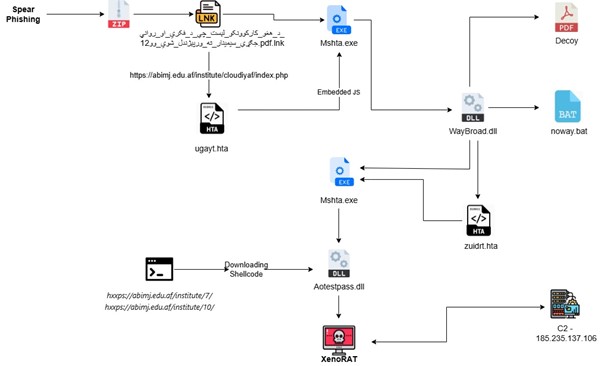
Infection Chain | Image: Seqrite Labs
Security researchers recently uncovered a highly targeted cyber espionage campaign sweeping across South Asia. Specifically, Seqrite Labs identified a sophisticated SideCopy XenoRAT malware attack focused directly on government networks. The malicious operation explicitly leverages precise localized lures to compromise sensitive endpoints. Furthermore, investigators have traced this cyber threat block back to a well-known regional state-sponsored threat cluster. Consequently, government networks must instantly elevate their defensive posture to combat these persistent intrusions.
Unmasking the Target Infrastructure
To begin with, the advanced persistent threat group behind this operation possesses a long tracking record. Analysts attribute the campaign to the SideCopy APT cluster with medium-to-high confidence. This specific collective operates under the broader Transparent Tribe umbrella. Historically, the Pakistan-linked group focuses heavily on geographic targets across neighboring territories. In this latest instance, their infrastructure targets the Afghan Ministry of Finance. Therefore, the campaign highlights a clear geopolitical motive centered on systemic surveillance.
The Initial Phishing Delivery Vector
The complex intrusion sequence initiates through a tailored spear-phishing email delivery path. This electronic mail contains a compressed archive enclosing a fraudulent shortcut file. To maximize execution success, the attackers crafted a Pashto-language filename to mislead local recipients. Specifically, the shortcut translates as a “List of Employees Who Were Introduced to the Intellectual and Psychological Warfare Seminar”. Because Pashto represents the dominant regional language, the bait appeared entirely authentic. Consequently, unsuspecting provincial finance officials clicked the attachment.
Executing Fileless Code Patterns
Once a victim runs the shortcut file, the asset executes a stealthy fileless routine. Instead of dropping a binary immediately, the shortcut covertly launches the native Windows command tool mshta.exe. This legitimate system binary fetches an externally hosted hypertext application file from a compromised domain. According to the technical report, “the command embedded within the shortcut points to a remote malicious PHP resource hosted over HTTPS”. By abusing these trusted components, the campaign easily slips past traditional endpoint software. Furthermore, this strategic evasion tactic significantly complicates automated behavioral analysis.
Memory Reconstruction Architectures
Subsequently, the remote web application processes a heavily obfuscated JavaScript payload within the host memory space. The loader script implements a custom Base64 decoding routine to hide its downstream modules. Next, the program pieces together a malicious dynamic link library by leveraging multiple advanced .NET components. Specifically, the malware handles this payload reconstruction phase strictly within volatile memory. “This staged approach is commonly used in fileless malware because it allows attackers to prepare malicious .NET objects for execution while minimizing forensic artifacts”. Consequently, traditional hard drive checks fail to spot the unauthorized software.
Exploiting Detailed Decoy Material
To distract the target, the loader script concurrently delivers a realistic decoy document to the screen. The dropped item consists of an actual provincial staff directory belonging to the Afghan Ministry of Finance. This document compiles extensive organizational details, listing active revenue chiefs and finance secretaries across all provinces. In addition, the file contains the personal mobile numbers of these public employees written in Dari and Pashto. Therefore, while the victim reviews what appears to be a routine government record, the underlying malware silently finalizes its local installation. This level of detail indicates that the threat actors conducted thorough prior reconnaissance.
Deploying Persistent Access Modules
In the final phase, the infection chain deploys its primary threat payload onto the compromised workstation. To begin with, security experts verified that this SideCopy XenoRAT malware attack drops an open-source remote control utility. To ensure a long-term presence, the software establishes automated registry execution keys that masquerade as legitimate Windows applications. Subsequently, once fully initialized, the backdoor implants open a persistent command channel back to the malicious operators. This outgoing data stream targets a dedicated server node located at internet protocol destination 185.235.137.106. However, the threat actors deliberately choose to stage this infrastructure on European servers to hide their origin.
Operational Summary
Ultimately, the security research team summarized the strategic mechanics of this operation under a distinctive title. Analysts coined the name Operation XENOFISCAL to capture both the tool and the target landscape. As emphasized in the brief, “Together they form a single codename that captures both the weapon and the victim in one word”. This aggressive pairing underscores the growing danger of highly tailored national identity profiling in modern cyber operations. Therefore, system administrators must implement rigid validation checks on all incoming shortcut scripts to protect administrative infrastructure.
Support Our Threat Intelligence
Find our threat intelligence and malware analysis helpful? Support our work today and unlock a 100% ad-free reading experience!
 Buy Me a Coffee
