 Do Son
The Rising Threat of TA4922
A prominent cybersecurity research group recently exposed a highly active threat cluster executing advanced financial attacks. A detailed Proofpoint cybercrime analysis has illuminated the rapid expansion of a Chinese-speaking threat group designated as TA4922. This group displays an exceptionally high operational tempo. Furthermore, the threat actors constantly update their malicious software arsenal to bypass modern enterprise defenses. Security teams worldwide are now tracking numerous TA4922 malware campaigns that target critical business sectors.
Geographic Footprint and Targeting Strategies
Historically, this malicious actor focused its efforts primarily on regional targets within East Asia. For example, organizations in Japan, Taiwan, and India faced frequent waves of malicious emails. However, the group has dramatically broadened its operational horizons over the past few months. According to researchers, the group’s activity has recently spread to countries across Europe and Africa. Specifically, corporate networks in the United Kingdom, Germany, Italy, and South Africa have suffered recent attacks.
Notably, the threat actors use highly regionalized social engineering lures to deceive their victims. These messages commonly impersonate local tax authorities, corporate finance departments, or human resources teams. To maximize success, the operators write these deceptive lures to closely match specific local language norms. Therefore, victims rarely notice any grammatical red flags or strange phrasing. Consequently, the campaigns achieve very high infection rates across diverse geographic regions.
Advanced Social Engineering and Out-of-Band Shifts
In addition to traditional email delivery, the group relies on a clever communication manipulation tactic. They actively try to shift their interactions away from monitored corporate channels. Specifically, the phishing emails instruct recipients to migrate conversations to messaging platforms like LINE, WhatsApp, or Microsoft Teams. For example, one campaign instructed Japanese recipients to create an entirely new corporate chat group.
Once the communication moves to these alternative platforms, the security visibility changes significantly. The report text explains the primary advantage for the threat actors:
“Once communication moves to those platforms, the actor is better positioned to extend social engineering, harvest contact information, or deliver malware beyond traditional email security visibility.”
Thus, out-of-band platforms allow the hackers to operate safely outside the boundary of automated email gateway scanning tools.
Dissecting the Evolving Malware Arsenal
RomulusLoader: Legitimate App Masquerading
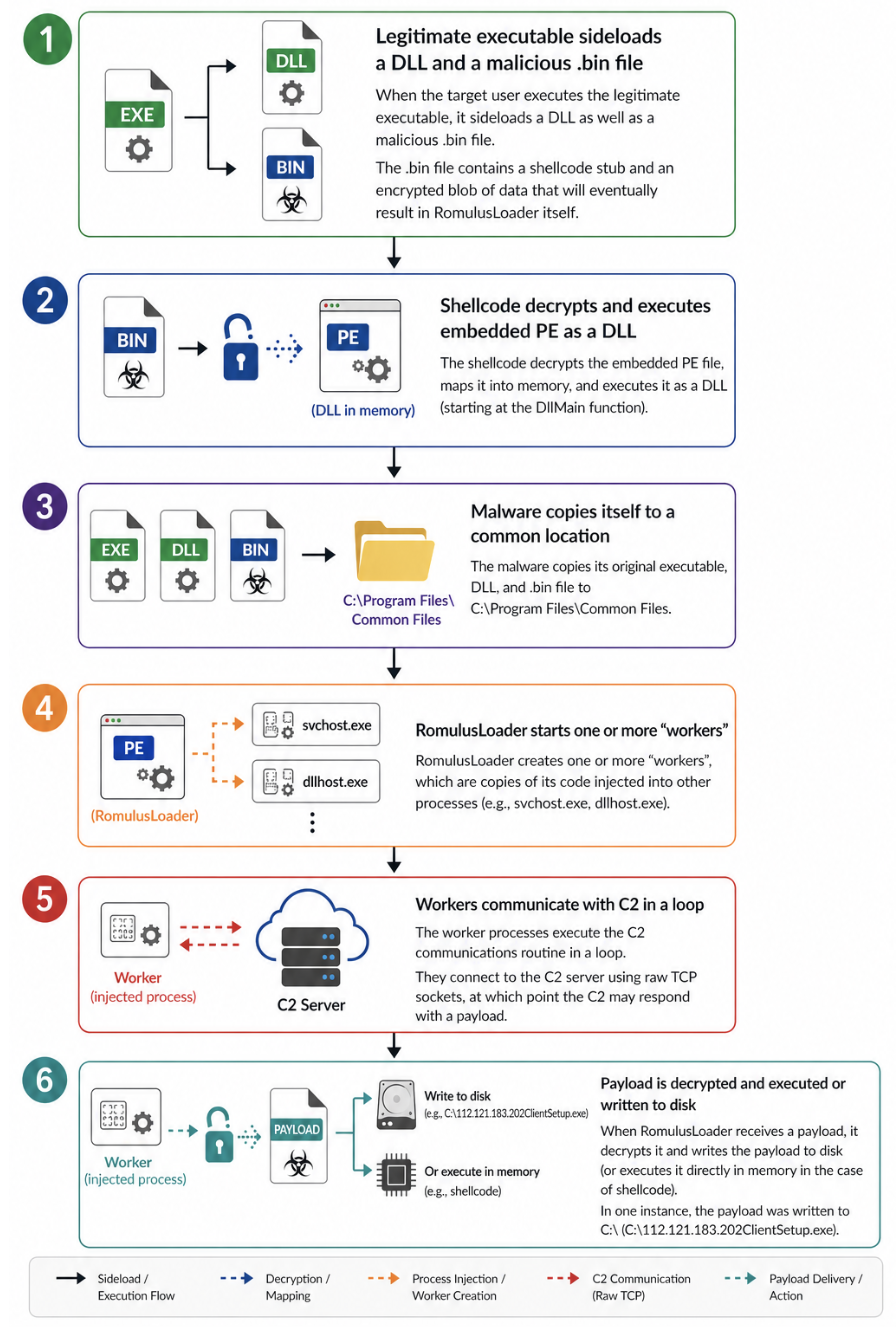
To establish a firm foothold inside compromised systems, the group deploys newly developed loader utilities. One standout tool in recent TA4922 malware campaigns is RomulusLoader, a unique utility written in C. This program downloads and executes subsequent payloads from command and control servers. To avoid detection, the loader masquerades as legitimate system components. For instance, analysts found variants mimicking the Vulkan Graphics API or AnyDesk software utilities.
When an unsuspecting user opens the parent program, it silently side-loads a malicious companion library. This library executes a shellcode stub that maps the core malware directly into system memory. Furthermore, RomulusLoader copies its operational files into common system directories to ensure long-term persistence. It then injects its code into legitimate host processes like svchost.exe or dllhost.exe. This process hollowing routine effectively masks the attacker’s ongoing network activities from basic endpoint defenses.
SilentRunLoader: AI-Assisted Malware Creation
Another alarming component of the group’s toolkit is a compiled Python utility called SilentRunLoader. This stealthy program is designed to gather sensitive browser data from local machines. Specifically, it harvests saved credentials, session cookies, and local browsing histories directly from Google Chrome. It then packs these data files into a zip archive and uploads them to a remote server.
Intriguingly, the code for this data stealer contains several strange, unconfigured attributes. For example, investigators found a generic placeholder key left completely unchanged in the main configuration script. As highlighted in the report:
“Given the comments, strings, and unchanged, hardcoded constants in the code, we assess with high confidence that this group is likely using LLM’s to rapidly develop new Python-based malware.”
Therefore, security experts believe that the group is using artificial intelligence to “vibe-code” unique malware variants at a blistering pace.
Atlas RAT: Comprehensive Surveillance
For high-value targets, the threat group deploys Atlas RAT, a full-featured modular backdoor trojan. This advanced payload can harvest broad system specifications and execute arbitrary commands. Furthermore, it features dangerous spying capabilities. For example, the tool can record surrounding audio, capture webcam feeds, log keystrokes, and steal clipboard data.
Before activating these features, the backdoor runs several complex environmental checks. It verifies whether the host environment belongs to an automated analysis sandbox. Specifically, it checks for built-in sandbox names like WDAGUtilityAccount or virtualization flags like mshome. If the environment appears unsafe, the malware instantly terminates its execution to evade signature generation.
Winos4.0: Evasion via Code Bloat
Finally, this Proofpoint cybercrime analysis notes that the threat group continues to abuse the open-source Winos4.0 framework. In early 2026, researchers spotted a heavily modified variant featuring a massive codebase expansion. Specifically, the newer file sample was 71 times larger than standard historical iterations.
The threat actors intentionally padded the file structure with massive amounts of artificial junk code. Consequently, basic endpoint perimeter scanners struggle to process the bloated file efficiently. This simple trick allows the malicious application to sit undetected on endpoints for extended periods.
Summary of Operational Impacts
Ultimately, this adversary group presents an expanding danger to multinational corporations and government agencies. According to current tracker metrics, the actor now conducts more unique malicious campaigns than any other tracked cybercrime group. Although the group’s primary motivations appear financial, the extensive surveillance capabilities of their malware remain deeply concerning. Therefore, corporate IT departments must implement strict directory restrictions, enforce application allowlisting, and monitor unusual outbound ports to stop this fast-moving threat.
Support Our Threat Intelligence
Find our threat intelligence and malware analysis helpful? Support our work today and unlock a 100% ad-free reading experience!
 Buy Me a Coffee
