Skip to content
September 20, 2026
  • Bluesky
  • Facebook
  • Linkedin
  • Mastodon
  • RSS
  • Twitter
  • Youtube

Daily CyberSecurity

Zero-hour alerts. Unmatched analysis.

Primary Menu
  • Home
  • CVE Data
    • CVE Watchtower
    • Top Exploited CVEs
    • CVE Stats by Vendor
    • Q2 2026 Report
    • CVE Alerts
    • CVE Alert Settings
    • Pricing
  • Cyber Criminals
  • Data Leak
  • Free Tools
    • CVSS 3.1 Calculator
    • Certificate Viewer
    • DNS Lookup
    • Encoder & Hash Generator
    • IP / Subnet Calculator
    • Whois Lookup
  • Linux
  • Malware
  • Vulnerability
  • Submit Press Release
  • Weekly Recap
Light/Dark Button
  • Home
  • News
  • Malware
  • TeamTNT’s “Docker Gatling Gun” Campaign Targets Exposed Cloud Environments with New Sliver Malware
  • Cyber Security
  • Malware

TeamTNT’s “Docker Gatling Gun” Campaign Targets Exposed Cloud Environments with New Sliver Malware

Do Son October 28, 2024 3 minutes read
TeamTNT - Docker Gatling Gun

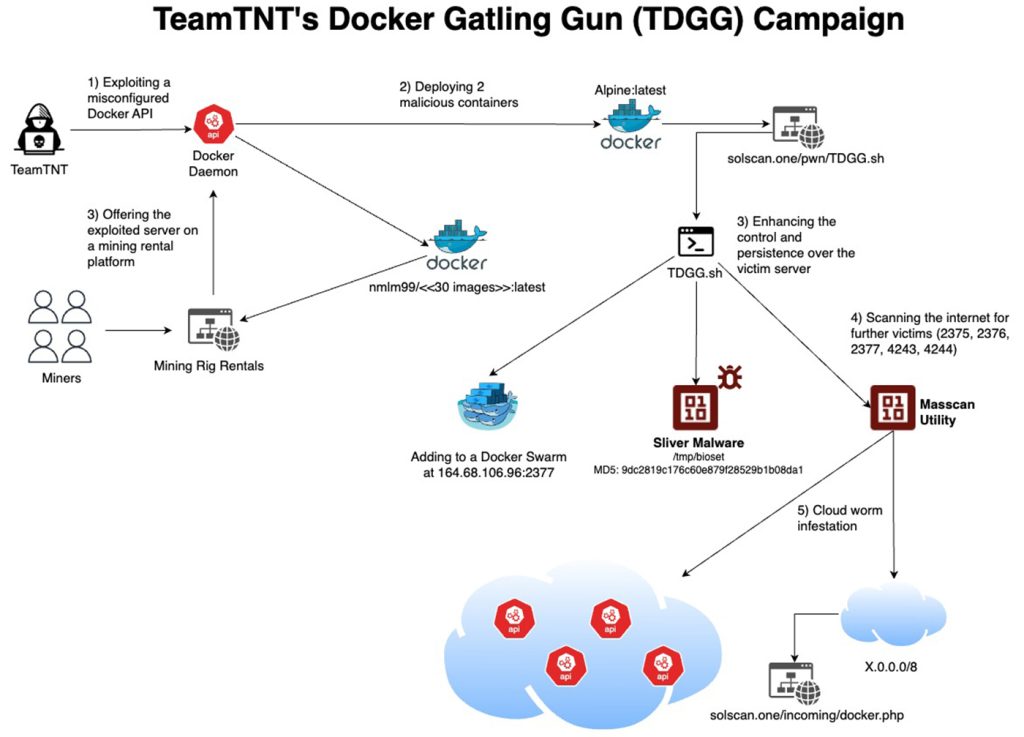
The entire attack flow | Image: Aqua Nautilus

Add Daily CyberSecurity as a preferred source on Google

A new report from Aqua Nautilus, led by Assaf Morag, Director of Threat Intelligence, has revealed a large-scale campaign by the notorious hacking group TeamTNT, known as the “Docker Gatling Gun.” TeamTNT, which previously abandoned some of its attack strategies, has returned with a renewed focus on exposed Docker environments, leveraging them to deploy cryptominers, malware, and even sell compromised computing power to third parties.

In this campaign, TeamTNT uses “native capabilities in cloud environments by appending compromised Docker instances to a Docker Swarm,” facilitating malware deployment through shared resources. They have also introduced the powerful Sliver malware, an upgrade from their previous Tsunami backdoor, which enables advanced Command and Control (C2) capabilities over multiple protocols like HTTPS and DNS.

The report describes TeamTNT’s attack flow as methodical and multifaceted. The group begins by scanning for exposed Docker daemons on ports 2375, 2376, 4243, and 4244, using a custom attack script dubbed “Docker Gatling Gun” that targets up to 16.7 million IP addresses. Once access is gained, they deploy an initial script, TDGGinit.sh, from Docker Hub, which “executes an Alpine Linux image with malicious commands,” thus taking over the Docker instance.

From here, TeamTNT incorporates multiple malicious techniques that reflect their campaign’s overall goals:

  1. Resource Hijacking: After compromising a system, they either install cryptomining software or rent out the victim’s computational power, generating revenue without needing to manage cryptomining infrastructure.
  2. C2 with Sliver Malware: Sliver replaces the less stealthy Tsunami malware, adding encryption and multi-protocol support for C2 channels, which makes it harder for defenders to detect. Sliver’s implants support Command and Control (C2) over multiple protocols, including mTLS, WireGuard, HTTP(S), and DNS
  3. Lateral Movement and Persistence: By exploiting local networks, TeamTNT spreads its infection across additional Docker instances within the same infrastructure, integrating these compromised nodes into a Docker Swarm for seamless control.
  4. Credential Theft and Misconfigurations: The report notes that TeamTNT actively searches for misconfigured files, such as SSH and cloud service credentials, storing these details to spread malware through unsecured accounts. As TeamTNT expands its infrastructure, it gains persistent access and deeper control over targeted environments.

TeamTNT also resorts to a familiar tactic—leveraging Docker Hub as a storage and distribution hub for malicious images. The report indicates that TeamTNT compromised a Docker Hub account, “uploading around 30 images, divided into infrastructure and impact images,” which allows them to target victims with ease and scale their campaign effectively. In another sign of persistence, they have revived their former domain, teamtnt.red, and registered new malicious domains to support their campaign’s resurgence.

Given the scale and sophistication of TeamTNT’s latest operations, Aqua Nautilus advises organizations to secure Docker environments rigorously. Recommendations include:

  • Restricting Docker daemon access to prevent unauthorized connections.
  • Regularly monitoring Docker Hub for suspicious or unusual activity.
  • Enforcing multi-factor authentication and privileged access controls to reduce exposure.

Related Posts:

  • Multiple Vulnerabilities in Logitech Harmony Hub allow the hacker to gain root access

Related coverage

  • Menorah Malware: APT34’s Latest Cyberweapon Unmasked by Trend Micro
  • Ddostf DDoS Bot Exploits Vulnerabilities: MySQL Servers at Risk
  • Ransomware Gangs’ New Tactic: Weaponizing Legitimate Entities
Track all actively exploited CVEs →

Support Our Threat Intelligence

Find our threat intelligence and malware analysis helpful? Support our work today and unlock a 100% ad-free reading experience!

Buy Me a Coffee Logo Buy Me a Coffee
Select your plan
Free Pro Team

Hover over a plan to see its benefits.

Get Zero-Hour Vulnerability Alerts

Critical CVEs, CVSS scores, and PoC updates — straight to your inbox every week.

We respect your inbox. Unsubscribe anytime.

SHARE
Share on FacebookShare on XShare on LinkedInShare on TelegramShare on BlueskyShare on Mastodon
Written by
@DdoS · Security Researcher

Do Son

Do Son is the Founder and Editor of SecurityOnline.info. Working in cybersecurity since 2013, he reports on vulnerabilities, malware, and emerging threats, providing timely analysis to help organizations and individuals stay ahead of evolving risks.

Tags: Docker Gatling Gun TeamTNT

Search

Translation

CVE ALERTS
📧

Email Delivery
Get threat intel straight to your inbox.

♾️

Unlimited Vendors
Track every technology in your stack.

🚨

All New CVE Alerts
Be the first to know about new flaws.

⚙️

Custom EPSS Threshold
Filter noise, focus on real risks.

💬

Slack & Teams Webhook
Integrate directly into your SecOps.

🚫

100% Ad-Free
Enjoy an uninterrupted reading experience.

$7/mo
Subscribe Now

🚨 Active Exploits in the Wild

  • CVE-2026-58138CVSS 9.8
    Orkes Conductor 3.21.21 before 3.30.2 contains an unauthenticated remote code execution vulnerability that allows remote attackers to execute...
    Admin intel📅 Updated: Sep 20, 2026
  • CVE-2026-86124CVSS 9.8
    AutoAgent contains an unauthenticated remote code execution vulnerability in the TCP server that binds to all interfaces and...
    Admin intel📅 Updated: Sep 19, 2026
  • CVE-2025-39682CVSS 9.8
    In the Linux kernel, the following vulnerability has been resolved: tls: fix handling of zero-length records on the...
    CISA KEV📅 Added to KEV: Sep 18, 2026
  • CVE-2025-39964CVSS 7.8
    In the Linux kernel, the following vulnerability has been resolved: crypto: af_alg - Disallow concurrent writes in af_alg_sendmsg...
    CISA KEV📅 Added to KEV: Sep 18, 2026
  • CVE-2026-53266CVSS 8.8
    In the Linux kernel, the following vulnerability has been resolved: netfilter: bridge: make ebt_snat ARP rewrite writable The...
    CISA KEV📅 Added to KEV: Sep 18, 2026
  • CVE-2026-76460CVSS 10.0
    A vulnerability in an API of Cisco Identity Services Engine (ISE) could allow an unauthenticated, remote attacker to...
    Admin intelCISA KEV📅 Added to KEV: Sep 16, 2026📅 Updated: Sep 16, 2026
  • CVE-2026-89026CVSS 9.8
    The Issabel Framework, the web framework supporting Issabel PBX software, before commit b97dbaf contains a hard-coded HS256 JWT...
    Admin intel📅 Updated: Sep 16, 2026
  • CVE-2026-58704
    In Cellular Modem, there is a possible permission bypass due to a logic error in the code. This...
    Admin intelCISA KEV📅 Added to KEV: Sep 16, 2026📅 Updated: Sep 16, 2026
Powered by CVE Watchtower

Critical Vulnerabilities

  • CVE-2026-58138CVSS 9.8
    Orkes Conductor 3.21.21 before 3.30.2 contains an unauthenticated remote code execution vulnerability that allows remote attackers to execute...
    Admin intel📅 Updated: Sep 20, 2026
  • CVE-2026-90817CVSS 9.8
    An unauthenticated Remote Code Execution vulnerability was found in the survey passthrough routing and Data Import processing logic,...
    📅 Updated: Sep 20, 2026
  • CVE-2026-94003CVSS 10.0
    A vulnerability has been found in Comfast CF-N1-S 2.6.0.1. Impacted is the function get_css_path_from_uri of the file /cgi-bin/mbox-config...
    📅 Updated: Sep 20, 2026
  • CVE-2026-94084CVSS 9.4
    Suricata before 8.0.7 has an Http2ThreadMultiBuf use-after-free when a transaction is inspected by rules that use http.response_header with...
    📅 Updated: Sep 20, 2026
  • CVE-2026-94083CVSS 9.4
    Suricata before 8.0.7 has a DoH2 type confusion that can cause an invalid free, because cleanup code for...
    📅 Updated: Sep 20, 2026
  • CVE-2026-93958CVSS 9.1
    A vulnerability was found in D-Link R95 BE9500_1.00.16. This vulnerability affects the function system of the file /bin/ssi...
    📅 Updated: Sep 20, 2026
  • CVE-2026-76672CVSS 9.9
    A vulnerability exists in the SD-WAN Orchestrator that may lead to the exposure of sensitive configuration information. An...
    📅 Updated: Sep 20, 2026
  • CVE-2026-39919CVSS 9.8
    Ghostscript before 10.08.0 contains a heap-based buffer overflow vulnerability in the JPEG 2000 output adapter (base/sjpx_openjpeg.c) that allows...
    📅 Updated: Sep 20, 2026
Powered by CVE Watchtower

Daily CyberSecurity

  • About SecurityOnline.info
  • Advertise with us
  • Announcement
  • Contact
  • Contributor Register
  • Login
  • Disclaimer
  • DCMA
  • Privacy Policy
  • About SecurityOnline.info
  • Advertise on SecurityOnline.info
  • Contact Us

When you purchase through links on our site, we may earn an affiliate commission. Here’s how it works

  • CVE Watchtower
  • CVE Statistics by Vendor 2026
  • Q2 2026 Report
  • Top Exploited CVEs
  • Bluesky
  • Facebook
  • Linkedin
  • Mastodon
  • RSS
  • Twitter
  • Youtube
© 2017 - 2026 Daily CyberSecurity. All Rights Reserved.