 Do Son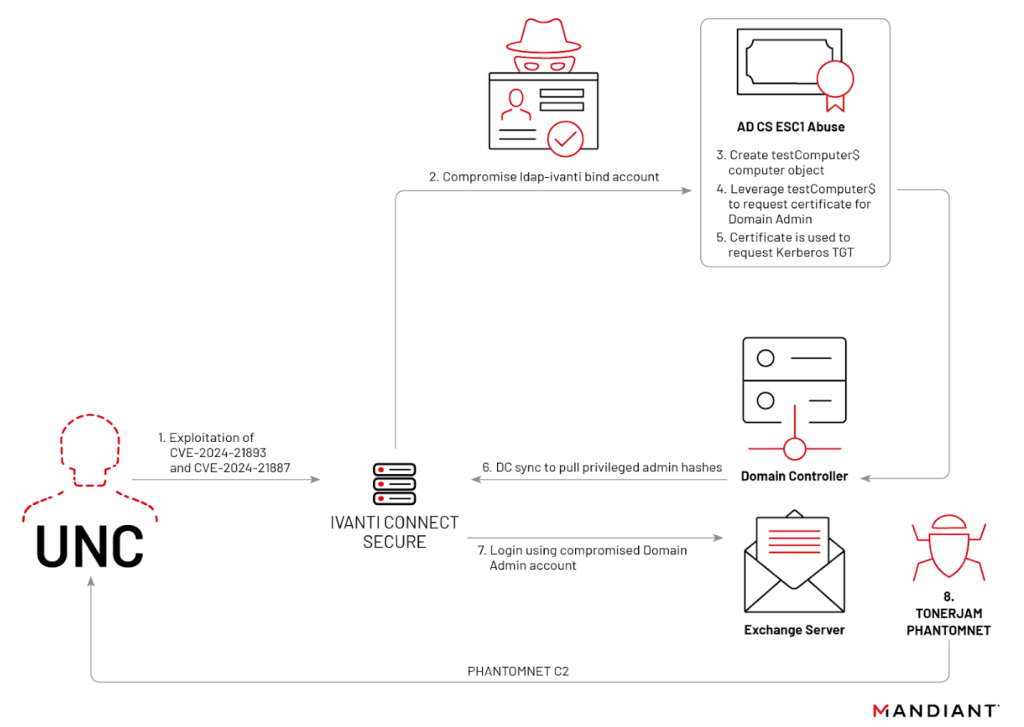
UNC5330 attack path diagram | Image: Google
A sophisticated cyber espionage operation has compromised several enterprise networks by targeting unguarded edge devices. Security investigators recently exposed the sneaky mechanics of an ongoing VerdantBamboo malware campaign. This Chinese advanced persistent threat group systematically infiltrates specialized file storage and firewall platforms. Consequently, the threat actors can monitor data traffic and maintain long-term access without triggering internal alerts. Security managers must scrutinize their unmonitored hardware systems immediately to neutralize this threat.
According to a Volexity threat report, the initial intrusion came to light after analysts noticed anomalous outbound traffic. The compromised virtual machine was running an on-premise Egnyte Storage Sync system. Instead of connecting to trusted domains, the server was quietly beaconing to an attacker-controlled infrastructure behind proxy walls. Furthermore, the malicious actors used these connections to infiltrate cloud environments. As noted in the official forensic analysis:
“The initial findings determined that the threat actor used the malware’s proxying capabilities deployed on the Storage Sync system, along with compromised credentials, to access the victim’s Microsoft 365 (M365) environment.”
Therefore, the attackers successfully bypassed strict cloud policies by blending into normal day-to-day operations.
The Infiltration of Edge Appliances
Exploiting Local Privilege Escalation
The threat group originally gained access to the storage device by using stolen local credentials via secure shell sessions. However, the intruders quickly escalated their authority to gain full root capabilities. Specifically, they uncovered an insecure sudo configuration entry that allowed them to execute custom commands. By abusing the system utilities, the operators could arbitrarily write malicious files to any directory on the local disk. Instead of establishing permanent system files, they manually launched their primary backdoor whenever they needed access. Consequently, static file scanners failed to notice the implant during routine reviews.
Implementing Backup Access Channels
Additionally, the attackers deployed a fallback command channel to maintain access if their primary toolkit stopped working. To achieve this goal, the operators altered the native system schedule files. They added an automated task to run a basic script on a monthly cadence. Volexity tracks this specific python-based backup utility under the name AGENTPSD. This utility would execute a reverse shell if the primary framework vanished. Thus, the VerdantBamboo malware campaign maintained its invisible foothold for over eighteen months before discovery.
The Compromise of the Supply Chain
Breaching the Managed Service Provider
During the investigation, the team discovered that the threat actor had also compromised the organization’s third-party Managed Services Provider. Consequently, researchers shifted their focus to examine the provider’s defensive perimeter. They quickly found that the provider’s core pfSense firewall was heavily infected with a custom backdoor. This firewall implant was a specialized Unix variant designed explicitly to run on FreeBSD architectures. Furthermore, the attacker established permanent persistence by modifying the firewall’s default startup configurations.
Bypassing Perimeter Mitigations
Even after the security team isolated the infected sync servers, the threat group managed to return. Specifically, the network administrators had taken the corporate virtual private network offline for safety. However, this action accidentally exposed the main firewall administration interface directly to the open internet. Because the exposed interface lacked multi-factor authentication, the hackers connected easily using stolen administrative credentials. Once inside, they configured a brand-new virtual network tunnel to re-establish entry. Next, they moved laterally across the network to deploy a new payload onto an internal storage appliance.
Advanced Malware Architecture and Evasion
The Compilation Tricks of PLENET
The secondary implant on the internal storage systems represents a highly sophisticated evolution in malware development. Specifically, developers engineered this tool, tracked under the name PLENET, using the modern .NET Core framework. Furthermore, the authors compiled the binary into native machine code using advanced ahead-of-time technologies. This approach embeds all necessary runtime libraries into one single, massive standalone file. Because standard analysis tools struggle to parse this runtime, reverse-engineering the logic becomes extremely difficult. Therefore, the group successfully used this evasion strategy to mask their malicious functions from deep inspection.
Summary of Strategic Impacts
Ultimately, this VerdantBamboo malware campaign shows how modern threat actors systematically avoid standard endpoint detection systems. They focus their energy entirely on proprietary appliances that cannot run advanced logging agents. As this Volexity threat report explicitly concludes:
“VerdantBamboo is a highly sophisticated threat actor that seeks to leverage a combination of living-off-the-land techniques and malware deployment on systems that traditionally do not or cannot run EDR software.”
To defend against these tactics, organizations must enforce multi-factor authentication across all administrative dashboards. Additionally, network teams must isolate proprietary devices behind strict firewalls to block unauthorized command channels. Continuous inspection of outbound traffic remains vital to intercepting hidden edge intrusions.
Support Our Threat Intelligence
Find our threat intelligence and malware analysis helpful? Support our work today and unlock a 100% ad-free reading experience!
 Buy Me a Coffee
