 Do Son
Cybersecurity researchers from CYBERNEWS recently published a report disclosing a serious security issue uncovered in Tencent Cloud, caused by a severe misconfiguration that exposed sensitive credentials and internal source code environments to the public internet.
These exposed assets could have granted attackers full access to Tencent Cloud’s internal services and backend infrastructure. The leaked data, tied to both testing and production environments, was left publicly accessible and at risk of being harvested by automated bots—potentially triggering a major data breach.
The incident did not directly affect Tencent Cloud customers—their account credentials and other personal data remain secure. However, researchers expressed concern that attackers could exploit the leaked internal service data to launch broader attacks, thereby amplifying the potential impact.
Affected services included Tencent Cloud’s internally used load balancers as well as deployments of JEECG, an open-source development platform promoted by Tencent Cloud. The exposed files contained hard-coded plaintext passwords, sensitive internal .git directories, and other exploitable information.
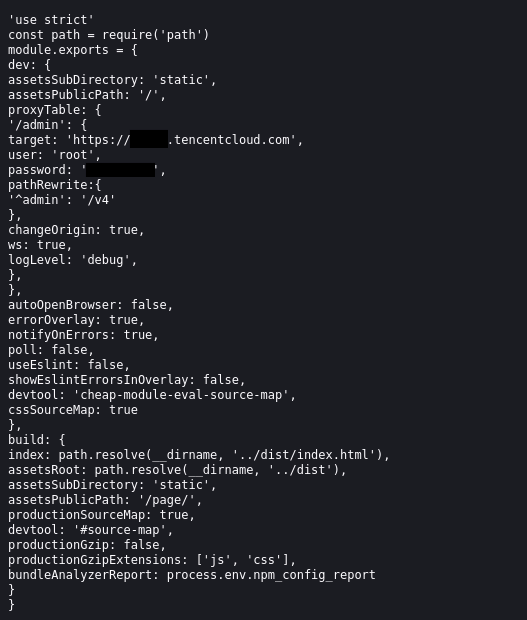
According to CYBERNEWS researchers, if attackers had obtained this data, they could have leveraged the passwords to gain direct access to Tencent Cloud’s management console, and potentially used the exposed credentials to assume full control of backend infrastructure and internal services.
Upon discovery, the researchers promptly reported the issue to Tencent Cloud, which acknowledged the problem but noted that it had already been flagged by other researchers. Tencent Cloud confirmed that corrective measures had since been implemented to remediate the vulnerability.
CYBERNEWS explained that the misconfiguration was first detected during an internet-wide scan for improperly configured servers in late July 2025. Historical evidence suggests the servers had been publicly exposed since at least April 2025—meaning the data may have remained vulnerable for several months prior to remediation.
Update on August 29:
Tencent Cloud’s security team clarified that the supposed misconfiguration or vulnerability was not a flaw in a production system, but rather an intentionally deployed honeypot, designed for security research and defensive purposes. The honeypot contained no real user data.
Honeypots are a common practice among large technology companies, serving as decoy environments to lure attackers. The term itself derives from the way bears are drawn to honey. By deploying realistic traps, companies entice hackers into controlled zones, where their actions can be closely monitored and recorded.
Every move made by intruders inside a honeypot—including attempted exploits—is observed and logged, allowing security teams to study attacker behavior and refine targeted defensive strategies.
Tencent Cloud’s security team added that most honeypots are time-limited experiments, and the one highlighted in this case has already been decommissioned. They also acknowledged that part of the confusion stemmed from a communication gap with CYBERNEWS: had the researchers been promptly informed that this was a honeypot, the incident would never have escalated into such a public misunderstanding.
A Tencent spokesperson said:
“The reports are incorrect. No user data was exposed and no business operations were ever put at risk. The system referenced was an intentionally deployed honeypot, which is a time-limited security measure designed and created to test defenses, and it has already been taken offline. This is also a common and standard security practice being used across the industry.”
Related Posts:
- Hacker Leaks 1.4 Billion Tencent Records: Mobile, Email, and QQ IDs Exposed
- BMW models have been exposed to security flaws that can be remotely attacked by hackers
- CISA reveals the top ten most common cybersecurity misconfigurations
- Unrestricted Access: A Simple Web Misconfiguration Exposes Critical Data
Support Our Threat Intelligence
Find our threat intelligence and malware analysis helpful? Support our work today and unlock a 100% ad-free reading experience!
 Buy Me a Coffee

Upon verification regarding the aforementioned Tencent Cloud “security vulnerability” issue, our security team would like to provide the following clarification:
The configuration information in question does not constitute a genuine production system vulnerability, but rather a high-interaction honeypot system deployed by Tencent Cloud’s security team for proactive defense and threat monitoring. Such deployments represent common industry practice in cloud security, designed to simulate real environments for the purpose of luring and identifying malicious attacks—thereby enabling early threat detection, enhancing overall security protection capabilities, and better safeguarding customer data and business operations.
This honeypot system did not involve any real user data or business resources, and posed no actual risk. The batch of honeypots utilized for security research has now completed its predetermined mission cycle and has been officially taken offline. We appreciate the attention from all sectors regarding Tencent Cloud’s security practices, and we remain committed to continuously strengthening our security capabilities to provide customers with more reliable services.