 Do Son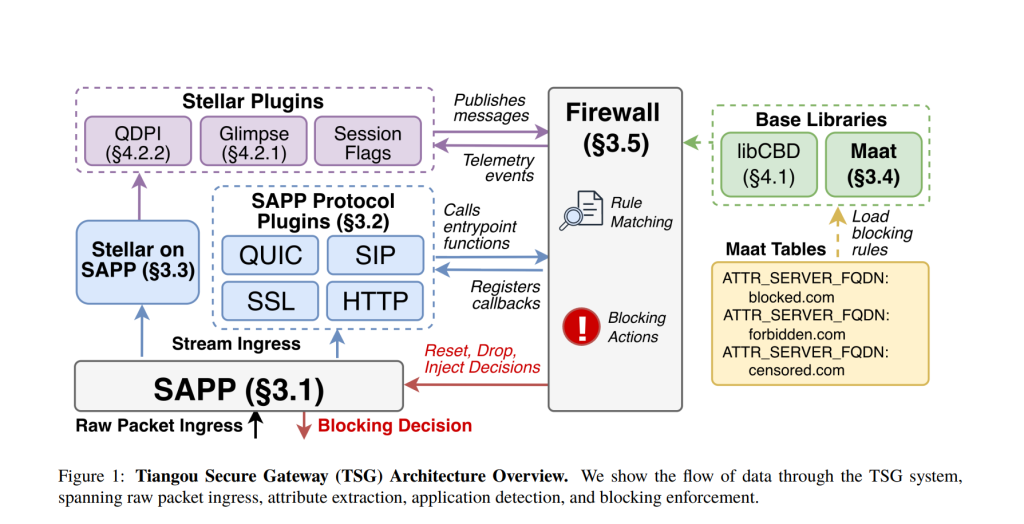
Researchers gathered and successfully ran a commercial internet censorship platform – Tiangou Secure Gateway (TSG) – inside a controlled laboratory environment, relying entirely on leaked source code. The Chinese-developed platform detects VPNs and other circumvention tools, throttles traffic, severs connections, and redirects requests. A comparison against real-world censorship behavior revealed a probable connection between TSG and components of the Great Firewall of China.
A Massive Leak: 100,000 Internal Files From Geedge Networks
In September 2025, more than 100,000 internal files belonging to developer Geedge Networks became publicly accessible. The leaked archive contained source code, internal correspondence, configuration files, over 500 Git repositories, and five years of version history. The researchers behind the study described the leak as the first known source-code disclosure of a commercial deep packet inspection censorship system. A team spanning four universities, working alongside the GFW Report project, reconstructed the most recent release version of TSG from the archive and successfully deployed a working build within an isolated environment.
Geedge Networks and Its Ties to Myanmar, Pakistan, and Ethiopia
Geedge Networks was founded in 2018 by one of the key architects of the Great Firewall of China. Internal materials link TSG to deployments in Myanmar, Pakistan, and Ethiopia, where the company reportedly assisted with implementation, trained local operators, and provided ongoing technical support.
How TSG Detects and Blocks Traffic
TSG parses DNS, TLS, and QUIC protocols, identifies specific applications, and enforces rules configured by its operator. The platform can drop packets outright, issue TCP reset commands, throttle data transmission, and redirect both HTTP and DNS requests. The system also supports user-level tracking at the internet service provider layer.
Its filtering rules take into account IP addresses, domain names, JA3 and JA4 fingerprints, certificate fields, packet length, and specific byte sequences. Among the documented targets were ExpressVPN, NordVPN, Psiphon, Tor, and other circumvention tools. Within Geedge’s internal logs, 21 of 29 documented signatures were assigned the maximum, fifth-tier risk rating.
Two of TSG’s three primary application-recognition modules relied on third-party components. Glimpse used the open-source libprotoident library, while QDPI was built on top of the commercial Qosmos ixEngine.
Internal Jira Tickets Reveal How Customer Requests Shaped Development
Internal Jira tickets reveal how customer requirements directly influenced filter development. A project in Myanmar required TSG to be taught to block Signal specifically when its censorship-circumvention mode was enabled. While testing filtering rules for Psiphon in Ethiopia, developers discovered a risk of mistakenly blocking TikTok, BBC, CNN, and the New York Times, forcing them to add these popular domains to an exclusion list.
The DNS Fingerprint That Links TSG to the Great Firewall
The clearest evidence connecting TSG to the Great Firewall emerged in how the system handles DNS. Within a DNS packet, repeated segments of a domain name can be replaced with compression pointers. TSG successfully parsed a specially crafted query containing a chain of 17 such pointers, but failed to recognize a query containing 18 pointers. This exact same limitation, along with several other response characteristics, was found in one of the known Chinese DNS injection systems.
Two additional Great Firewall components were found to use the value 13 within their algorithm for constructing TCP reset packets – a value that matched TSG’s default configuration exactly. The researchers consider these matching characteristics strong evidence that TSG’s code, or a closely related version of it, is deployed within the Great Firewall’s own infrastructure.
Responsible Disclosure: Access Restricted to Vetted Researchers
The leaked code and the reconstructed working build have not been publicly released, owing to significant ethical concerns. Access will instead be granted on request, limited to responsible researchers and organizations with no connection to the deployment of censorship systems.
Support Our Threat Intelligence
Find our threat intelligence and malware analysis helpful? Support our work today and unlock a 100% ad-free reading experience!
 Buy Me a Coffee
