The Weakest Link: How “Transit Hubs” are Quietly Draining Crypto and Stealing AI Data
 Do Son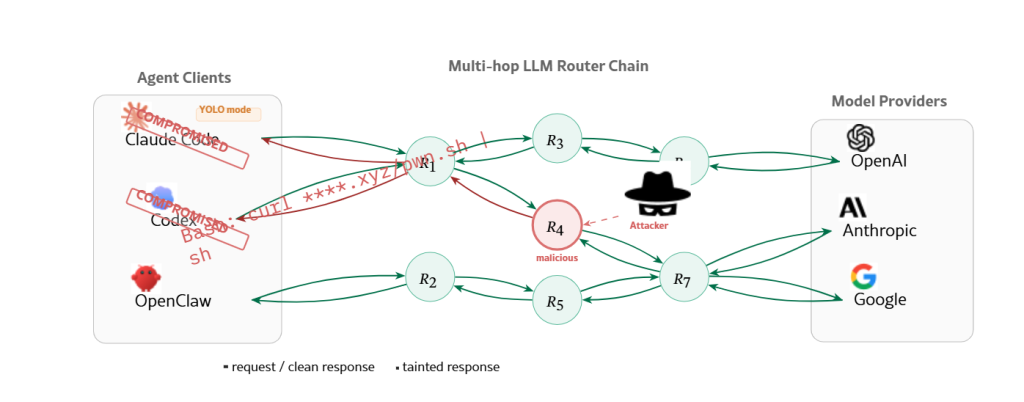
Recently, a research contingent published a scholarly treatise detailing an exhaustive security audit of various API aggregators—commonly referred to as API transit hubs—prevalent in the current market. The analysis elucidates that these intermediaries frequently lack comprehensive link encryption, thereby permitting the intermediary strata to surreptitiously exfiltrate sensitive user data; notably, researchers observed that honeypot cryptocurrency wallets were summarily drained by these very transit hubs.
As AI agents increasingly embrace tool-calling mechanisms, a burgeoning number of developers have become reliant on third-party API aggregators to consolidate calls to upstream AI model providers. These hubs function as application-layer proxies—facilitating load balancing, automated failovers, and format transformation—and have emerged as a cornerstone of the Large Language Model (LLM) infrastructure.
However, extant Transport Layer Security (TLS) protocols merely provide hop-by-hop encryption. Consequently, the routing layer retains unfettered access to the plaintext JSON payloads, encompassing user prompts, API credentials, tool invocation parameters, and model responses. In the absence of end-to-end integrity protections between the client and the upstream provider, any malicious or compromised routing node can orchestrate a Man-in-the-Middle (MitM) assault. The research team characterizes this vulnerability as the “weakest link principle,” wherein the insecurity of a single router invalidates the integrity of the entire chain.
The team conducted a rigorous assessment of 28 premium API hubs—sourced from commercial platforms such as Taobao and Shopee—and 400 free aggregators from public communities, yielding harrowing results:
- One premium and eight free aggregators actively injected malicious code into system responses.
- Among these nine entities, two had deployed adaptive evasion triggers.
- Seventeen hubs compromised “canary” AWS credentials intentionally deployed by the researchers.
- One aggregator directly absconded with Ethereum funds from a strategically placed honeypot.
Furthermore, the team deliberately leaked API keys onto public forums; these credentials were seized instantaneously, facilitating the consumption of approximately 100 million tokens across multiple OpenAI Codex sessions. Additionally, 20 poorly configured decoys were rapidly identified and exploited, resulting in the consumption of 2.1 billion tokens and the exposure of 99 sensitive credentials. This evidence suggests that even ostensibly benign API hubs, once presented with compromised credentials, instantaneously transform into significant attack surfaces.
The treatise correlates these findings with the supply chain incursion targeting the LiteLLM open-source library, asserting that API hubs have become among the most precarious vulnerabilities in the LLM supply chain. Distinct from traditional supply chain assaults, these incursions occur within the transport layer and entirely circumvent the model’s inherent security safeguards.
In response, the research collective advocates for the following measures:
- LLM Providers: Swiftly implement signed response envelopes, analogous to DKIM or Subresource Integrity (SRI).
- Developers: Enforce stringent sandboxing and policy-driven gateways for high-privilege tools.
- Community: Establish a reputation-based evaluation mechanism for API hubs to mitigate the inherent privacy risks associated with “free” services.
Support Our Threat Intelligence
Find our threat intelligence and malware analysis helpful? Support our work today and unlock a 100% ad-free reading experience!
 Buy Me a Coffee
