Lock the Front Door: The “Localhost” Loophole Leaving Thousands of Clawdbot Agents Exposed
 Do Son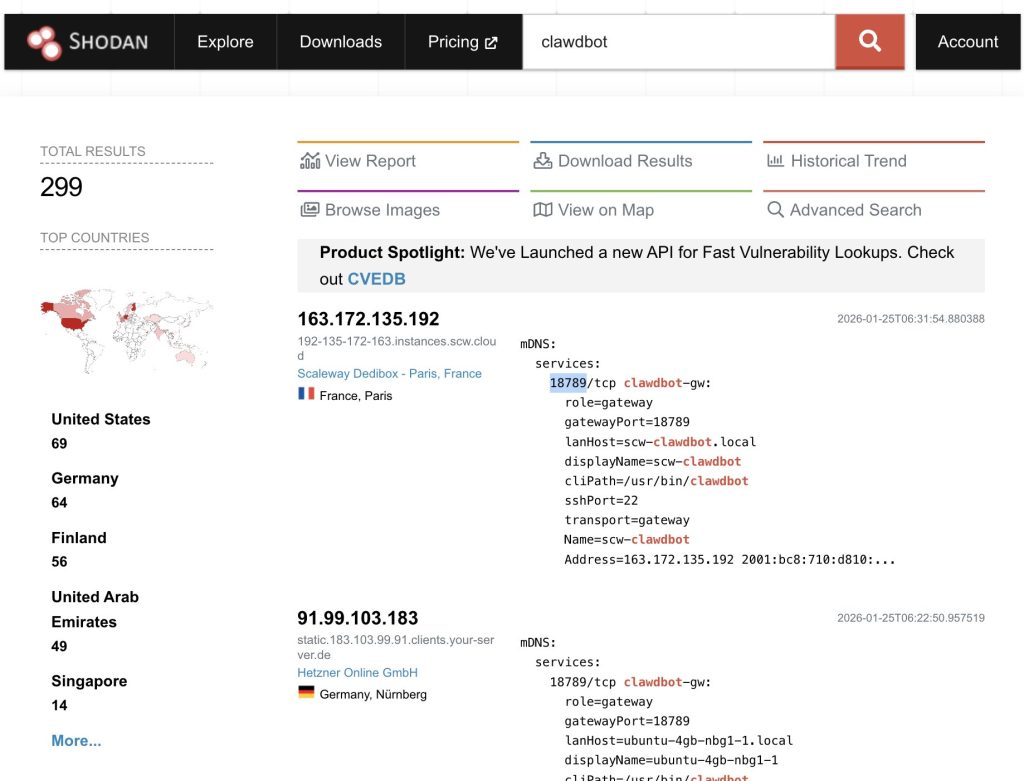
Image: @theonejvo
The trending AI assistant utility Clawdbot is currently proliferating across social media, with a multitude of users orchestrating deployments via Mac mini hardware. However, the tool is equally compatible with containerized environments or Virtual Private Servers (VPS), where default configurations frequently facilitate exposure to the public internet.
While global accessibility allows users to interface with Clawdbot from any locale, a significant demographic has failed to implement robust security protocols. This oversight has left numerous instances directly susceptible to external probes; indeed, security research collectives have already identified multiple Clawdbot nodes operating without defenses.
Clawdbot functions as a “digital majordomo,” wielding extensive permissions and often harboring credentials for a myriad of third-party services. Consequently, an unsecured and exposed instance serves as a transparent gateway through which unauthorized actors can exfiltrate sensitive user data. An investigation by the O’Reilly cybersecurity community revealed that over 1,000 instances are currently reachable via public scans, with at least 300 lacking any form of authentication mechanism whatsoever.
The core of this vulnerability resides in the interplay between Clawdbot’s authentication logic and its deployment modalities. The Control UI utilizes encrypted device identification and a challenge-response protocol; however, under default local development configurations, connections originating from localhost are granted automatic approval without further verification.
When users transition to production environments utilizing NGINX or Caddy as a reverse proxy, all incoming traffic appears to originate from 127.0.0.1. This architectural nuance causes external requests to be erroneously categorized as local, thereby bypassing authentication and permitting the execution of arbitrary commands.
Given the sheer volume of confidential telemetry managed by Clawdbot, a compromised instance allows an adversary to manipulate the agent through prompt injection, response subversion, or the unauthorized exfiltration of data through integrated channels. The peril escalates proportionally with the degree of systemic authority granted to the agent.
In response, the security community has submitted Pull Requests (PRs) to fortify default configurations and enhance proxy-aware authentication. The official Clawdbot documentation has been revised to emphasize stringent security guidelines. Users currently hosting Clawdbot instances are urged to consult the latest security mandates to bolster their defensive posture.
Related Posts:
Support Our Threat Intelligence
Find our threat intelligence and malware analysis helpful? Support our work today and unlock a 100% ad-free reading experience!
 Buy Me a Coffee
