 Do Son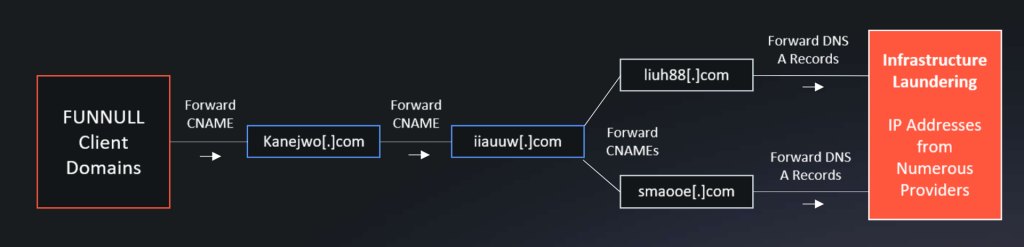
Diagram of a CNAME chain between an IP and a client domain cluster | Image: Silent Push
The threat group known as Triad Nexus has successfully bypassed international sanctions to reinstate a global fraud engine responsible for over $300 million in reported losses. A new investigative report from Silent Push reveals a sprawling ecosystem that has matured its operational security to a level that “blinds U.S. investigators” through sophisticated geographic fencing and a rotating network of “clean” front companies.
Triad Nexus does not rely on the low-reputation, “bulletproof” hosting of the past. Instead, the group has pioneered a technique the report calls “Infrastructure Laundering”. By weaponizing “account mules” to acquire accounts at major enterprise cloud providers, the syndicate gains a veneer of professional performance that “even tech-savvy Western audiences can’t resist”.
The investigation identifies Amazon (AS16509), Cloudflare (AS13335), Google (AS396982), and Microsoft (AS8075) as the primary platforms currently being exploited in these schemes . To prevent total takedowns, the group segments its operations into multiple ASN pools, making it nearly impossible for investigators to map the entire network at once.
The group’s success is driven largely by high-fidelity brand impersonation and “pig-butchering” scams, with individual victim losses averaging $150,000. Triad Nexus manages a catalog of “pixel-perfect” clones that target everything from luxury retail to public services.
Documented targets include:
- Luxury & Retail: High-fidelity clones of Tiffany, Cartier, Chanel, and eBay used to intercept high-value transactions.
- Banking & Fintech: Payment portals for more than 25 global institutions, including Bank of America and Wells Fargo, used for large-scale credential harvesting.
- Public Services: A deceptive clone of the Vietnam Post used to facilitate regional personally identifiable information (PII) theft.
In a cynical move to avoid law enforcement monitoring following U.S. Treasury sanctions in 2025, the group implemented a counterintuitive “U.S. Block”. Visitors attempting to access their fraudulent sites from U.S. IP addresses are met with a “451 Unavailable for Legal Reasons” error message.
As the network withdraws from the U.S. market to avoid detection, it is aggressively expanding into Spanish, Vietnamese, and Indonesian markets using localized templates.
The group has launched several “clean” front companies—entities that manufacture trust through professional branding and “egregious lies”.
- Bole CDN (cdnbl[.]com): Claims to have served 10,000 clients since 2015, despite domain records showing it was registered in March 2025.
- CDN1[.]ai: Falsely claims to work with global brands like Nestlé to lure in legitimate developers.
- Other Shells: Investigators have also flagged Yunray[.]ai, CDN5[.]com, and CTGCDN as part of this complex shell game.
Traditional reactive security measures are proving insufficient against Triad Nexus’ automated rotation of deceptive infrastructure. To counter this, the report highlights the necessity of CNAME Chain Mapping.
While standard lookups may only show a single link, CNAME Chain Mapping exposes the multi-tiered redirection paths used to hide the final destination, often leading back to laundered IP addresses on the group’s “bulletproof” backbone. As of April 2026, the group has shifted from nine stable CNAME domains to over 175 randomly generated CNAMEs to route its malicious traffic.
Support Our Threat Intelligence
Find our threat intelligence and malware analysis helpful? Support our work today and unlock a 100% ad-free reading experience!
 Buy Me a Coffee
