Unmasking Genisys: The AI-Powered Ad Fraud Scheme Silently Hijacking Your Smartphone
 Do Son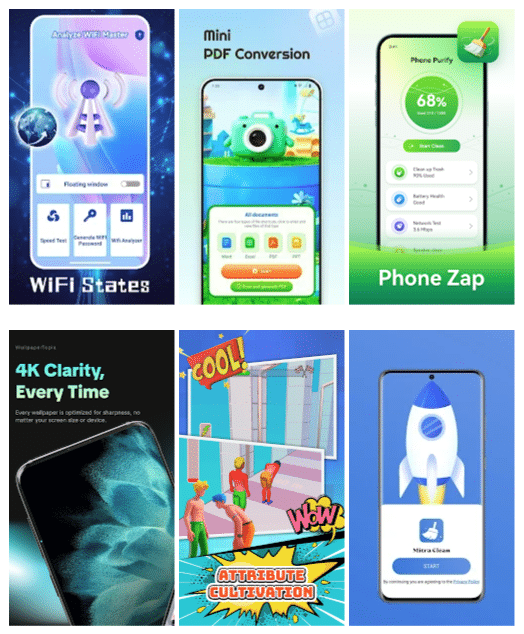
Image: The IAS Threat Lab
The digital advertising landscape is facing a sophisticated new predator. The IAS Threat Lab has recently unmasked Genisys, a massive mobile ad fraud scheme that hijacks everyday smartphones to power a “synthetic web ecosystem” designed to siphon millions from advertisers.
Genisys is a direct evolution of a previous fraud operation known as Arcade. However, while its predecessor was large, Genisys introduces aggressive new evasion tactics that allow it to hide in plain sight on millions of devices worldwide.
At its core, Genisys turns a user’s smartphone into a silent, money-making machine for fraudsters. Fraudulent apps—often disguised as simple utilities like “Phone Purify,” or “WIFI Signal Tester,” —embed malicious code directly into the device.
Once installed, these devices are “hijacked to run malicious activity in the background, diverting processing power and network resources without users’ knowledge or consent”. The apps generate hidden in-app browser sessions to load websites in the background, effectively “manufacturing” web traffic that advertisers pay for, thinking they are reaching real humans.
The most defining feature of Genisys is its reliance on Artificial Intelligence to build its infrastructure. Unlike earlier schemes that relied on existing websites, Genisys interfaces with a network of nearly 500 AI-generated domains.
These sites are built at scale and appear as generic blogs or news outlets. As the IAS Threat Lab observed, “Their purpose is not to attract readers or build an audience, but to exist as scalable endpoints for traffic monetization”. By using AI, operators can rotate these domains frequently, expanding their infrastructure faster than traditional security methods can respond.
To avoid detection, Genisys employs extensive app bundle ID spoofing. To an advertiser, the traffic might look like it’s coming from hundreds of different, highly popular mobile apps.
In reality, this is “manufactured attribution noise” designed to mask the small set of malicious apps actually responsible for the fraud. This technique fragments the traffic’s profile, making it incredibly difficult for platforms to identify and block the true source of the invalid activity.
The IAS Threat Lab identified that many of these apps are published by developers with an extensive history of violations. In response, IAS worked in close partnership with Google to dismantle the operation.
Actions taken against identified apps led to a sharp decline in fraudulent supply, with bid request volumes for affected apps dropping by more than 95%.
Google Play Protect now warns users and automatically disables apps associated with the Genisys threat, even if they were installed from third-party sources.
The IAS Threat Lab warns that “removing individual apps does not meaningfully disrupt operations when developers with extensive histories of violations are able to re-enter platforms”. Addressing future threats will require a coordinated effort that targets the repeat offenders, their laundering domains, and their monetization infrastructure all at once.
Support Our Threat Intelligence
Find our threat intelligence and malware analysis helpful? Support our work today and unlock a 100% ad-free reading experience!
 Buy Me a Coffee
