 Do Son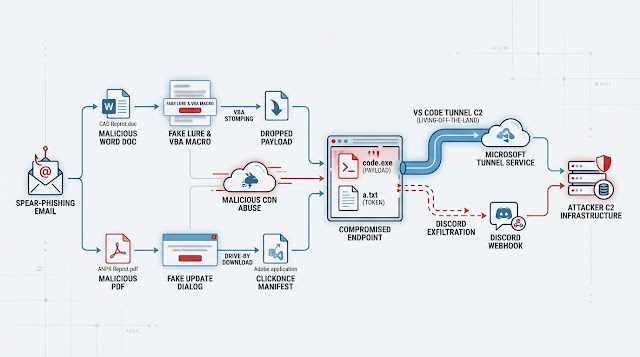
Image: Joe Security
A sophisticated cyber espionage operation recently targeted prominent public safety organizations in Pakistan. Specifically, the threat actors launched a highly targeted spear-phishing campaign against staff members of the Punjab Safe Cities Authority (PSCA). The campaign also focused heavily on employees working within the PPIC3 infrastructure. During the post-incident investigation, security researchers uncovered a highly creative approach involving VS Code Remote Tunnels abuse. This unique attack vector allowed malicious actors to gain full operational access to compromised local workstations. Furthermore, the attackers bypassed standard perimeter defenses by leveraging trusted cloud computing channels.
Exploiting Institutional Authority with Custom Lures
To begin with, the threat actors conducted thorough intelligence gathering on their target organization. They customized their malicious messages to look like normal everyday corporate communication. For example, the phishing emails carefully impersonated an internal technical consultant. Additionally, the message body referenced real agency initiatives like the Safe Jail Project. The text discussed complex layouts and specific automatic number plate recognition systems. This realistic social engineering approach ensured an incredibly high compliance rate. Consequently, the recipients opened the attached files without any initial suspicion. The attack delivered two distinct malicious documents named CAD Reprot.doc and ANPR Reprot.pdf.
Reversing Traditional Phishing Paradigms
The true innovation of this digital assault lies within its secondary stage execution. Analysts noted that the primary Word document drops a modified application binary directly onto the victim’s hard drive. According to the analysis, “What made this case particularly noteworthy was the attackers’ use of Visual Studio Code as a living-off-the-land tool, combined with Discord webhooks for data exfiltration.” Traditional phishing attempts usually focus on harvesting corporate user credentials. In contrast, this stealthy operation focused on deep system infrastructure enrollment.
Mechanics of the Infrastructure Takeover
The execution chain alters typical device authorization mechanics to achieve its remote access goals. When the dropped execution file runs, it initiates a legitimate login protocol with public cloud platforms. The report states that “Instead of relying on a traditional custom backdoor, it abuses victim-assisted device-code authentication to enroll the host into the VS Code Remote Tunnels infrastructure.” Next, an embedded Visual Basic macro captures the generated authorization code silently. It then exfiltrates this sensitive verification token directly to an attacker-controlled Discord webhook channel.
Connecting the External Control Endpoint
Once the actors receive the stolen token, they complete the connection sequence from their remote station. Surprisingly, they utilize their own sovereign developer identities to finish the process. The analysis highlights that “Rather than stealing the victim’s Microsoft account, the attacker appears to use their own account to bind the victim’s machine to a legitimate Microsoft tunneling workflow.” Consequently, the targeted computer registers as an active endpoint under the attacker’s account profile. This unique method ensures that all ongoing communication blends perfectly with trusted developer telemetry.
Deploying a Parallel Delivery Mechanism
Simultaneously, the secondary PDF attachment delivered an alternative infection vector using a blurred background display. This file tricked users into clicking a button to download a fake application update. The downloaded package contained a specialized ClickOnce deployment manifest. ClickOnce technology typically allows enterprise administrators to distribute applications across an internal network easily. However, the threat actors weaponized this feature to load an unauthorized application payload. Although security countermeasures eventually suspended the delivery domain, the attempt shows high operational flexibility.
Conclusion and Strategic Defenses
Ultimately, this campaign highlights the growing danger of trusted developer utilities in modern threat landscapes. This instance of VS Code Remote Tunnels abuse provides attackers with a fully functional interactive shell environment. Therefore, standard signature-based detection mechanisms often fail to flag the operational traffic. To protect corporate endpoints, security administrators must monitor unauthorized registry additions under the user execution keys. Furthermore, companies should restrict access to external developer endpoints to safeguard critical data assets.
Support Our Threat Intelligence
Find our threat intelligence and malware analysis helpful? Support our work today and unlock a 100% ad-free reading experience!
 Buy Me a Coffee
