The Fractured Evolution of Wireless Connectivity: Stagnant Wi-Fi 7 Adoption and the Emergence of Wi-Fi 8
 Do Son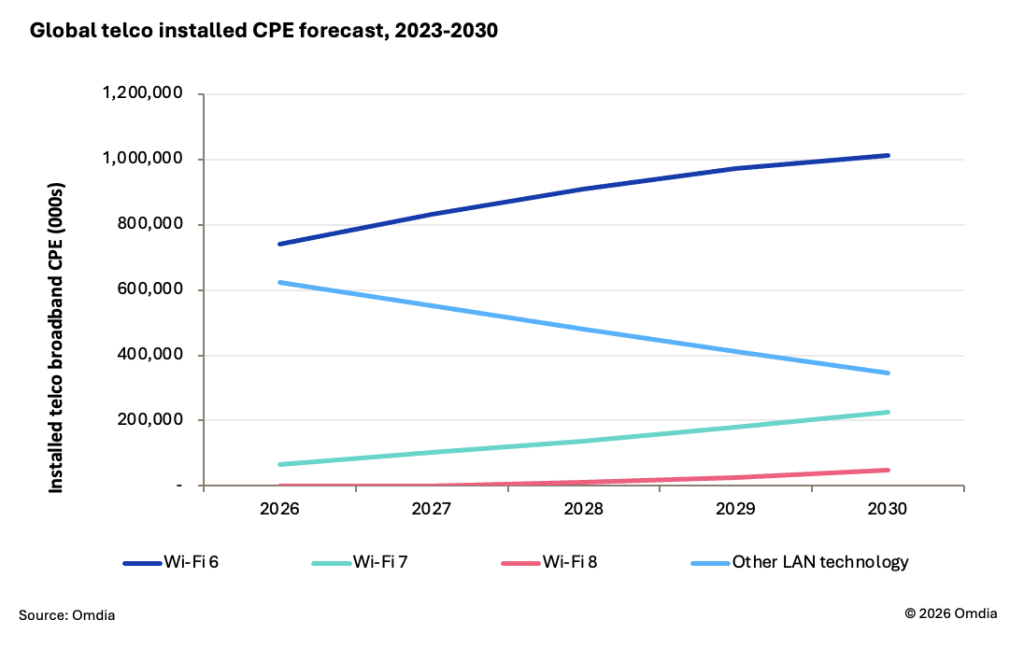
Omdia’s Installed Consumer Broadband CPE Forecast: 2025–30 | Image: Omdia
When the Wi-Fi Alliance ratified the Wi-Fi 7 (802.11be) standard in 2024, a monumental wave of hardware upgrades seemed inevitable. However, recent empirical data from Ookla Speedtest paints a far more conservative picture. As of the first quarter of 2026, the global market share of Wi-Fi 7 languishes below two percent. Instead, legacy standards continue to dominate our collective digital existence. Specifically, Wi-Fi 6 commands a 26.7% share, while the venerable Wi-Fi 5 retains a staggering 38.3% dominance.
Global Polarization in Adaptation: Singapore’s Triumph and China’s Distinctive Path
Globally, the distribution of Wi-Fi 7 resembles a profound dichotomy. Singapore spectacularly leads this digital frontier, boasting an impressive twenty-five percent adoption rate among its populace. Clearly, this phenomenon is no mere fortuity. It represents a meticulous symphony orchestrated by state policy and telecommunication providers.
Recently, the Singaporean government aggressively championed 10 Gbps residential broadband. Concurrently, authorities enlightened consumers that legacy Wi-Fi 6 and 6E routers cast an artificial bottleneck on such immense speeds. Consequently, internet service providers bundled Wi-Fi 7 hardware directly with premium data plans, successfully igniting an upgrade renaissance.
In stark contrast, the North American landscape exhibits a more lethargic progression. Although the region pioneered 6GHz utilization—courtesy of the FCC’s early liberation of a massive 1200 MHz spectrum—Wi-Fi 7 penetration rests at a modest 6.8%. Meanwhile, Europe and Latin America stumble due to regulatory inertia regarding the 6GHz band. As a direct consequence, consumers in these jurisdictions remain heavily tethered to legacy 5GHz and archaic 2.4GHz frequencies.
Concurrently, the Chinese market presents an intriguing geopolitical anomaly. Because state regulators reserved the entire 6GHz spectrum for mobile telecommunications (IMT) in anticipation of future 6G architectures, local Wi-Fi 7 routers underwent a severe technical compromise. Manufacturers were forced to omit the 6GHz band entirely, engineering a customized dual-band (2.4GHz and 5GHz) alternative. Nevertheless, buoyed by domestic manufacturing economies of scale, China still boasts a respectable 7.5% device connection rate to Wi-Fi 7 networks.
The Artificial Intelligence Onslaught: Skyrocketing Component Costs
Beyond the fragmentation of global spectrum policies—such as the European Union liberating only the lower block and the United Kingdom adopting a shared paradigm—the primary impediment to universal adoption is, unexpectedly, the artificial intelligence boom. Indeed, the global insatiability for AI infrastructure has caused the valuation of high-performance memory and compute modules to soar.
Ultimately, this economic friction within the semiconductor supply chain has heavily inflated the Bill of Materials (BOM) for smartphones and Customer Premises Equipment (CPE). For worldwide internet service providers, subsidizing expensive Wi-Fi 7 hardware for consumers has become a highly precarious business model. Consequently, this financial strain protracted the decommissioning timeline for antiquated Wi-Fi 4 and Wi-Fi 5 architectures.
A Glimpse into the Horizon: Wi-Fi 8 Prioritizes Equilibrium Over Velocity
While the technology sector continuously wrestles with Wi-Fi 7 integration, the vanguard of the next generation—designated as Wi-Fi 8 or IEEE 802.11bn—is already crystallizing. Commercial hardware is projected to surface by 2028, though certain progressive vendors plan experimental deployments as early as late 2026 or 2027. Crucially, Wi-Fi 8 signals a profound philosophical paradigm shift in networking history. The upcoming standard abandons the blind pursuit of astronomical maximum velocities. Instead, it anchors its core architectural philosophy to Ultra High Reliability (UHR).
Architectural Innovations of the IEEE 802.11bn Paradigm
Forsaking Peak Velocity for Deterministic Latency
The theoretical maximum throughput of Wi-Fi 7 already reaches a breathtaking 46 Gbps via 4096 QAM and 320 MHz channels. However, this capacity vastly exceeds contemporary residential and commercial requirements. Therefore, Wi-Fi 8 shifts its research focus entirely toward minimizing latency and packet loss metrics. This strategic redirection ensures unyielding performance stability within heavily congested network topologies.
Coordinated Multi-AP Topology
This mechanism introduces a transformative capability to wireless networking. Historically, legacy mesh routers operated autonomously, frequently generating mutual radio interference. To alleviate this friction, Wi-Fi 8 introduces Coordinated Spatial Reuse (Co-SR) and Coordinated OFDMA. Consequently, multiple access points can precisely synchronize their broadcast schedules and frequencies, completely neutralizing co-channel interference within dense enterprise or residential environments.
Seamless Mobility and Enhanced Power Optimization
Furthermore, Wi-Fi 8 dramatically refines the roaming transitions between separate access points, achieving true zero-packet-drop handovers. Simultaneously, the framework optimizes power management protocols for connected hardware. This enhancement is critically vital for the continuously expanding smart home Internet of Things (IoT) ecosystem.
The Wireless Vanguard for 50G PON Integration
As next-generation 50G PON fixed-line broadband steps into commercial deployment over the coming years, Wi-Fi 8 will serve as its indispensable wireless conduit. The fiber optic backbone delivers monumental, symmetrical bandwidth paired with sub-millisecond latency. Conveniently, the unyielding reliability of Wi-Fi 8 elegantly intercepts this torrential data stream. Ultimately, this harmony guarantees that the end-to-end user experience is never degraded by localized environmental interference.
Analytical Insights: The Evolution from Benchmarks to Genuine Experience
Reflecting upon the lineage from Wi-Fi 4 to Wi-Fi 7, corporate marketing historically focused on a numbers game of doubled bandwidth and escalated QAM modulation. Admittedly, weaponizing the 6GHz spectrum and Multi-Link Operation (MLO) successfully liberated the core pathways of indoor wireless transmission. However, the upcoming Wi-Fi 8 standard represents the ultimate architecture required for spatial computing and automated manufacturing. When a user dons a Vision Pro wearable device, or an enterprise deploys Automated Guided Vehicles (AGVs), the immediate demand is rarely fetching a 100-gigabyte file instantly. Rather, the architecture absolutely cannot tolerate even a fifty-millisecond network drop.
In addition, while 50G PON platforms sustain the colossal data backbone of the artificial intelligence era, Wi-Fi 8 ensures this computational power reaches every terminal node reliably. By abandoning raw speed escalation, the standard leverages collaborative computing to fully maximize the utility of existing 2.4GHz, 5GHz, and 6GHz spectra.
Unquestionably, this choice is not merely a capitulation to physical limitations. Instead, it marks a mature transition from an era of benchmark worship to an age of genuine experiential quality. Until Wi-Fi 8 hardware formally debuts in 2028, the ultimate crucible for hardware manufacturers lies in their ability to tune existing 5GHz and emergent 6GHz bands seamlessly.
Support Our Threat Intelligence
Find our tech and OS security coverage helpful? Support our work today and unlock a 100% ad-free reading experience!
 Buy Me a Coffee
