Skip to content
September 14, 2026
  • Bluesky
  • Facebook
  • Linkedin
  • Mastodon
  • RSS
  • Twitter
  • Youtube

Daily CyberSecurity

Zero-hour alerts. Unmatched analysis.

Primary Menu
  • Home
  • CVE Data
    • CVE Watchtower
    • Top Exploited CVEs
    • CVE Stats by Vendor
    • Q2 2026 Report
    • CVE Alerts
    • CVE Alert Settings
    • Pricing
  • Cyber Criminals
  • Data Leak
  • Linux
  • Malware
  • Vulnerability
  • Submit Press Release
  • Weekly Recap
Light/Dark Button
  • Home
  • News
  • Windows
  • A Simple New Windows 11 Local Account Bypass Appears
  • Windows

A Simple New Windows 11 Local Account Bypass Appears

Do Son September 14, 2026 2 minutes read
0
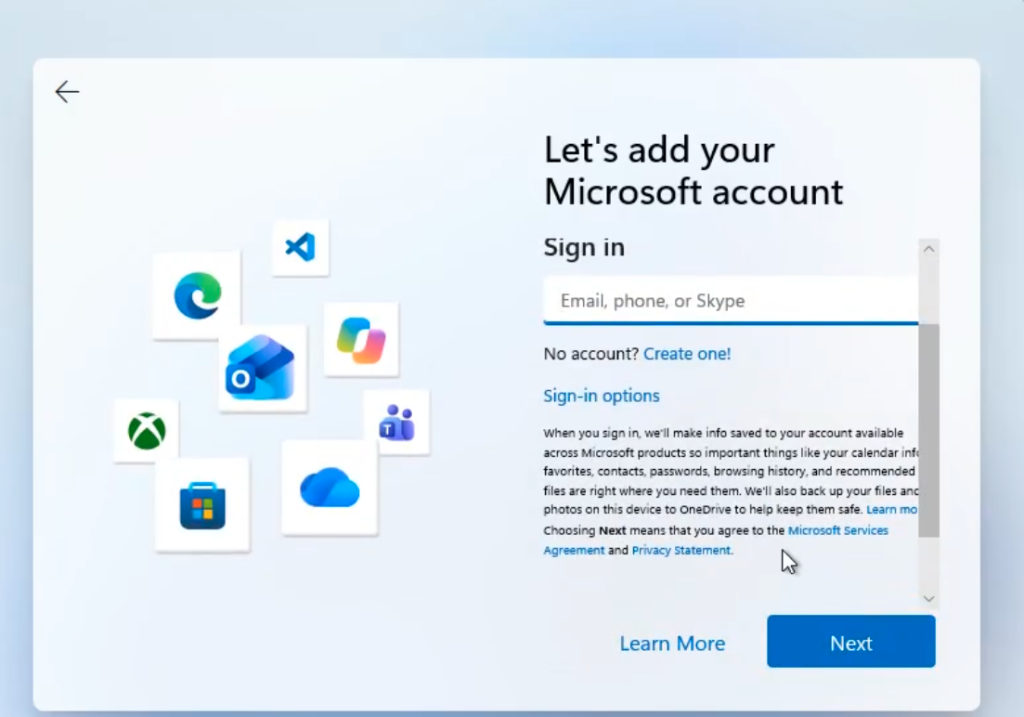
Windows 11 Home OOBE local account bypass using the Learn More hyperlink on the sign-in screen
Add Daily CyberSecurity as a preferred source on Google

The well-known enthusiast BobPony recently uncovered a new way to circumvent account sign-in on Windows 11 Home. The method proves remarkably simple yet effective. Thereafter, when users installing the system encounter the point in the OOBE interface that forces a Microsoft account login, they can employ this trick to swiftly create a local account.

The Current Flow Demands a Microsoft Account

At present, Windows 11 Home compels users to register and log in with a Microsoft account. The methods once used to skip account sign-in, including OOBE\BYPASSNRO, editing the registry, or invoking start ms-cxh:localonly, have all been progressively removed by Microsoft. Consequently, users can no longer create a local account through the ordinary route.

Attempting to bypass the login with a bogus account such as no@thankyou.com is likewise futile. Naturally, these are all evasion methods that Microsoft has successively deleted across version updates. Therefore, users wishing to bypass account sign-in have found the task relatively troublesome.

The New Bypass Is Exceedingly Simple

On the screen where one enters an account, a lengthy block of Microsoft’s explanatory text sits below, and within it lies a Learn More hyperlink. Users need only click that link, whereupon the details load and the setup then automatically jumps to the create-a-local-account page. BobPony shared the discovery in a post demonstrating the Learn More trick on the Microsoft account sign-in page.

This appears to be some kind of bug. Under normal circumstances, OOBE itself fetches content online, and the Learn More hyperlink ought to display additional information before offering a return button. In reality, however, it leaps directly to the create-a-local-account page, so this is almost certainly an error.

The Bad News for Users

The unfortunate part is that if Microsoft intends to seal off this method, doing so is trivially easy. It need only continue adjusting the OOBE backend server to quickly close the link-redirection error. In that event, users would once again be forced to log in with a Microsoft account, unable to create a local one.

Related coverage

  • Chrome Installer Bug: ARM Version Delivered to x86 Users
  • CrowdStrike Outage: Microsoft Points Finger at EU Agreement
  • Windows 11 Gaming Issues Emerge After August Update
Track all actively exploited CVEs →

Support Our Threat Intelligence

Find our tech and OS security coverage helpful? Support our work today and unlock a 100% ad-free reading experience!

Buy Me a Coffee Logo Buy Me a Coffee
Select your plan
Free Pro Team

Hover over a plan to see its benefits.

Stay Ahead of the Threat

Join security professionals receiving zero-hour CVE alerts, PoC updates, and threat analysis directly to their inbox.

No spam. One actionable email per week. Unsubscribe anytime.

SHARE
Share on FacebookShare on XShare on LinkedInShare on TelegramShare on BlueskyShare on Mastodon
Written by
@DdoS · Security Researcher

Do Son

Do Son is the Founder and Editor of SecurityOnline.info. Working in cybersecurity since 2013, he reports on vulnerabilities, malware, and emerging threats, providing timely analysis to help organizations and individuals stay ahead of evolving risks.

Tags: BobPony Local Account Microsoft Microsoft Account OOBE Windows 11

Leave a Reply Cancel reply

You must be logged in to post a comment.

Search

Translation

CVE ALERTS
📧

Email Delivery
Get threat intel straight to your inbox.

♾️

Unlimited Vendors
Track every technology in your stack.

🚨

All New CVE Alerts
Be the first to know about new flaws.

⚙️

Custom EPSS Threshold
Filter noise, focus on real risks.

💬

Slack & Teams Webhook
Integrate directly into your SecOps.

🚫

100% Ad-Free
Enjoy an uninterrupted reading experience.

$7/mo
Subscribe Now

🚨 Active Exploits in the Wild

  • CVE-2026-51990
    A critical remote code execution vulnerability in Sogou Input Method, one of the most widely used Chinese-language input...
    Admin intel📅 Updated: Sep 12, 2026
  • CVE-2026-85706CVSS 10.0
    GitLab has remediated an issue that, under certain conditions, an unauthenticated user could have read arbitrary files from...
    Admin intelCISA KEV📅 Added to KEV: Sep 11, 2026📅 Updated: Sep 11, 2026
  • CVE-2026-42016CVSS 8.1
    JFrog Artifactory (Self Hosted) versions before 7.133.11 are vulnerable to a privilege escalation attack due to a validation...
    Admin intelCISA KEV📅 Added to KEV: Sep 11, 2026📅 Updated: Sep 11, 2026
  • CVE-2026-42018CVSS 7.5
    JFrog Artifactory could return an internal anonymous-user token to an unauthenticated caller when anonymous access is disabled, potentially...
    Admin intelCISA KEV📅 Added to KEV: Sep 11, 2026📅 Updated: Sep 11, 2026
  • CVE-2026-84869CVSS 9.9
    A condition in the ScreenConnect client may allow files to be transferred and executed through an active remote...
    CISA KEV📅 Added to KEV: Sep 11, 2026
  • CVE-2026-20079CVSS 10.0
    A vulnerability in the web interface of Cisco Secure Firewall Management Center (FMC) Software could allow an unauthenticated,...
    Admin intelCISA KEV📅 Added to KEV: Sep 9, 2026📅 Updated: Sep 9, 2026
  • CVE-2025-25249CVSS 8.1
    A heap-based buffer overflow vulnerability in Fortinet FortiOS 7.6.0 through 7.6.3, FortiOS 7.4.0 through 7.4.8, FortiOS 7.2.0 through...
    Admin intelCISA KEV📅 Added to KEV: Sep 9, 2026📅 Updated: Sep 9, 2026
  • CVE-2026-87491
    Out of bounds write in V8 in Google Chrome prior to 153.0.8010.36 allowed a remote attacker to execute...
    Admin intelCISA KEV📅 Added to KEV: Sep 9, 2026📅 Updated: Sep 9, 2026
Powered by CVE Watchtower

🔴 Live Critical Threats

  • CVE-2026-90608CVSS 9.9
    A flaw has been found in Totolink A3002MU Hh-B20211125.1046. The affected element...
  • CVE-2026-90607CVSS 9.9
    A vulnerability was detected in Totolink A3002MU Hh-B20211125.1046. Impacted is the function...
  • CVE-2026-90606CVSS 9.9
    A security vulnerability has been detected in Totolink A3002MU Hh-B20211125.1046. This issue...
  • CVE-2026-90605CVSS 9.9
    A weakness has been identified in Totolink A3002MU Hh-B20211125.1046. This vulnerability affects...
  • CVE-2026-81648CVSS 10.0
    The CryptoPayment Gateway WordPress plugin from 1.2.1 to 1.2.2 does not apply...
  • CVE-2026-90558CVSS 9.8
    sngrep through 1.8.4 contains stack buffer overflow vulnerabilities in SIP attribute formatting...
  • CVE-2026-78159CVSS 9.8
    The The Events Calendar plugin for WordPress is vulnerable to Remote Code...
  • CVE-2026-78006CVSS 9.8
    The The Events Calendar plugin for WordPress is vulnerable to Remote Code...
  • CVE-2026-85681CVSS 9.8
    The WP Component WordPress plugin through 2.2.4 does not have any capability...
  • CVE-2026-84171CVSS 9.8
    The WP images upload on piclect WordPress plugin through 1.0 does not...
Powered by CVE WATCHTOWER

Daily CyberSecurity

  • About SecurityOnline.info
  • Advertise with us
  • Announcement
  • Contact
  • Contributor Register
  • Login
  • Disclaimer
  • DCMA
  • Privacy Policy
  • About SecurityOnline.info
  • Advertise on SecurityOnline.info
  • Contact Us

When you purchase through links on our site, we may earn an affiliate commission. Here’s how it works

  • CVE Watchtower
  • CVE Statistics by Vendor 2026
  • Q2 2026 Report
  • Top Exploited CVEs
  • Bluesky
  • Facebook
  • Linkedin
  • Mastodon
  • RSS
  • Twitter
  • Youtube
© 2017 - 2026 Daily CyberSecurity. All Rights Reserved.