 Do Son
A new and highly specialized malware threat has emerged in the industrial cybersecurity landscape, signaling a targeted effort to disrupt critical infrastructure. Security researchers from Darktrace recently identified and analyzed a sample dubbed ZionSiphon, which pairs standard host-based infection techniques with specific logic designed to sabotage water treatment and desalination facilities.
While the malware currently appears to be in a developmental or “defanged” state, its architecture reveals a clear and dangerous intent to transition from digital espionage to physical disruption.
The malware is explicitly designed to operate within a specific geopolitical context, featuring hardcoded targeting and messaging aimed at Israel. Darktrace’s analysis found that “the clearest indicators of intent in this sample are its hardcoded Israel-focused targeting checks and the strong political messaging found in some strings in the malware’s binary”.
The code defines a strict set of IPv4 ranges (such as 2.52.0.0 through 2.55.255.255) meant to isolate the infection to Israeli networks. Furthermore, the malware contains class initializers with strings expressing support for regional actors, underscoring its role as a tool for “hacktivism” or state-sponsored disruption rather than simple financial gain.
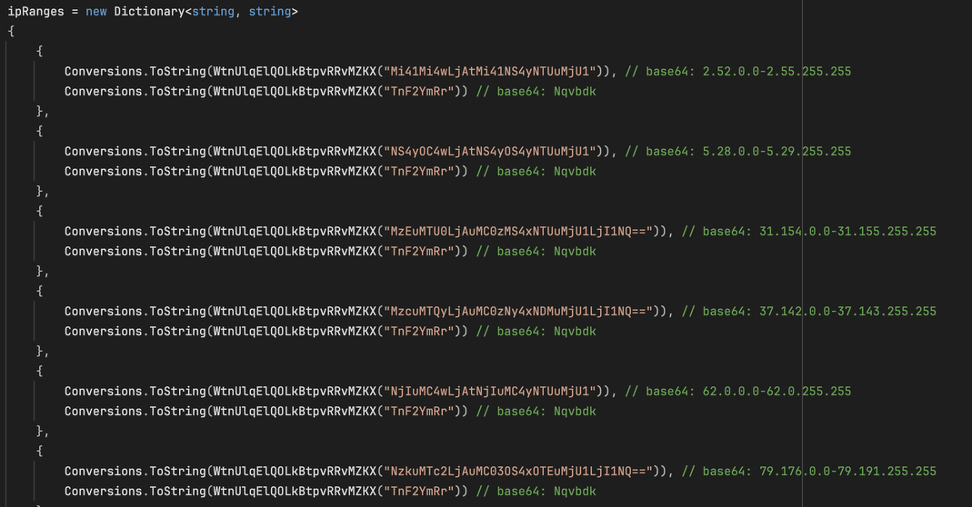
What elevates ZionSiphon above typical malware is its focus on Operational Technology (OT). The sample is designed to scan local subnets for ICS-relevant services and contains logic specifically tailored to the Modbus protocol—a standard for communication between industrial devices.
Darktrace’s investigation reveals an objective:
“The inclusion of Modbus sabotage logic, filesystem tampering targeting chlorine and pressure control, and subnet-wide ICS scanning demonstrates a clear intent to interact directly with industrial processes controllers and to cause significant damage and potential harm”.
By targeting the control systems for chlorine levels and water pressure, an attacker could potentially contaminate water supplies or cause catastrophic physical failure in a desalination plant’s piping infrastructure.
Despite the high-stakes targeting, ZionSiphon currently suffers from several technical shortcomings that suggest it may not be fully “field-ready”. Researchers identified “numerous implementation flaws,” including dysfunctional country-validation logic and several placeholder components for protocols like DNP3 and S7comm.
According to the report, “numerous implementation flaws, most notably the dysfunctional country-validation logic and the placeholder DNP3 and S7comm components, suggest that analyzed version is either a development build, a prematurely deployed sample, or intentionally defanged for testing purposes”.
ZionSiphon represents a significant milestone in the evolution of infrastructure-targeting threats. It follows the path of earlier ICS-focused campaigns, such as Stuxnet or Industroyer, by attempting to bridge the gap between IT environments and physical controllers.
Darktrace concludes that “ZionSiphon underscores a growing trend in which threat actors are increasingly experimenting with OT-oriented malware and applying it to the targeting of critical infrastructure”.
Support Our Threat Intelligence
Find our threat intelligence and malware analysis helpful? Support our work today and unlock a 100% ad-free reading experience!
 Buy Me a Coffee
