 Do Son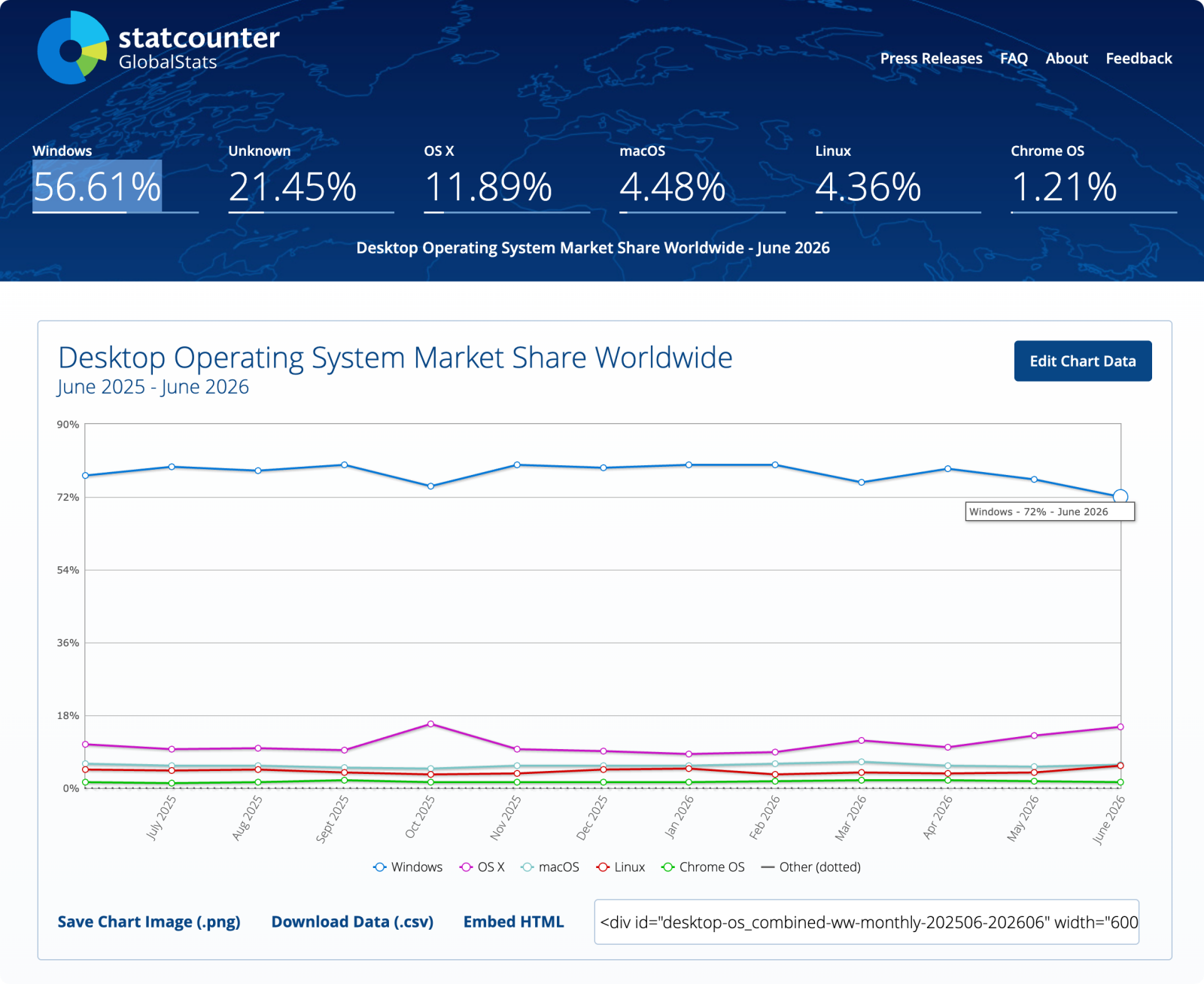
Image: StatCounter
Market research firm StatCounter frequently publishes statistics on operating systems, browsers, and other products. Recently, their June 2026 report claimed a drastic shift. Specifically, Windows overall market share supposedly plunged from 79% to 56%. Consequently, numerous websites reported that Windows had fallen below the 60% threshold.
Many observers linked this rapid decline to the rise of Linux. Furthermore, some users speculated about a dramatic shift in the desktop landscape. However, evidence confirmed that StatCounter published erroneous statistics. In reality, Windows did not fall below 60% market share. Now, the firm has officially corrected these flawed metrics.
You can click here to view the latest data.
Identifying the Data Anomalies
A Suspicious Drop
The flawed report indicated a sudden plunge to 56.55% for Windows. Previously, this share remained highly stable around 78% to 79%. Looking solely at these numbers, one might quickly assume a total collapse.
Unexplained Shifts
However, competing operating systems showed no significant growth during this period. For example, Linux share edged up slightly to 4.39%. Similarly, macOS share rose marginally to 16.37%. Thus, these minor gains cannot explain a massive 20% drop for Windows.
Another major anomaly appeared in the unknown system category. Typically, this unclassified segment holds a very low market share. Yet, the June report showed this category surging to 21.45%. Therefore, tracking errors likely misclassified many Windows users into this unknown group.
StatCounter Acknowledges Errors
Initial Adjustments
After intense debate, StatCounter recognized the glaring data anomalies. Subsequently, the firm began revising the desktop operating system figures. Their initial correction placed Windows market share at 72%. Admittedly, this figure remains much better than the alarming 56%.
Ongoing Revisions
Nevertheless, the adjusted 72% mark still appears somewhat irregular. Moving forward, StatCounter will likely continue refining its data. Otherwise, a 6% drop in a single month remains highly improbable. Consequently, these skewed figures fail to offer accurate reference value.
Additionally, StatCounter derives its data from site visits using its tracking code. Ultimately, these numbers remain estimates rather than official Microsoft figures. Therefore, technical glitches in the tracking code can easily generate flawed results.
Support Our Threat Intelligence
If you find our CVE report and cybersecurity news helpful, consider supporting our work.
 Buy Me a Coffee
PayPal
Buy Me a Coffee
PayPal

