 Ddos
Ddos 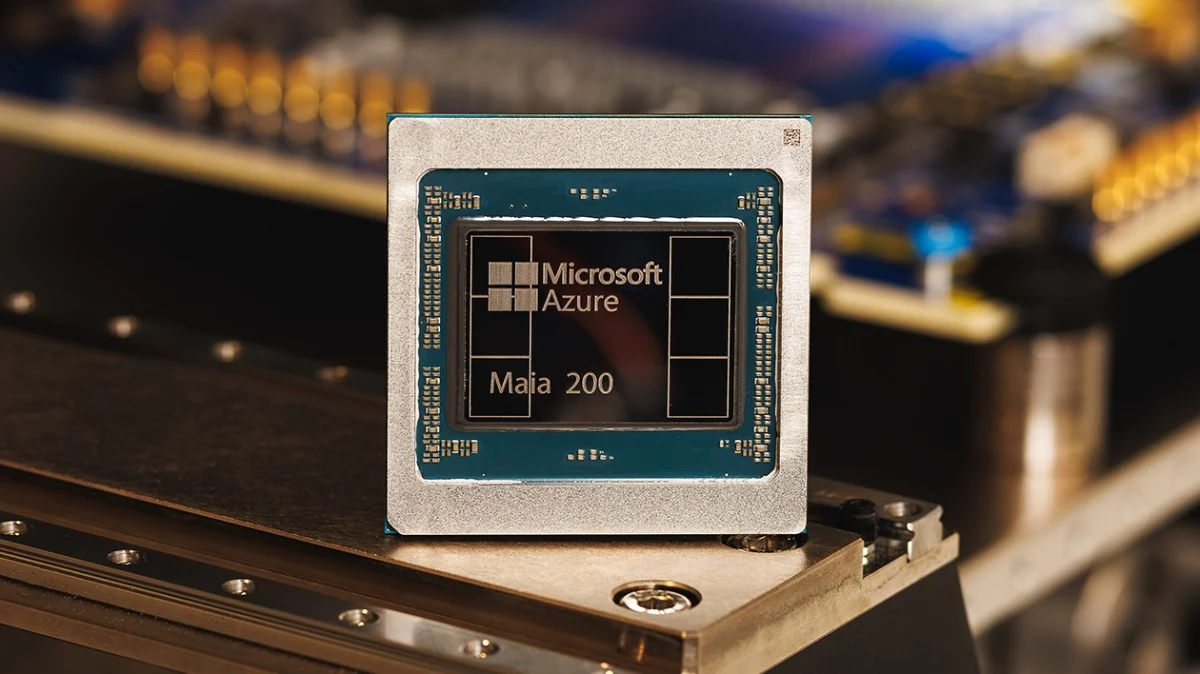
Microsoft, intensifying its pursuit within the sovereign silicon arena, formally unveiled its second-generation AI processor, Maia 200, on January 26. Engineered utilizing TSMC’s 3nm process—dispelling prior conjectures regarding the adoption of Intel’s fabrication technology—this chip is heralded as Microsoft’s most formidable inference system to date. It boasts a 30% improvement in performance-per-dollar over its predecessor and explicitly challenges the supremacy of Google’s TPU and Amazon’s Trainium in key benchmarks.
The technical architecture of the Maia 200 is remarkably robust, housing over 140 billion transistors on a single die. To address the rigorous computational demands of AI inference, official telemetry indicates:
-
FP4 Precision: Delivers in excess of 10 petaFLOPS.
-
FP8 Precision: Delivers in excess of 5 petaFLOPS.
-
Thermal Design Power (TDP): Maintained below 750W.
-
Memory: Integrated with 216GB of HBM3e high-bandwidth memory, achieving a staggering throughput of 7 TB/s.
Scott Guthrie, Microsoft’s Executive Vice President of Cloud and AI, emphasized that the Maia 200 is not only adept at orchestrating today’s most expansive models but is also architected to accommodate the gargantuan models of the future. In a bold competitive stroke, Microsoft asserted that the Maia 200’s FP4 performance triples that of Amazon’s Trainium 3, while its FP8 capabilities eclipse Google’s seventh-generation TPU, “Ironwood.”
Initial deployment has commenced within Microsoft’s Iowa data centers, primarily supporting the internal Superintelligence Team in synthesizing data for next-generation model training. It will also serve as the backbone for Copilot and heavyweight models such as OpenAI’s GPT-5.2. The strategic quintessence of the Maia 200 is “autonomy.” Amidst the scarcity and exorbitant costs of NVIDIA GPUs, proprietary silicon allows Microsoft to diminish hardware expenditure while optimizing computational efficiency for the Azure cloud architecture.
Notably, Microsoft has eschewed NVIDIA’s proprietary InfiniBand in favor of standardized Ethernet for interconnectivity, signaling a resolute intent to fracture NVIDIA’s ecological monopoly. While Microsoft entered the custom-silicon race later than Google, its symbiotic relationship with OpenAI has granted it profound insight into the precise hardware requirements for executing GPT-scale models.
The positioning of the Maia 200 is surgical: it does not seek to dethrone NVIDIA’s H100/H200 in the “training” domain, but rather to capture the burgeoning “inference” market. As services like Copilot scale to serve hundreds of millions of concurrent users, utilizing premium NVIDIA GPUs for inference becomes prohibitively expensive; here, the Maia 200’s cost-to-performance ratio becomes its defining advantage. While NVIDIA’s dominance in high-end training remains secure for now, the escalating prowess of self-developed silicon from the “Cloud Trinity” (AWS, Google, and Microsoft) will inevitably erode its market share in inference.
Related Posts:
Support Our Threat Intelligence
If you find our CVE report and cybersecurity news helpful, consider supporting our work.
 Buy Me a Coffee
PayPal
Buy Me a Coffee
PayPal
