A New Era for AI: Microsoft Unveils an Optical Computer That’s 100x More Efficient
 Do Son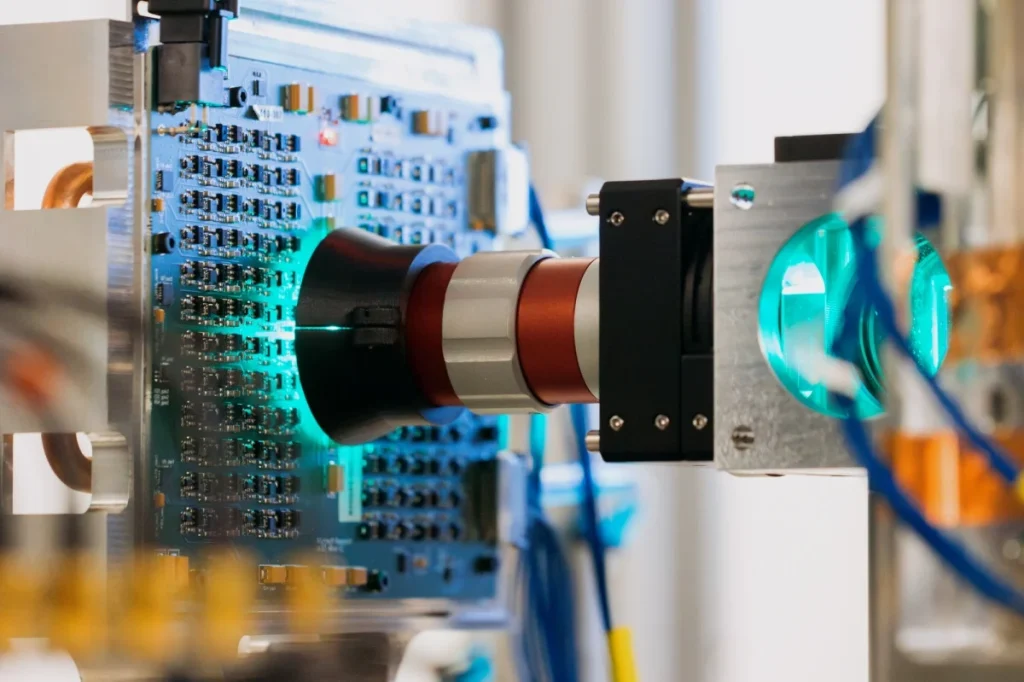
In recent years, the surging demand for AI computing power has outstripped the supply of GPUs, while concerns over energy consumption have become an industry-wide anxiety. Yet Microsoft Research’s Cambridge team has chosen to redefine computation through light itself. Their creation, dubbed the Analog Optical Computer (AOC), is assembled from off-the-shelf components such as smartphone camera sensors, Micro LEDs, and lenses. Remarkably, it demonstrated speeds and energy efficiency in experiments that surpassed GPUs by a factor of 100—an achievement that earned it publication in Nature.
The concept of optical computing was first proposed in the 1960s, but remained largely theoretical due to limitations in fabrication technology. After four years of development, Microsoft’s team succeeded in merging optics with analog circuits within a single loop. Matrix operations are executed in light, while non-linear functions and arithmetic are handled electronically. Each iterative computation requires only 20 nanoseconds, rapidly converging to a fixed-point solution.
This architecture eliminates the need for costly digital-to-analog conversions and possesses inherent noise resistance, allowing optical computation to operate stably on real-world hardware for the first time. To prove AOC’s value beyond a laboratory prototype, the team tested it in finance and healthcare.
In collaboration with Barclays Bank, the system solved an optimization problem for financial settlements in just seven iterations. In healthcare, MRI data was transformed into an optimization framework for compressed sensing imaging, reconstructing 32 × 32 brain slices. By creating a digital twin capable of simulating 200,000 MRI variations, the technology suggests that scan times could be reduced from 30 minutes to just five, greatly easing patient burden.
The researchers also discovered that AOC’s fixed-point search mechanism is particularly well-suited to AI models requiring iterative convergence, such as Deep Equilibrium Networks (DEQs). On benchmarks like MNIST, Fashion-MNIST image classification, and nonlinear regression tasks, AOC’s results aligned with digital simulations at nearly 99% accuracy. Through temporal multiplexing, the hardware was scaled to an effective weight size of 4,096, proving its capability to handle not only small models but also large-scale AI inference.
Microsoft estimates that a mature AOC could reach 500 TOPS per watt, a staggering leap over NVIDIA’s H100, which delivers roughly 4.5 TOPS per watt—a difference of two orders of magnitude in efficiency. If modular expansions reach 100 million to 2 billion weights, AOC could emerge as a low-power “new infrastructure” for AI inference.
The project is led by Principal Manager Francesca Parmigiani, Principal Researcher Jiaqi Chu, and machine learning specialist Jannes Gladrow, who spearheaded the cross-disciplinary team that transformed a half-century-old vision into reality. By releasing an open digital twin, they hope to engage a wider community of researchers. As project lead Hitesh Ballani emphasized, their ultimate goal is to make AOC an integral part of tomorrow’s AI infrastructure.
Related Posts:
- Cisco ATA 190 Series Analog Telephone Adapter Firmware Flaws Exposed: Patch Now!
- WhoFi: New AI-Powered Wi-Fi Biometrics Track Humans Through Walls with 95.5% Accuracy
- Intel GPU Performance Hit by Security Mitigations: Ubuntu Weighs Disabling Them for 20% Boost
- NVIDIA: “No Backdoors, No Kill Switches,” Rejecting Calls for Government Hardware Controls
Support Our Threat Intelligence
Find our tech and OS security coverage helpful? Support our work today and unlock a 100% ad-free reading experience!
 Buy Me a Coffee
