 Do Son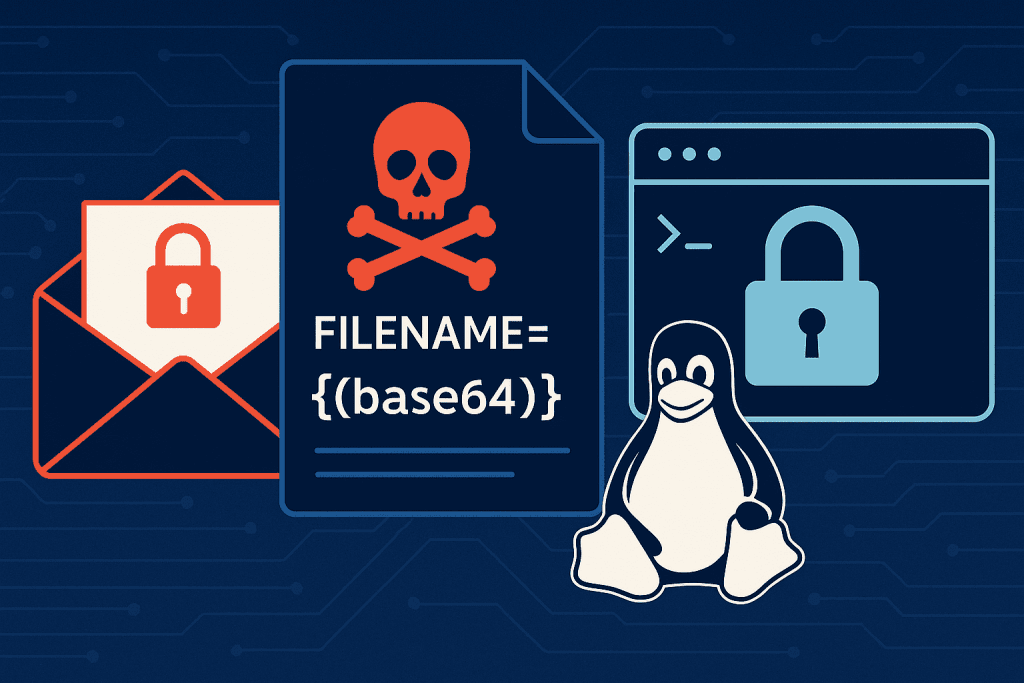
Linux has long been considered a fortress of security—a preferred platform for developers, system administrators, and security professionals worldwide. But according to new research from the Trellix Advanced Research Center, attackers are now exploiting one of its overlooked weaknesses: how the operating system and shell scripts handle filenames.
As the researchers put it, “Instead of focusing solely on exploiting software vulnerabilities, they’re weaponizing behaviors, scripting patterns, and even file metadata like filenames to breach systems in stealthy and unexpected ways.”
The campaign begins with a spam email disguised as a beauty product survey invitation, offering a small monetary reward to trick recipients. The email contains a .rar archive (yy.rar) with a file whose filename itself is malicious.
Trellix explains: “The payload isn’t hidden inside the file content or a macro, it’s encoded directly in the filename itself.”
When extracted, the file appears as a document but contains embedded Bash commands. If a system administrator or script processes filenames with commands like eval “echo $f” or ls | while read f; do eval “echo $f”; done, the hidden payload executes automatically—without the user double-clicking or launching the file.

The infection proceeds in multiple stages:
- Weaponized Filename – The malicious filename evaluates to a Base64-decoded command piped to Bash, silently triggering the attack.
- Downloader Script – A second-stage Bash script identifies the system’s architecture (x86, x64, ARM, ARM64) and fetches a tailored ELF binary from the attacker’s server.
- In-Memory Loader – The ELF binary decrypts an XOR-encrypted payload in memory (key: 0x99) and launches it as a disguised kernel thread ([kworker/0:2]).
- Final Payload (VShell) – A full-featured backdoor providing remote access, file operations, process management, port forwarding, and encrypted C2 communications.
This stealthy approach allows the malware to remain fileless, operating directly in memory while masquerading as a legitimate system process.
This attack chain is particularly insidious for several reasons:
- “No executable permission required initially—just unpacking or listing the archive contents in a script is enough to trigger infection.”
- Cross-platform reach – The malware supports x86, x64, and ARM architectures, targeting servers, IoT devices, and cloud environments.
- Memory-only execution – With no disk artifacts, detection becomes significantly harder.
- Fallback persistence – The downloader script attempts multiple writable paths and uses nohup to ensure execution survives environment restrictions.
By combining filename-based injection with Bash scripting weaknesses, attackers bypass many traditional security measures. Antivirus engines rarely scan filenames, and static analysis tools fail against malformed archive headers.
The VShell malware, written in Go and widely used by Chinese APT groups, provides robust capabilities for remote control and espionage. It offers:
- Reverse shell access
- File upload/download/deletion
- Process management
- TCP/UDP port forwarding
- Stealth execution in memory
- Custom encrypted C2 traffic
As Trellix warns, “This analysis highlights a dangerous evolution in Linux malware delivery where a simple file name embedded in a RAR archive can be weaponized to execute arbitrary commands.”
The VShell campaign illustrates how attackers are turning low-complexity techniques into high-impact compromises. By exploiting Linux’s permissive execution environment and overlooked scripting behaviors, threat actors can infiltrate even hardened systems.
Trellix concludes, “Attackers are increasingly exploiting scripting environments, system utilities like nohup, and filename parsing behaviors to bypass traditional security layers.”
Related Posts:
- Unauthenticated RCE in Mitel SIP Phones (CVSS 9.8) Detailed with PoC Exploit
- Vulnerability in Vesta Control Panel Exposes Admin Accounts
- North Korean Hackers Target Cryptocurrency Developers with Thiefbucket Malware
- ImageMagick Flaw (CVE-2025-53101): Stack Buffer Overflow Allows Potential Remote Code Execution
Support Our Threat Intelligence
Find our threat intelligence and malware analysis helpful? Support our work today and unlock a 100% ad-free reading experience!
 Buy Me a Coffee
