 Do Son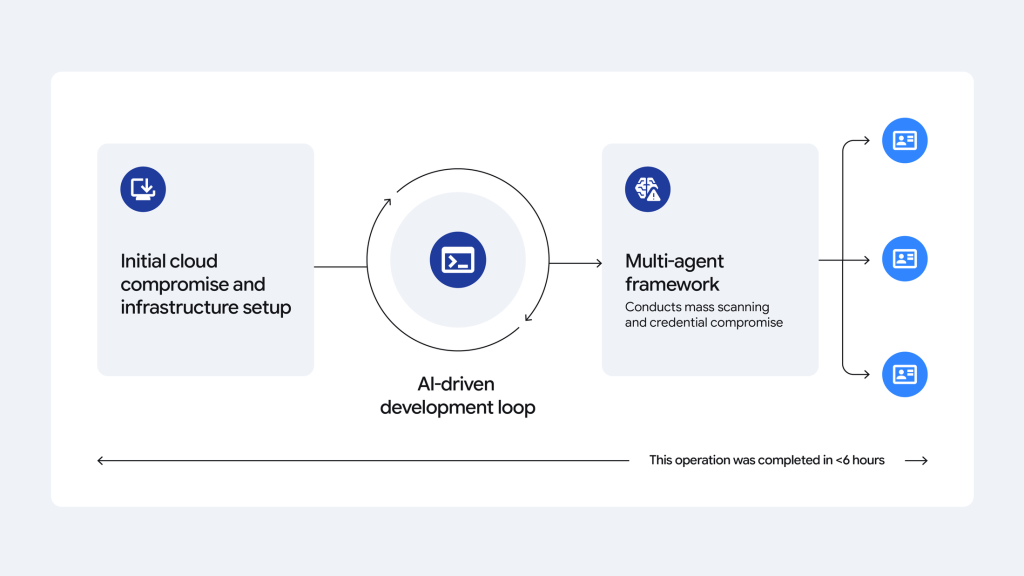
Bespoke Vulnerability Scanning and Credential Harvesting Campaign | Image: Google Threat Intelligence Group
At a Glance
- Actor or Group: Suspected state-sponsored groups (UNC6508, BASIN CASTLE) and cyber criminals (UNC6780).
- Activity Type: Open source supply chain compromise, AI credential harvesting, and cloud resource hijacking.
- Targets or Victims: Healthcare, government, media sectors, and software developers.
- Scale: Automated campaigns organizing over 23,800 harvested secrets; millions of model distillation prompts.
- Jurisdiction: No official charges filed; actors are suspected to operate from multiple global regions.
- Source: Google Threat Intelligence Group (GTIG).
TL;DR
Threat actors are weaponizing artificial intelligence to speed up software supply chain attacks and steal proprietary models. Suspected attackers use multi-agent frameworks to automate scanning and credential theft. Consequently, security teams must adapt to these rapid, automated exploitation lifecycles.
What Happened in Recent Attacks
According to the latest findings, malicious groups are actively targeting valuable machine learning assets. They want to steal proprietary models, source code, and API keys. Furthermore, attackers co-opt victim cloud environments to run unauthorized compute workloads. The primary report states, “GTIG observed threat actors compromise a cloud resource, then plan, build, and execute an agent-enabled mass credential harvesting campaign in under six hours.”
This behavior marks a clear shift in hacking tactics. Criminals use artificial intelligence as a force multiplier across the entire attack lifecycle.
Who is Behind These Operations
Google researchers identified several distinct groups driving these campaigns with varying confidence levels. A financially motivated actor named UNC6780 allegedly compromised legitimate developer accounts. Their goal was to inject malicious code into official repository environments. Meanwhile, a suspected China-nexus espionage group, BASIN CASTLE, used generative tools to profile high-value targets. They also used it to translate localized phishing lures.
Additionally, a suspected Russia-based group known as UNC5792 tested models to analyze Telegram channels automatically. To bypass access costs, these actors steal developer credentials. They frequently purchase compromised platform accounts on underground forums.
The Impact and Scale
The scale of these operations is expanding rapidly. An autonomous framework named “Recon” organized and validated over 23,800 harvested secrets in real time. These stolen secrets included valuable API keys for cloud services. Moreover, adversaries conduct massive distillation attacks against leading platforms.
Some of these coordinated campaigns exceed 100 million prompts. Attackers deploy proxy infrastructure to obscure their origins and bypass security controls. The exact financial impact remains undisclosed as unconfirmed claims. However, the theft of proprietary research could cost organizations millions of dollars in lost intellectual property.
How to Stay Protected
Defenders must update their security postures to combat these fast-moving adversarial AI threats. Organizations should monitor their continuous integration pipelines for unusual tasks. Additionally, security teams must restrict outbound traffic from build environments. This step helps prevent unauthorized data theft.
Companies should audit cloud quotas regularly to detect suspected hijacking attempts. In response, Google continues to harden its models against misuse. Administrators must apply strict access controls to all corporate assets. Finally, security teams should monitor API usage closely to spot anomalies early.
Support Our Threat Intelligence
Find our threat intelligence and malware analysis helpful? Support our work today and unlock a 100% ad-free reading experience!
 Buy Me a Coffee
