 Do Son
What looks like a simple payment receipt attachment can sometimes be the start of something far more dangerous. In a recently observed attack, a routine-looking phishing email quietly triggered a full-scale malware compromise, showcasing an advanced Agent Tesla infection chain. This sophisticated operation moves swiftly from a single click to total system compromise without the victim ever realizing what is happening in the background.
Instead of relying solely on exploiting unpatched document software as seen in past campaigns that heavily abused known Microsoft Office flaws such as CVE-2017-11882, CVE-2017-0199, and CVE-2018-0802 modern operators are utilizing highly deceptive script-based loaders. While those older vulnerabilities allowed attackers to trigger remote code execution simply by convincing a user to open a crafted document, today’s network defenders have largely patched those specific flaws. In response, threat actors have pivoted. They now employ heavily obfuscated scripts to accomplish the same initial access goals, bypassing modern security perimeters by leveraging native administrative tools already present on the victim’s machine.
The Staged Infection Process
According to the comprehensive report detailing from phishing email to process injection inside a multi-stage Agent Tesla infection chain, the malware operators have perfected the art of silent execution. The report from Point Wild explicitly notes, “Behind that one attachment was a carefully staged attack involving hidden script execution, PowerShell-based payload delivery, in-memory malware loading, process injection, and stealthy data theft techniques designed to stay invisible for as long as possible.”
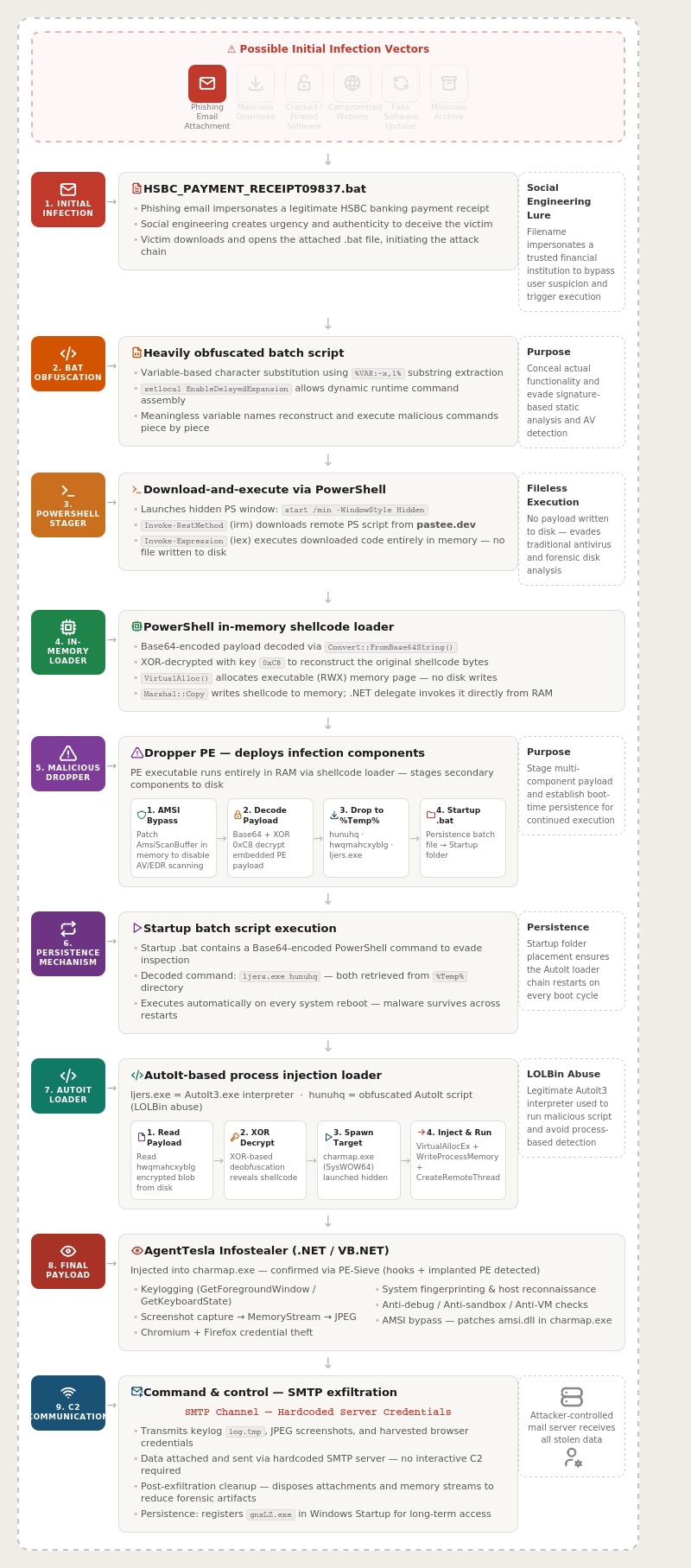
The initial hook is a meticulously crafted email designed to evade basic spam filters. When the attached archive is extracted and opened, the heavily obfuscated Batch script springs into action. This script is engineered specifically to disable local security warnings before it silently launches PowerShell. By operating directly in memory, the malware avoids leaving recognizable artifacts on the hard drive, which is a common detection point for traditional disk-based antivirus scanning. As researchers explain, “In simple terms, the victim opens what looks like a harmless file, but behind the scenes a heavily obfuscated Batch script silently launches PowerShell, which then pulls and executes additional malicious code directly in memory.” This fileless approach significantly reduces the time defenders have to spot and intercept the attack.
Process Injection and Evasion
From there, the attack escalates into a staged execution chain. The PowerShell script handles shellcode decoding and begins setting up persistent footholds on the compromised machine. Process injection is a critical phase of this operation. By forcing a trusted application like charmap.exe to run the malicious code, the attackers can bypass application allowlisting and firewall rules that might otherwise block an unknown executable from communicating with the internet. This technique, known as process hollowing, involves creating a new instance of the legitimate process in a suspended state, unmapping its original code, and injecting the malicious payload before resuming the process thread. This makes the Agent Tesla infection chain incredibly difficult for standard security software to spot.
Robust Anti-Analysis Capabilities
Another hallmark of this modern malware is its robust anti-analysis capabilities, which are baked directly into the core. The embedded VB.NET payload is heavily armed with defense evasion techniques designed to frustrate reverse engineers. Analysts discovered specific anti-debugging functions intended to detect whether the malware is being executed within a controlled debugging environment.
Furthermore, the payload actively performs anti-sandbox DLL checks and enumerates system hardware to identify virtual machines (Anti-VM). If the code detects artifacts commonly associated with automated malware analysis systems such as specific hypervisor drivers or sandbox configurations it abruptly halts execution to prevent security analysts from dissecting its behavior. These combinations of anti-debugging, anti-sandbox, and Anti-VM checks confirm the sophisticated behavioral characteristics that elevate this variant beyond a simple credential stealer.
Stealthy Data Exfiltration
The exfiltration module of Agent Tesla is highly configurable and remarkably comprehensive. Once fully deployed and confident that it is running on a genuine victim’s machine, the malware silently operates in the background. It aggressively targets sensitive information, sweeping the compromised system to steal browser credentials, session cookies, and saved auto-fill data. Additionally, it features a persistent keylogger that records every keystroke, ensuring that even newly typed passwords are captured.
The malware frequently captures screenshots of the active desktop, providing the attackers with real-time visual context of the victim’s activities. This stolen data is then covertly exfiltrated to the attacker’s command-and-control server. To remain undetected during this final phase, the malware often utilizes legitimate protocols like SMTP, FTP, or even Telegram bots to blend its illicit data transfers in with normal, everyday network traffic.
This detailed breakdown of the attack lifecycle highlights a critical reality in modern cybersecurity: user interaction is often the weakest link, but the resulting automated execution chain is highly advanced. To defend against these stealthy intrusions, organizations must employ advanced endpoint detection and response (EDR) solutions capable of monitoring process hollowing and in-memory execution, alongside comprehensive employee phishing awareness training.
Support Our Threat Intelligence
Find our threat intelligence and malware analysis helpful? Support our work today and unlock a 100% ad-free reading experience!
 Buy Me a Coffee
