 Do Son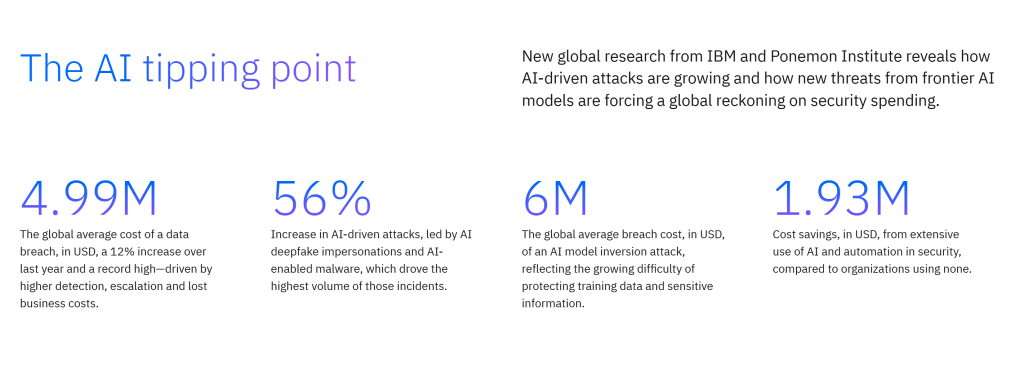
While enterprises are busily integrating artificial intelligence into their workflows to elevate productivity, malicious actors are far from idle. According to the recently published “Cost of a Data Breach Report 2026” report by IBM, AI has officially emerged as the most lethal weapon in the arsenal of cybercriminal syndicates.
The report elucidates that up to one-quarter of malicious intrusions and data breaches globally are inextricably linked to AI technology. This represents a staggering 56% surge compared to the previous year. These AI driven cyberattacks are not only proliferating in frequency but are also tremendously devastating. They inflict an average financial hemorrhage of $6 million per incident. This cost surpasses the financial toll of conventional data breaches by approximately $1 million.
The Economic Paradigm Subverted by AI
This annual treatise, conducted by the Ponemon Institute and sponsored by IBM, reveals dark trends. Hackers are extensively employing deepfakes for identity masquerading. Alternatively, they are engineering AI-capable malware to orchestrate their assaults.
Suja Viswesan, Vice President of IBM Security Software, highlights a grim reality: “The economic calculus of cyberattacks is shifting.” Historically, launching a large-scale offensive necessitated colossal expenditures of time and manpower. Today, for a mere few thousand dollars, malicious actors can leverage AI to automate and scale their onslaughts. This efficiency inflicts multimillion-dollar catastrophes upon enterprises. Consequently, this profoundly asymmetrical economic structure places unprecedented pressure on corporate cybersecurity defenses.
The Clash of Spear and Shield: Temporal Lags
Confronted with the perils introduced by AI, are enterprises adequately prepared? The empirical data suggests a glaring velocity disparity between the defensive and offensive factions.
Enterprises integrating AI and automation to safeguard operational security can reduce their data breach costs by an average of $2 million. Furthermore, 85% of surveyed organizations intend to augment their investments in sophisticated AI security solutions. Despite these intentions, corporate agility remains distressingly sluggish in domains where racing against hackers is paramount.
Over half of the organizations have commenced utilizing Agentic AI for threat detection and defense. Yet, a mere 18% have applied AI agents to vulnerability management. This implies that while AI accelerates the hackers’ ability to unearth and exploit vulnerabilities, corporate remediation velocities for known flaws have failed to keep pace. Ultimately, this mercilessly amplifies their defensive vulnerabilities.
Critical Infrastructure as Ground Zero
Furthermore, hackers exhibit profound strategic acumen in their target selection. The report divulges that up to 62% of AI driven cyberattacks are aimed squarely at critical infrastructure. Specifically, the financial services and energy sectors endure the most frequent bombardments.
Should these industries fall under attack, it effortlessly precipitates massive system outages and supply chain severances. Statistics reveal that the financial sector suffers an average data breach loss of $6.3 million, while the energy sector incurs $5.2 million. Beyond exploiting AI to besiege traditional IT architectures, AI models and applications themselves have devolved into fresh prey for cybercriminals. Over 20% of surveyed organizations reported that their proprietary AI systems had endured attacks, culminating in internal data breaches. Such incursions typically do not strike the AI model’s core directly. Instead, they exploit peripheral vulnerabilities, such as compromised APIs and plugins (27%) or egregious cloud misconfigurations (27%).
Ransomware Pivots to Reputational Extortion
This report additionally highlights two noteworthy cybersecurity trajectories shaping the modern threat landscape.
- The Metamorphosis of Ransomware Tactics: The proportion of ransomware incidents has ascended from 34% last year to 39%. The leverage employed by hackers is no longer confined to operational paralysis. Rather, it has evolved into far more ruinous reputational extortion. A striking 41% of attacks wield brand reputation as a negotiation cudgel, followed closely by employee data (35%) and intellectual property (31%).
- Fragile Cryptographic Foundations: Even as the industry awakens to the impending peril of quantum computing decryption, contemporary foundational encryption endeavors remain disastrously inadequate. Among organizations that have suffered data breaches, a mere 37% have encrypted their sensitive data at rest and in transit. Only 34% possess a lucid comprehension of their current cryptographic assets.
Author’s Perspective
This IBM report unequivocally demonstrates that in the epoch of weaponized AI, the crux of defense is no longer merely erecting taller firewalls. Rather, it necessitates fighting magic with magic through AI. Enterprises must seamlessly weave remediation protocols into their developmental pipelines. They must harness AI agents to truncate the temporal lag of vulnerability patching. Furthermore, they must manage risks with the very mindset and velocity of hackers. Only then can they stand invincible in this fiercely asymmetrical cybersecurity arms race.
Support Our Threat Intelligence
Find our threat intelligence and malware analysis helpful? Support our work today and unlock a 100% ad-free reading experience!
 Buy Me a Coffee
