Hundreds of Millions Affected: New “nginx-poolslip” Zero-Day Weaponizes ASLR Bypass for Remote Code Execution
 Do Son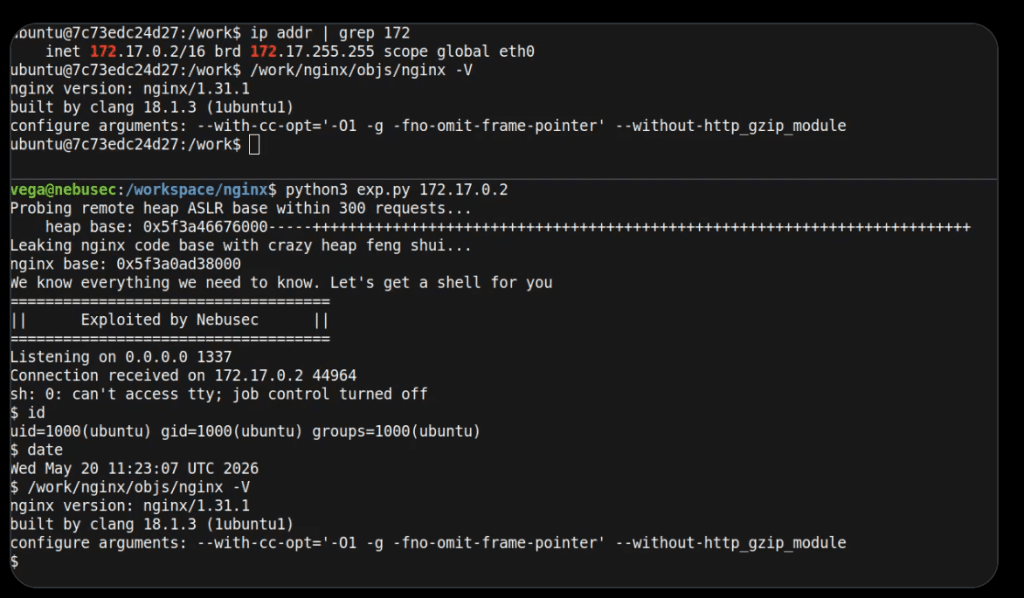
Just when the internet thought it was safe to breathe following the patching of the notorious nginx-rift vulnerability, a massive new threat has emerged for the global web infrastructure.
The threat research team at Nebula Security has shocked the cybersecurity community by announcing the discovery of a brand-new, unpatched zero-day vulnerability dubbed “nginx-poolslip”. Crucially, the vulnerability targets the latest mainline release of the web server software, Nginx version 1.31.0.
Because Nginx powers roughly a third of all active websites worldwide—handling everything from high-traffic enterprise tech stacks to critical cloud load balancers—the number of affected individuals and systems potentially scales into the hundreds of millions.
According to the initial bulletin from Nebula Security, the zero-day was uncovered by Vega, the firm’s advanced autonomous security agent. While human analysts were busy verifying deployment configurations for the previous nginx-rift patch, Vega was programmatically mapping out adjacent memory handling architectures within Nginx’s core pooling logic, ultimately finding a completely unvetted code execution pathway.
Rather than keeping the discovery entirely behind closed doors, a researcher from Nebula Security took to the X platform to publish a video demonstration. The proof-of-concept video showcases a highly polished attack script executing in real-time against a fully hardened, modern Linux server environment running Nginx 1.31.0.
Introducing nginx-poolslip, a fresh RCE for the the latest nginx release 1.31.0.
nginx-rift has been patched, but our security agent Vega has found a new 0 day.
We will release the full technical writeup with ASLR bypass 30 days after the patch on https://t.co/LAhOC5UHrp. pic.twitter.com/4rqMp4uA4i
— Nebula Security (@nebusecurity) May 20, 2026
What makes nginx-poolslip an exceptionally dangerous class of exploit is its ability to effortlessly dismantle modern operating system defenses. Typically, security mitigations like Address Space Layout Randomization (ASLR) prevent memory corruption bugs from being weaponized. ASLR randomizes the locations of key program components in memory, causing conventional execution payloads to blindly crash the application instead of spawning a shell.
The Nebula Security demonstration reveals that nginx-poolslip contains a built-in, highly reliable remote ASLR bypass mechanism.
The attack sequence follows a multi-stage execution flow:
- Remote Heap Probing: The exploit script initiates a series of roughly 300 targeted, high-frequency HTTP requests to dynamically map the server’s memory layout from afar.
- “Crazy Heap Feng Shui”: By precisely orchestrating the allocation and deallocation of data structures within Nginx’s memory pools, the exploit forces the underlying heap base address to surface.
- Leaking the Nginx Base: Once the heap structure is aligned, the exploit successfully leaks the exact, active cryptographic memory offsets of the Nginx codebase, rendering the protection offered by ASLR completely obsolete.
With the memory offsets completely exposed, the exploit transitions directly into its final stage: Remote Code Execution (RCE).
The script triggers a tailored memory corruption primitive, forcing the running Nginx process to branch away from its legitimate instruction path and execute a payload embedded within the request. In the video demonstration, the automated terminal window outputs a victorious status log: “Exploited by Nebusec. We know everything we need to know. Let’s get a shell for you.”
Seconds later, an interactive terminal session opens natively on the target host. Running the standard id command reveals complete system subversion, showing that the attacker has instantly achieved absolute, root-level administrative access over the underlying host container:
Nebula Security has stated that the technical details and the weaponized exploit binaries shown in the demonstration remain under strict embargo to give organizations time to coordinate a defense.
The firm announced that the full technical writeup, explicitly documenting the ASLR bypass and memory-pooling manipulation techniques, will be published openly on their official research portal, http://nebusec.ai, exactly 30 days after an official patch is released by the Nginx upstream maintainers.
Because nginx-poolslip is a zero-day vulnerability with no upstream patch currently available for version 1.31.0, enterprise security teams must adopt a proactive containment posture immediately:
- Enforce Strict Network Segmentation: Restrict public internet exposure to your Nginx administrative and monitoring endpoints wherever possible. Ensure frontend web proxies are placed behind strict Web Application Firewalls (WAFs) configured to flag anomalous, high-frequency request clustering.
- Monitor Process Anomalies: Configure endpoint detection and response (EDR) tooling to closely watch the Nginx worker processes (nginx: worker process). Any instances of nginx spawning unexpected shell processes like /bin/sh or /bin/bash should trigger immediate, automated host isolation logs.
- Prepare for Emergency Patching: Keep a close eye on the official Nginx security announcement boards. Once the patch drops, the 30-day public disclosure clock begins ticking, making immediate regression testing and deployment mandatory for production servers worldwide.
Support Our Threat Intelligence
Find our vulnerability reports and weekly recaps helpful? Support our work today and unlock a 100% ad-free reading experience!
 Buy Me a Coffee
