 Do Son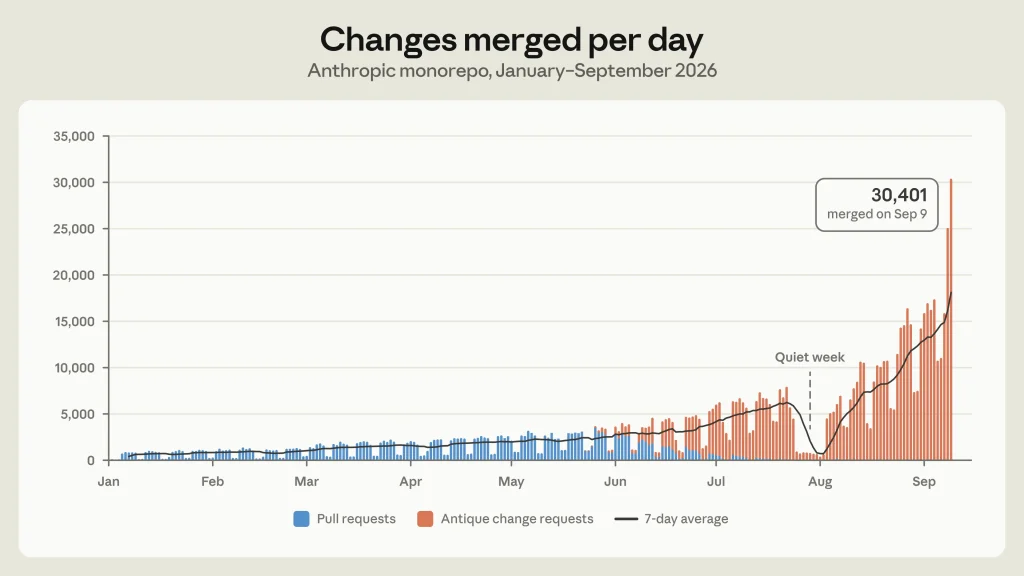
Changes merged to our monorepo per day, from January to September 2026.
Anthropic recently revealed that its engineering team migrated away from Git. Specifically, the organization transitioned its primary codebase to a custom internal platform called Scion. The company pursued this shift because daily software development with Claude caused code output to surge dramatically. Consequently, conventional Git struggled to satisfy the demands of the team’s colossal monolithic repository.
To overcome these bottlenecks, an agile team transitioned the primary repository within five months. Simultaneously, engineers constructed bespoke code review, search, and permission management utilities. However, Anthropic clarified that it harbors no plans to open-source Scion. Instead, the company published an architectural overview to share server-side scaling insights with the broader software community.
Massive Repositories Meet Hyper-Frequent Changes
In an illuminating technical post, Anthropic explained the motivation behind redesigning source control for the artificial intelligence era. Specifically, the team averaged roughly 2,500 daily code merges in May 2026. However, by September 2026, daily merged changes skyrocketed to an astonishing 30,000. Furthermore, the main branch history expanded toward 100 gigabytes, while a compressed working copy exceeded 25 gigabytes.
The Burden of Distributed Architecture
Simultaneously, continuous integration systems execute approximately 25 million code checkouts every day. If runners fetched complete repository clones for every operation, theoretical data traffic would exceed 600 petabytes. Git’s traditional distributed architecture allows every client to retain an entire repository history for offline operations. While this model suits human developers, it imposes severe overhead on cloud environments dominated by automated agents.
Offloading Source Control Workloads to the Server
To solve this bottleneck, the Scion architecture adopts a specialized client-server paradigm. Specifically, clients request file trees and commit histories strictly on demand. Meanwhile, the central server cluster executes resource-intensive operations like commits, merges, and rebases. Regional proxy tiers cache frequently accessed code objects locally, consistently maintaining cache hit rates above 99%.
Remarkable Efficiency and Resource Recovery
Consequently, the system delivers staggering operational improvements over previous multi-mirror Git infrastructure. In fact, Scion slashed central CPU and memory utilization down to a mere 0.05% of previous levels. Furthermore, continuous integration and research checkouts accelerated by roughly 100 times. As a result, the engineering organization reclaimed 25% of total CI processor capacity.
A Specialized Tool for Agentic AI Workflows
Notably, a compact team of seven engineers engineered Scion and executed the core repository migration within five months. Interestingly, Claude actively assisted in optimizing the data conversion pipeline from Git to Scion. By doing so, the AI helped slash memory consumption by twentyfold while quadrupling data throughput. Nevertheless, human software engineers remained indispensable for navigating architectural trade-offs and enforcing strict system boundaries.
Ultimately, Anthropic stressed that Scion does not represent a universal replacement for Git. Rather, engineers purpose-built the platform for massive corporate monorepos and high-density agentic workflows. Furthermore, adopting such an architecture requires migrating code search, review, and integration pipelines. Therefore, Anthropic hopes these server-side scaling paradigms will inspire future improvements across open-source version control ecosystems.
Support Our Threat Intelligence
Find our tech and OS security coverage helpful? Support our work today and unlock a 100% ad-free reading experience!
 Buy Me a Coffee
